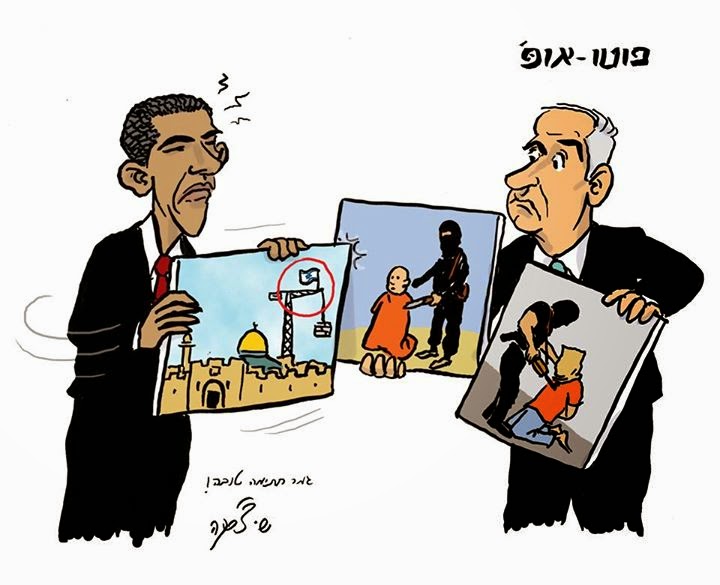
From January 2009 to the present, the conflict between Israel and the
United States has never been connected to any real chance of peace or
ending the conflict in a manner that is consistent with American pledges
about ensuring the Jewish state’s security. At this point, it is time
for even those that have rationalized and apologized for Obama’s
penchant for attacking Israel to face up to the fact that his behavior
requires a better explanation than an alleged desire to save it from
itself. Nor is the argument about Iran enough to justify what we are
witnessing. Nothing about the current argument can be traced to U.S.
security needs. Rather, its motive seems more about personal anger and
vague ideological assumptions about Israel and the Palestinians that
have no connection to reality.
That is a sobering thought that should motivate even those Democrats
who are no fans of Netanyahu to begin speaking up against an
administration policy that seems rooted in spite, not strategy.
Where does Israel fit into this? It seems that Victor Davis Hanson got it partly right when he wrote:
Does
Team Obama really believe that a murderous autocratic cabal like Hamas
is merely different from a democratic constitutional republic like
Israel? At best we have naiveté at the helm (Obama thinks he can
mesmerize misunderstood killers), at
worst, a genuine feeling that Israel is an aggressive, Western
imperialist power exploiting indigenous people of color who simply wish
to be free--in other words, the Rev. Wright-Bill Ayers-Rashid Khalidi
view of the Middle East.
If D'Souza is correct (and
what he writes is certainly plausible), it should be clear that Obama
views Israel - like the United States - as a post-colonial country that
is "an aggressive, Western imperialist power exploiting indigenous people of color who simply wish to be free."
But Hanson got one detail wrong. Obama doesn't look at us that way
because of Wright, Ayers and Khalidi. They just reinforced the view of
Israel that Obama already had in his blood from his Kenyan father.
I've been telling you all for eight years that the company a politician keeps matters. We could all have figured this out eight years ago (I did). What could go wrong?
Obama says there won't be a 'peace agreement,' blames Netanyahu, will try to force creation of a 'Palestinian state'
Barack Hussein Obama has acknowledged the 'reality' that there won't be a 'peace agreement' during his term in office, and has decided instead to attempt to force the creation of a 'Palestinian state' through the United Nations. For all of this he blames Binyamin Netanyahu.
In a stark assessment of U.S.-Israel relations,
Mr. Obama, speaking at a news
conference, put a firm end to one of the
top foreign-policy goals of his second term: a Middle East peace deal that
includes the creation a Palestinian state.
“What we can’t do is pretend that there’s a
possibility for something that’s not there,” Mr. Obama said. “And we can’t
continue to premise our public diplomacy based on something that everybody knows
is not going to happen at least in the next several years.”
He added, “For the sake of our own credibility I
think we have to be able to be honest about that.”
...
Messrs. Obama and Netanyahu are deeply divided
over nuclear talks with Iran, an issue likely to resurface as the next deadline
in negotiations arrives next week. The two leaders have long disliked each
other, but Mr. Obama played down the notion that personal discord was motivating
his policy decisions.
“The issue is not a matter of relations between
leaders. The issue is a very clear substantive challenge: We believe that two
states is the best path forward for Israel’s security, for Palestinian
aspirations, and for regional stability,” Mr. Obama said. “And Prime Minister
Netanyahu has a different approach.”
The president said the U.S. is considering
alternatives to Israeli-Palestinian talks, including taking action at the United
Nations that would afford Palestinians statehood.
Most pro-Israel administration evah? Really? Is this what we can expect next? Now that the US has left Iraq to Islamic State and Afghanistan to the Taliban, they have the troops available. What could go wrong?
In April 2013, US Secretary of State John Kerry told a Congressional hearing:
"Mr
Kerry, the US secretary of state, told the US House of Representatives
Foreign Affairs Committee on Wednesday that the 'window' for a two state
solution was 'shutting'.
'I think we have some period of time, a year, a year-and-a-half, or two years and it's over,' he said."
I never quite thought of it in these terms, but Lev Tsitrin argues that almost precisely two years later, Binyamin Netanyahu made Kerry into a prophet. Except that Obama is, for some strange reason, unhappy about his Secretary of State being proven right.
But why "evaluate" "other options" regarding Mr. Netanyahu, who, after all, merely confirmed what Mr. Kerry stated two years prior? Shouldn't Mr. Obama rather "evaluate" Mr. Kerry? And for that matter, given that Mr. Kerry acted as a mouthpiece of the Obama administration when making his prophetic statement, shouldn't Mr. Obama "evaluate" Mr. Obama – giving himself a high mark for being right on what he said, and for embracing Mr. Netanyahu for so precisely confirming Mr. Obama's, and Mr. Kerry's, prediction? Shouldn't Netanyahu's statement be a moment of pride for Mr. Obama? Why isn't Mr. Obama happy?
The United States
will not take the floor at the main U.N. human rights forum on Monday
during the annual debate on violations committed in the Palestinian
territories, a U.S. spokesman told Reuters.
The step, which is
unprecedented at the 47-member state forum where Washington unfailingly
defends Israel, follows signals that the Obama administration is
undertaking a "reassessment" of relations with the Jewish state.
"The
U.S. delegation will not be speaking about Palestine today," a U.S.
spokesman in Geneva told Reuters in response to a query as the debate
began. He declined further comment.
Waiting to hear that the US is defending Iran's, Syria's and 'Palestine's 'human rights' records.
UPDATE 12:40 PM
Here's an interesting development from my Twitter feed.
@IsraelMatzav Israel says US was absent fr UNHRC session at its request, not as reported by Reuters as sign Obama displeasure with Israel.
— Eli Tabori (@etabori) March 23, 2015
President Hussein Obama and his State Department have made a big deal out of Prime Minister Netanyahu's election campaign statement - since walked back - that there would be no 'Palestinian state' on his watch. The Obami have claimed that 'words matter' (Hat Tip: Memeorandum).
"We take him at his word when he said that it wouldn't happen during his
prime ministership, and so that's why we've got to evaluate what other
options are available to make sure that we don't see a chaotic situation
in the region," the president said in an interview with The Huffington
Post on Friday.
Citing a similar statement by White House spokesman Josh Earnest, Rabbi Shmuely Boteach points out that the Obama administration doesn't treat all words equally.
So let’s get this straight. When foreign
leaders speak, it matters. What they say is consequential. Bibi’s going
to have to pay for his remarks.
But I have one question. Why doesn’t any of this apply to Iran? Why, on Saturday Ayatollah Ali Khameini uttered the words “Death to America” even as John Kerry was expressing optimism the very same day that the United States would come to a nuclear accord with Iran!
Suddenly, Iran’s words don’t matter?
Boteach goes on to speculate why Netanyahu's words matter while Khameni's words can be swept aside.
My own belief is this. President Obama is
desperate for some foreign policy victories. There’s a year-and-a-half
left to his Presidency and the world is on fire. From Iran to Boko Haram
to ISIS to Putin to Hezbollah to Al Qaida and Hamas, bad guys are
running amok under this president. American Foreign policy is a
shambles.
The only ally President Obama can truly expert
pressure on for a deal that would give him the lasting foreign policy
legacy he needs and craves is Israel. And in the past Israeli Prime
Ministers have proven so utterly malleable. American Presidents have
squeezed them like lemons.
But Bibi refuses to be squeezed. He won’t play
ball. He won’t withdraw from Judea and Samaria and allow “Hamastan” on
his eastern border the way it is in Gaza. He won’t shut up about
America’s capitulation to the Iranian mullahs that would leave them with
a military-grade nuclear program. He won’t go quietly into the nuclear
night while America appeases one of the most violent and vile regimes on
earth.
This darned Bibi guy just won’t bend.
And our President finds the intransigence so utterly frustrating.
I don't believe things would be any better if (God Forbid) the Left had won the election. At the end of the day, even Herzog and Livni could not have concluded a deal that gave the 'Palestinians' everything they want, both because the 'Palestinians' would never agree to any deal and because the Left would never succeed in getting such a deal through the Knesset. Look what happened to Ehud Olmert in 2008.
And the Clinton's hatred for Netanyahu also might have something to do with Obama's attitude. After all, Hillary was Secretary of State.
But in the meantime, the hypocrisy is flaming. Will anyone in the media call Obama on it? Calling @APDiplowriter....
True colors: Sore loser Obama taking revenge against Israel
Barack Hussein Obama has gone ballistic against Israel, saying that he will use the United Nations (Hat Tip: Memeorandum) to pressure the Jewish state to self-destruct, and prompting Prime Minister Netanyahu to walk back comments (Hat Tip: Memeorandum) he made the day before the election about being opposed to a 'Palestinian state.' This is from the first link.
Angered by Netanyahu’s hard-line platform toward the Palestinians, top
Obama officials would not rule out the possibility of a change in
American posture at the United Nations, where the U.S. has historically
fended off resolutions hostile to Israel.
And despite signals from Israel suggesting that Netanyahu might walk
back his rejection, late in the campaign, of a Palestinian state under
his watch, Obama officials say they are taking him at his word.
“The positions taken by the prime minister in the last days
of the campaign have raised very significant substantive questions that
go far beyond just optics,” said a senior administration official,
adding that recent Israeli government actions were in keeping with
Netanyahu’s rhetoric.
While saying it was “premature” to discuss
Washington’s policy response, the official wouldn’t rule out a modified
American posture at the United Nations, where the U.S. has long fended
off resolutions criticizing Israeli settlement activity and demanding
its withdrawal from Palestinian territories.
“We are signaling
that if the Israeli government’s position is no longer to pursue a
Palestinian state, we’re going to have to broaden the spectrum of
options we pursue going forward,” the official said.
Mr. Netanyahu said in an interview on MSNBC
that he still wanted “a sustainable, peaceful two-state solution” to
the Israeli-Palestinian conflict and that he had not intended to reverse
the position he took endorsing that in a 2009 speech at Bar-Ilan
University. But he said the Palestinian leadership’s refusal to
recognize Israel as a Jewish state, and its pact with the militant
Islamist Hamas movement, made that impossible right now.
“I haven’t changed my policy,” Mr. Netanyahu said in the interview, his first since his resounding victory on Tuesday, which handed him a fourth term. “What has changed is the reality.”
“I don’t want a one-state solution; I want a sustainable, peaceful
two-state solution, but for that, circumstances have to change,” he
added. “I was talking about what is achievable and what is not
achievable. To make it achievable, then you have to have real
negotiations with people who are committed to peace.”
His description of the reality is correct, but I think it's been that way all along. And whether or not Netanyahu intended to reverse the Bar Ilan speech remains to be seen. In the meantime, the Obama administration will seize Netanyahu's Tuesday comments as a way to do what Obama has wanted to do all along.
The failure of 'don't do stupid stuff' as a strategy
In a devastating piece, Rich Lowry rips what's left of the covers off President Hussein Obama's 'don't do stupid stuff' strategy (Hat Tip: Memeorandum).
What we have been witnessing the past few weeks, in real time, is the
intellectual collapse of Obama’s foreign policy, accompanied by its
rapid political unraveling. When Al Franken is ripping you for lacking a
strategy against ISIL in Syria, you have a problem.
Obama’s view
was that Al Qaeda was holed up in the badlands of Pakistan and you
could drone it into submission. Then, if you stopped stirring up
hornets’ nests in the Middle East, and demonstrated your good
intentions, and pulled entirely out of Iraq and stayed out of Syria, you
could focus on “nation building at home” and not worry about places
like Mosul and Aleppo.
This, in a nutshell, was the theory of the “don’t do stupid stuff” doctrine.
Every particular was wrong.
...
Our
good intentions, as Obama defines them, got us nothing. We elected a
president with the middle name of Hussein who did all he could to
liquidate George W. Bush’s foreign policy and made outreach to the
Muslim world one of his top priorities — yet the terror threat has
grown.
We pulled out of Iraq and assiduously stayed out of Syria,
and now there is a caliphate stretching across the border that, in the
words of Secretary of Defense Chuck Hagel, represents “an imminent
threat to every interest we have.”
The hoary hawkish clichés
about the stakes in Iraq — repeated over and over again by Sens. John
McCain and Lindsey Graham over the years — proved correct.
...
The political worm has turned so completely that Sen. Rand Paul of
Kentucky, who the day before yesterday was scolding interventionists for
their simple-mindedness, now evidently supports war in Iraq and Syria.
He told The Associated Press that as president he would seek
“congressional authorization to destroy [ISIL] militarily.”
The
most prominent figure who is out of step with this new zeitgeist is
President Obama. The other day he explained that things aren’t as bad as
they seem because social media is amplifying events. He has gone from
blaming George W. Bush to blaming Instagram.
Does anyone really
believe that if we were reading about a radical terror group of
unspeakable savagery sweeping through the Middle East in the print
editions of newspapers instead of on Twitter it would seem any less
alarming?
The social media excuse is another evasion by a
president who wants to avoid speaking too forthrightly about the threat
of ISIL, lest he commit himself to the forceful action necessary to
defeat it.
When the only tool you have is a hammer, President
Obama has said of President Bush’s alleged approach to the world, every
problem looks like a nail. By the same token, when the only tool you
have is retreat, every problem looks “manageable.”
From Rand Paul to Joe Biden, Al Franken and Elizabeth Warren - a pretty wide range there.
Israel isn't even mentioned here and that's actually the right thing. Where Israel does deserve mention is to point out the gross miscalculation by Obama and Kerry (and to a lesser extent by Clinton before Kerry) that the key to resolving the world's problems was to set up a 'Palestinian state.' The focus on Israel and the 'Palestinians' was nothing short of a messianic obsession (Boogie Yaalon got that right), and while the media gets some of the blame for putting the 'Palestinians' on the top of the agenda, most of the blame goes to Obama himself.
I sure hope it's clear to all of you that a 'Palestinian state' wouldn't have made a bit of difference to ISIS or al-Qaeda.
Rich Lowry has a scathing summary of why John Kerry's mission to get a cease fire in Gaza failed. It can be summed up in a few words: The United States has no influence.
After six years of resetting, leading from behind, ending wars,
nation building at home, and pivoting to Asia, the U.S. has reduced
itself to a husk of its former influence. When Kerry showed up in Cairo
to meet with the president of Egypt, he was wanded by the guards, as if
he had just wandered in from the airport security line.
Kerry
underlined his dubious relevance by his inability to secure a ceasefire,
and his dubious wisdom by making it his overarching goal. At this
point, after Israel has committed itself on the ground, the U.S. should
be seeking to give it the time it needs to do as much damage as possible
to Hamas’s military infrastructure, instead of effectively bailing out
the terror group.
Kerry held an ill-advised confab in Paris with
Qatar and Turkey, the patrons of Hamas. Even the Palestinian Authority
blasted this as the “friends of Hamas” meeting. With the Egyptians, the
Saudis, the Emiratis, the Jordanians, and the Palestinian Authority all
functionally on Israel’s side in the Gaza War, it should be in a
superior diplomatic position, but its superpower patron evidently didn’t
get the memo.
By the time Kerry returned home, he had been
showered with so much criticism by the Israelis that the U.S. government
was saying it could endanger our relationship. The question raised by
Obama-administration foreign policy again and again is, How can
self-styled “smart power” be so dumb and toothless?
For all
of Kerry’s failings, he is a relative giant among a foreign-policy team
composed largely of political hacks and post-American declinists. At
least Kerry retains some of the old Democratic-party belief in America’s
importance in the world. His condemnation of Syria’s use of chemical
weapons last year was a stirring moral indictment of the Assad regime
– although President Obama immediately undercut him when he abandoned
his own “red lines.”
So far, Kerry’s tenure as secretary of state
is making Hillary Clinton’s undistinguished stint look impressive by
comparison. But that’s mostly a matter of timing. It is his misfortune
to be present at the unraveling, as crisis after crisis unfolds, with
the administration lacking the interest or the tough-mindedness to
effectively respond.
To deliberately wage war so that your own
people can be telegenically killed is indeed moral and tactical
insanity. But it rests on a very rational premise: Given the Orwellian
state of the world’s treatment of Israel (see: the U.N.’s
grotesque Human Rights Council), fueled by a mix of classic
anti-Semitism, near-total historical ignorance and reflexive sympathy
for the ostensible Third World underdog, these eruptions featuring
Palestinian casualties ultimately undermine support for Israel’s
legitimacy and right to self-defense.
In a world of such Kafkaesque ethical inversions, the depravity of Hamas begins to make sense. This is a world in which the Munich massacre is a movie and the murder of Klinghoffer is an opera — both deeply sympathetic to the killers. This is a world in which the U.N. ignores humanity’s worst war criminals while incessantly condemning Israel,
a state warred upon for 66 years that nonetheless goes to extraordinary
lengths to avoid harming the very innocents its enemies use as shields.
It’s to the Israelis’ credit that amid all this madness they haven’t
lost their moral scruples. Or their nerve. Those outside the region have
the minimum obligation, therefore, to expose the madness and speak the
truth. Rarely has it been so blindingly clear.
Oh my... New York Times says Kerry should 'move on' from Middle East and worry about Ukraine
The New York Times gets it partly right in an editorial published on the Passover holiday, urging the Obama-Kerry administration to abandon the Middle East 'talks' and deal with the Ukraine. Of course, they blame Israel for the talks' failure.
The pointless arguing over who brought Israeli-Palestinian peace talks to the brink of collapse is in full swing.
The United States is still working to salvage the negotiations, but
there is scant sign of serious purpose. It is time for the
administration to lay down the principles it believes must undergird a
two-state solution, should Israelis and Palestinians ever decide to make
peace. Then President Obama and Secretary of State John Kerry should
move on and devote their attention to other major international
challenges like Ukraine.
...
Mr. Obama made the right decision to give it a second try last summer,
with Mr. Kerry bringing energy and determination to the negotiations.
But, after nine months, it is apparent that the two sides are still
unwilling to move on the core issues of the borders of a Palestinian
state, the future of Jerusalem, the fate of Palestinian refugees and
guarantees for Israel’s security. The process broke down last month when
Israel failed to release a group of Palestinian prisoners as promised
and then announced 700 new housing units for Jewish settlement in a part
of Jerusalem that Palestinians claim as the capital of a future state.
According to Mr. Kerry
that was the “poof” moment when it all fell apart, and the Palestinians
responded by applying to join 15 international conventions and
treaties. That move won’t get them a state, but it is legal and they did
not seek to join the International Criminal Court, a big fear of
Israel’s.
...
An Israeli-Palestinian peace deal is morally just and essential for the
security of both peoples. To achieve one will require determined and
courageous leaders and populations on both sides that demand an end to
the occupation. Despite the commitment of the United States, there’s
very little hope of that now.
No, there's no point in 'talks' right now, and it is time for the Obama-Kerry junta to move on. Can they do it? Can they abandon their obsession with Israel and the fierce moral urgency of creating a 'Palestinian state'? Don't hold your breath.
Rick Richman wrote a great piece in Commentary on Tuesday, in which he explains why the 'peace process' must be slowed down.
Before signing an agreement with an aging “president” more than five
years past the end of his stated term — someone with no known successor,
no process for choosing one, no institutions for holding elections, no
capacity to implement any agreement in half his putative state
(controlled by the terrorist group he promised to dismantle under the
Road Map and didn’t), presiding over a society steeped in anti-Semitic
incitement, unwilling to endorse even the concept of “two states for two
peoples” (much less explicitly recognize a Jewish state) – we should
put aside the perennial argument that time is running out, the
over-hyped demographics, and “what’s happening in the settlements”
(since what’s happening in the settlements is mostly construction in
areas Israel will retain in any conceivable peace agreement), and pause
to reflect on President Obama’s last sentence: “We do not know what a
successor to Abbas will look like.”
We do not know, in other words, who will be implementing the
agreement Israel is being rushed to sign. We do not know whether it will
be Hamas, taking over a Palestinian state in an election or coup (both
have happened before); or perhaps the guy next in line in Abbas’s
corrupt ruling party; or perhaps the charismatic terrorist currently
serving multiple life sentences in an Israeli jail, who would
undoubtedly be released as part of a “peace agreement” but is not likely
to be the next Nelson Mandela. We do not know because the Palestinian
Authority has demonstrated multiple times that if converted to a state it will be a failed one, lacking the basic institutions of a successful state, unwilling to recognize a Jewish one. Yesterday the Fatah leadership unanimously endorsed Abbas’s rejection of any recognition of Israel as a Jewish state, without which the “two-state solution” is simply a two-stage plan.
If it is in fact urgent to sign an agreement while President-for-Life
Abbas is still around, it is even more urgent for him to give his long
overdue Bir Zeit speech,
telling his people in Arabic that the price of a Palestinian state is
recognition of a Jewish one, and that the conflict will not end with the
“return” of the descendants of refugees from the 1948 war the Arabs
started to a place where those descendants have never lived. It will end
with their resettlement in the Arab states that started the war, where
those descendants have lived their entire lives, deprived of basic civil
and human rights by the countries of their birth.
If Abbas cannot give his Bir Zeit speech, it is not likely he can
preside over a peaceful state. Moreover, as President Obama noted, we do
not even know what the successor to Abbas will look like. Perhaps it is
time to rethink a Palestinian state, not rush to create one.
But Rick seems to have forgotten the 'fierce moral urgency' that the Obami attribute to the creation of a 'Palestinian state.'
The real explanation begins with President Obama's long-standing
friendship with Rashid Khalidi, now a professor at Bir Zeit on the
Hudson and a former spokesman for the PLO. It continues with 20 years of
listening to Jeremiah Wright's anti-Semitic diatribes week in and week
out. And both of those things sit on the bases of Obama's bitter, anti-colonialist father and his Muslim upbringing. Victor Davis Hanson probably came as close as anyone to getting it right when he wrote:
Does
Team Obama really believe that a murderous autocratic cabal like Hamas
is merely different from a democratic constitutional republic like
Israel? At best we have naiveté at the helm (Obama thinks he can
mesmerize misunderstood killers), at
worst, a genuine feeling that Israel is an aggressive, Western
imperialist power exploiting indigenous people of color who simply wish
to be free--in other words, the Rev. Wright-Bill Ayers-Rashid Khalidi
view of the Middle East.
That 'at worst' view is what
makes Obama believe that there's a 'fierce moral urgency' to make a
'Palestinian state' and thus undo the 'injustice' that's been done to
this imaginary 'people.' That's the truth - and not what Ethan Bronner writes in the New York Times.
Abu Mazen is aging. Obama and Kerry have less than three years left in office. And there's a fierce moral urgency to the creation of a 'Palestinian state.' So who gives a damn about Israel and the Jews?
Priorities: Syria is burning, but John Kerry still has his eye on... the 'peace process'
As Syria burns, US Secretary of State John Kerry keeps his eye on the only thing in the Middle East that matters to President Obama: The 'Palestinians.'
US Secretary of State John Kerry paid a lightning visit to Jerusalem
Sunday and, in addition to briefing Prime Minister Binyamin Netanyahu on
the Syrian situation, made clear he was not losing sight of the
Israeli- Palestinian talks.
“The road ahead is not easy,” Kerry
said at the outset of a 10-minute statement he delivered after holding a
more than three-hour meeting with Netanyahu. “If it was easy, peace
would have been achieved a long time ago. What is clearer than ever is
that this is a road worth traveling.”
Kerry said his discussions with Netanyahu were a follow- up to a
“very productive meeting” he had last week in London with Palestinian
Authority President Mahmoud Abbas.
Since that meeting, there has
been a significant drop in leaks about the talks appearing in the Arabic
press. Israel protested those leaks to US special envoy Martin Indyk,
arguing that they went against understandings by the sides before the
talks began and were making the talks more difficult.
...
Netanyahu, relating to the talks and referring to Kerry as “John” –
who in turn called him “my friend Bibi” – said, “We both know that this
road is not an easy one, but we have embarked on this effort with you in
order to succeed, to bring about a historic reconciliation between
Israelis and Palestinians that ends the conflict once and for all.”
Following
Kerry’s statement, and in an apparent sign of the easy rapport between
them, Netanyahu shook Kerry’s hand and said, “One hell of a sound bite.”
Kerry laughed.
While Netanyahu and Kerry were meeting privately, their top advisers were holding talks in a nearby room.
And for those who have forgotten why the 'Palestinians' are so important (how could you?), please recall this.
The real explanation begins with President Obama's long-standing
friendship with Rashid Khalidi, now a professor at Bir Zeit on the
Hudson and a former spokesman for the PLO. It continues with 20 years of
listening to Jeremiah Wright's anti-Semitic diatribes week in and week
out. And both of those things sit on the bases of Obama's bitter, anti-colonialist father and his Muslim upbringing. Victor Davis Hanson probably came as close as anyone to getting it right when he wrote:
Does
Team Obama really believe that a murderous autocratic cabal like Hamas
is merely different from a democratic constitutional republic like
Israel? At best we have naiveté at the helm (Obama thinks he can
mesmerize misunderstood killers), at
worst, a genuine feeling that Israel is an aggressive, Western
imperialist power exploiting indigenous people of color who simply wish
to be free--in other words, the Rev. Wright-Bill Ayers-Rashid Khalidi
view of the Middle East.
That 'at worst' view is what
makes Obama believe that there's a 'fierce moral urgency' to make a
'Palestinian state' and thus undo the 'injustice' that's been done to
this imaginary 'people.' That's the truth - and not what Ethan Bronner writes in the New York Times.
Jackson Diehl doesn't really tell us why Barack Hussein Obama is so tough on Israel when he's such a wimp on Syria. Or does he?
What’s extraordinary about Obama’s initiative is not its details, which don’t differ meaningfully from the ideas of Bill Clinton, George W. Bush or, for that matter, several of Netanyahu’s predecessors as prime minister. It is, rather, its superpower chutzpah — the brazen disregard for the views and political posture of this Israeli government, and the fecklessness and disarray of the current Palestinian leadership. Never mind, goes the implicit Euro-American line: We will make this happen.
What could account for such an attitude, given the timorous approach to the rest of the region? Part of it is understandable frustration with years of Israeli-Palestinian impasse, which is magnified by the conviction in much of official Washington that the terms for peace are well known and widely accepted, and need only be implemented. Part is legitimate worry that the Israeli- Palestinian front, though quiet now, could explode later this year after a United Nations vote, helping extremists in places such as Egypt. Yet the damage to U.S. interests from a U.N. resolution on Palestine would pale compared to the consequences of an Iranian-backed victory by Assad in Syria or the failure of NATO in Libya. Those crises have not moved Obama to lead.
There is, in his diplomacy, an implicit conviction that the United States must first of all deal with the sins of its own client. “Here are the facts we must all confront,” Obama declared in his speech to the AIPAC conference last month, before proceeding to deliver a lecture about Palestinian demography, Arab politics and the United Nations. It wasn’t that he was entirely wrong. But it’s revealing of this president that he is determined to speak truth to Binyamin Netanyahu — and not to Bashar al-Assad.
So why is Obama so tough on Israel and such a wimp when the subject is Syria (to use one prominent example)? There are a few reasons. First, because he can be. Israel really has no place else to turn in this world other than the United States, and Obama is cynically exploiting that dependence on America's good graces.
Second, because like most bullies, Obama is a coward at heart. He will only pick fights with people he thinks won't fight back, and not with the likes of Bashar al-Assad, who will murder a few hundred more people and tell Obama where to get off. Binyamin Netanyahu started to fight back against Obama last month, but Netanyahu is fighting with one hand tied behind his back by Israel's opposition.
Third, because the Israeli-'Palestinian' dispute is the only foreign policy issue about which Obama passionately cares. Obama is much more interested in doing things like socializing the United States' economy, and particularly its health care system, but when it comes to the Middle East, he has a legacy to which he must live up. That's why one of the first things he did upon taking office was to appoint a special Middle East envoy, and that's why Obama cannot get over his obsession with the 'Palestinians.' It's not so much that he cares about the Arabs, it's that he cannot abide the success of the Jews.
Evelyn Gordon makes a great case for why Quartet Middle East envoy Tony Blair ought to be fired. But it's probably not for the reason you think: They don't listen to him anyway.
This week, for instance, Blair warned that the Arab Spring, far from making Israeli-Palestinian peace talks more urgent, makes them almost impossible. Israel no longer knows what regional threats it may face, he explained, while Palestinian leaders will have trouble making “difficult compromises which will be tough to sell, in circumstances where they don’t know the regional context into which such compromises will be played.”
That should be obvious.
...
But instead of recognizing these obvious facts, France is pushing a plan to resume negotiations in Paris this fall, while the U.S. is working on its own plan for autumn talks in Washington. That both also propose a formula entirely unacceptable to Israel — requiring it to cede the entire West Bank without any Palestinian concession on the refugees in exchange, in line with Barack Obama’s May 19 speech — is mere icing on the cake.
It would be better if the Quartet actually took Blair’s advice. But since it won’t, it may as well at least stop wasting money on an unheeded envoy.
The peace plan, Juppe said, is largely based on U.S. President Barack Obama's speech last month, which called for a resumption of Palestinian-Israeli negotiations based on 1967 borders with agreed land swaps.
However, while Obama focused on guaranteeing Israel's security, the French initiative is concerned with "security for the two states (Israel and Palestine)," Juppe told a news conference with Prime Minister Salam Fayyad in the central West Bank city.
The plan had already been shown to President Mahmoud Abbas in Rome Wednesday.
The French initiative sets a one-year deadline for resolving the issues of Jerusalem and refugees, which Obama referred to without time-lines.
What could go wrong? Well, for starters, Netanyahu could actually think about showing up to this conference....
Arab League President Amr Moussa (left) explains why there is so much instability in the Middle East:
"The Palestinian issue is at the heart of instability in the Middle East," Moussa said, calling on the United States to move in "the coming weeks and months towards establishing a Palestinian state based on 1967 borders and with East Jerusalem as its capital."
Really? The guy in Tunisia set himself on fire because there's no 'Palestinian state'? Egypt overthrew Hosni Mubarak because there's no 'Palestinian state'? Yemen is trying to overthrow Saleh, Syria is trying to overthrow Assad and Libya is trying to overthrow Gadhafi because there's no 'Palestinian state'? Bahrain tried to overthrow the Emir because there's no 'Palestinian state'?
What a load of bull dung. There's only one person outside the Middle East who's taken in by it: Barack Hussein Obama.
Washington Post op-ed page editor Fred Hiatt wonders if President Obama has become too rigid to bring about peace in the Middle East (Hat Tip: Soccer Dad).
The guiding principle of foreign policy for Obama the candidate was engagement: the notion that by embracing the diplomacy that Bush supposedly had neglected, Obama would restore U.S. standing in the world. Where Bush had lectured and bullied, Obama would embrace alliances, international law and a more realistic acceptance of America’s declining relative power.
The thesis has had limited success. There have been diplomatic achievements with Russia, and a peaceful election in Sudan, but little or no progress in key targets of administration engagement: Iran, Burma, North Korea, Israel-Palestinian peace.
Still, when the people rose up in Iran, Obama seemed reluctant to disturb the possibility of negotiating with the ayatollahs. In Egypt, the administration was reluctant to give up on a partner who had promised to help in the Middle East peace process. In Syria, it seems reluctant to give up on a dictator who might someday promise to help in the peace process. In Libya, Obama’s commitment to a modest U.S. role has taken precedence over winning a war he hesitantly entered.
There’s virtue in consistency and danger in wild swings. Bush’s with-us-or-against-us epiphany proved unsustainable in a complex world, and his insight that Arab dictators, although allied with the United States, were feeding the terrorism that threatened us did not translate into a workable new policy toward the region.
But there’s danger in consistency, too — of failing to seize opportunities that unexpectedly present themselves. The Arab Spring could all go wrong or fizzle, but it could also prove comparable in import to the fall of the Soviet empire. You’d hope to see America doing everything within its considerable power to nudge it in the right direction, even if that requires a change in course or a shift in ideology.
Hiatt's right that Obama is too rigid. But here's the problem: The only Middle East issue with which Obama came into office with a stance was the one that said 'Palestinians good, Israel bad." That's variously been summarized on this blog as Obama's belief in the 'fierce moral urgency' of a 'Palestinian state,' his promotion of his father's anti-colonialism, and his perception of Israel as "an aggressive, Western imperialist power exploiting indigenous people of color who simply wish to be free." Obama has not and will not reconsider any of those positions. His worldview is as rigidly consistent as when he made the speech in the picture at the top of this post, and he's not even willing to consider how much of that 'suffering' was self-inflicted or inflicted by the 'Palestinians' leaders. And that's why he will never bring peace to the Middle East.
After showing that the Obama administration is protecting Bashar al-Assad even from the sanctions that it plans to impose on the Syrian regime, Lee Smith explains why Obama is protecting Assad. In five words, it's the peace process, stupid!
So why is the administration protecting a regime that makes war against its own people as well as America and her allies? As Michael Doran explains in his latest article in Foreign Affairs (“The Heirs of Nasser”), it is because “the Obama administration has made the Arab-Israeli peace process the organizing principle of its Middle East policy.”
From the outset, the Obama administration has believed in the importance of pursuing a "comprehensive" settlement -- meaning a peace treaty that includes not just the Palestinians but, in addition, all the Arab states, especially Syria. As the administration has failed to make any headway in Israeli-Palestinian negotiations, the Syrian track has grown in importance. Consequently, Washington has chosen to treat Syria not as an adversary deserving containment but rather as a partner in the negotiations deserving of engagement. In fact, the Obama administration sees the peace process as an instrument for wooing Syria away from Iran. At the very least, Washington believes that by bringing Damascus to the negotiating table, it can give the Syrians an incentive to tamp down Arab-Israeli violence. But such a strategy fails to acknowledge that the Syrians understand the thinking in Washington all too well -- they recognize the United States' fervent desire for negotiations and see in it an opportunity to bargain. Damascus seeks to trade participation in diplomatic processes, which costs it nothing, for tangible benefits from Washington, including a relaxation of U.S. hostility. In short, the Syrians believe that they can have it both ways... And why would they think otherwise? After all, nobody held them responsible for similar double-dealing in Iraq, where they were accomplices to the murder of Americans.
In other words, the Obama White House’s Syria policy is not pragmatic and cautious. Rather, it is adventurist and ideological. The administration is sheltering Damascus in order to salvage its own bankrupt Middle East policy. If he loses Assad, Obama is lost in the region and the administration will be forced, obviously against its will, to recalibrate. The question is, how much will U.S. interests suffer in the meantime?
I have been arguing since before the 2008 US elections that President Obama's entire Middle East policy can be summed up in the phrase "the fierce moral urgency of creating a 'Palestinian state.'" He has no interest in anything else in the region. And it shows.
In the wee hours of Thursday, I blogged a cry by Syrian dissident blogger Farid Ghadry who wonders why the World is ignoring what's going on in Syria. It's real simple Farid: They're following the 'leader.'
Great news: 'Palestinian Authority' trying to get Hamas removed from terror lists
In a bid to lay the groundwork for reconciliation between Hamas and Fatah, the 'Palestinian Authority' has asked the United States and the European Union to remove Hamas from their respective lists of terror organizations.
The Palestinian Authority is working toward removing Hamas from the US and EU list of terror organizations so as to pave the way for the Islamist movement to join a Palestinian unity government, PA negotiator Nabil Sha’ath revealed on Monday.
Sha’ath, who was speaking to reporters after meeting in Cairo with Arab League Secretary- General Amr Moussa, said he raised the issue with a number of governments during a recent tour of EU capitals.
“We are seeking to have Hamas removed from the list of terror organizations,” he said. “We want EU countries to recognize a Palestinian unity government that would include Hamas and other factions.”
Sha’ath said that his Fatah faction was keen on ending the dispute with Hamas.
“The current circumstances require us to reorganize our Palestinian home,” he added. “I have announced several times that we have accepted the Egyptian [reconciliation] initiative. We have agreed to a national unity government [with Hamas] that would implement the Egyptian document and prepare for elections.”
Sha’ath was referring to an Egyptian reconciliation plan that was presented to Fatah and Hamas in 2009.
He said that Fatah has accepted Hamas’s reservations about the plan, adding that he did not know why the movement was delaying its response.
“This is a question that every Palestinian and Arab should be asking,” he stressed. “My fear is that Hamas’s calculations about the Arab revolts are different than ours. We see that these revolutions’ main demand is unity and support for Palestinian rights.”
Sha’ath, a former PA foreign minister, said that a Fatah-Hamas reconciliation would embolden Palestinian struggle against Israeli occupation.
And just last week, Fatah demanded that 'Palestinian Prime Minister' Salam Fayyad be fired, because he suggested a reconciliation scenario with Hamas that would leave Gaza in Hamas' hands.
Let's not delude ourselves here. The Europeans will approve this in a second. It's what they've wanted for a couple of years now - ostensibly because boycotting Hamas 'isn't working anyway.' And the Obama administration is likely to go along because of the 'fierce moral urgency' of creating a 'Palestinian state.'
Elliott Abrams writes that the problem with the Obama administration's approach to Egypt is the lack of passion.
The first problem with the Obama Administration’s reaction has been noted above: inconstancy. Thinking it is calibrating its responses to events on the ground, it is instead leaving friend and foe alike unclear about its intentions. The larger problem is the lack of commitment and passion. The presidential statements have been those of Obama the academic, the cool analyst. Last Sunday he said “Here’s what we know: is that Egypt is not going to go back to what it was. The Egyptian people want freedom. They want free and fair elections. They want a representative government. They want a responsive government. And so, what we’ve said is: you have to start a transition now. Mubarak has already decided he’s not running for re-election again. His term is up this year. And what we’ve said is: let’s make sure that you get all the groups together in Egypt, let Egyptian people make a determination on what’s the process for an orderly transition, but one that is a meaningful transition.” Not exactly inspirational. And when asked whether the Muslim Brotherhood might take over he lapsed into down-home folksy talk: “there are a whole bunch of secular folks in Egypt.” Thousands of those “secular folks” are risking their lives in Tahrir Square every day, but the President has yet to give them any sense that he, and America, are moved, excited, and admiring about their fight for freedom.
Administration defenders point to a word here and a sentence there that show how hard the President and his staff are pressing the Egyptian regime. They can show you the words, the lyrics. Missing entirely is the music—the sense of passion, the message that we are inspired by the demonstrators and loathe stagnant dictatorships like the one that has ruled Egypt’s people for decades.
Compare what Natan Sharansky has said about Ronald Reagan’s “evil empire” speech, when asked if there were any particular moments that inspired the struggle against tyranny in the Soviet Union:
Of course! It was the great brilliant moment when we learned that Ronald Reagan had proclaimed the Soviet Union an Evil Empire before the entire world. There was a long list of all the Western leaders who had lined up to condemn the evil Reagan for daring to call the great Soviet Union an evil empire right next to the front-page story about this dangerous, terrible man who wanted to take the world back to the dark days of the Cold War. This was the moment. It was the brightest, most glorious day. Finally a spade had been called a spade. Finally, Orwell’s Newspeak was dead. President Reagan had from that moment made it impossible for anyone in the West to continue closing their eyes to the real nature of the Soviet Union. It was one of the most important, freedom-affirming declarations, and we all instantly knew it. For us, that was the moment that really marked the end for them, and the beginning for us. The lie had been exposed and could never, ever be untold now. This was the end of Lenin’s “Great October Bolshevik Revolution” and the beginning of a new revolution, a freedom revolution–Reagan’s Revolution.
In the face of a freedom revolution in Tunisia and Egypt, the President has not used his voice; he has not inspired the demonstrators nor has he been an articulate defender of our own values. Will he miss this historic moment, as he missed the moment when Iran’s people rebelled in June 2009?
Let's look at that Reagan speech, and then I'll have some comments about why Obama is not passionate about Egypt.
Let's go to the videotape.
That's passion!
Why doesn't Obama have it? Well, he does, but in the Middle East Obama's passion is limited to one issue: The 'Palestinians.' In Obama's world, the White Man (Israel) is 'oppressing' the Brown Man (the Arabs) and that bothers him. But in Egypt, there's one Brown Man (Mubarak) oppressing (notice no scare quotes) a lot of Brown Men, and that doesn't interest him much. That's the truth. In Obama's mind, there's no fierce moral urgency for regime change in Egypt like there is for a 'Palestinian state.' He just doesn't care.
I am an Orthodox Jew - some would even call me 'ultra-Orthodox.' Born in Boston, I was a corporate and securities attorney in New York City for seven years before making aliya to Israel in 1991 (I don't look it but I really am that old :-). I have been happily married to the same woman for thirty-five years, and we have eight children (bli ayin hara) ranging in age from 13 to 33 years and nine grandchildren. Four of our children are married! Before I started blogging I was a heavy contributor on a number of email lists and ran an email list called the Matzav from 2000-2004. You can contact me at: IsraelMatzav at gmail dot com