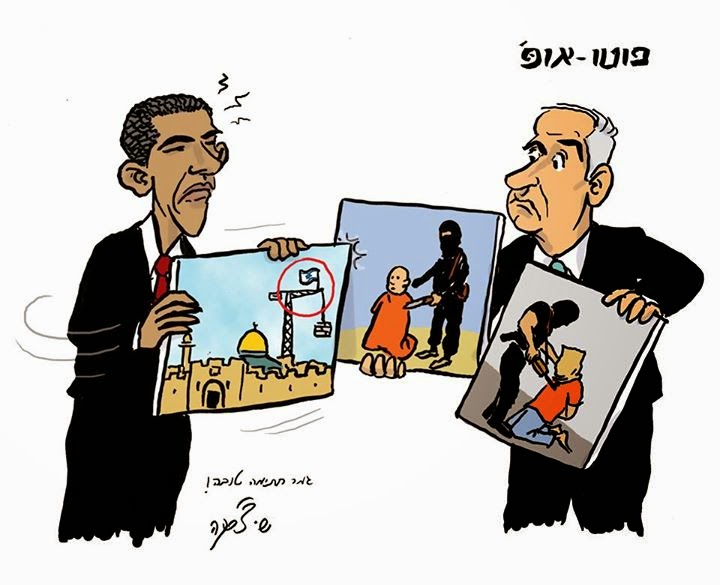
It's not that Kerry doesn't get Israel - he's enraged he can't get rid of it
In an editorial this morning, the Wall Street Journal blasts John Kerry's 'marathon speech' on Wednesday in which he
reserved rage only for Israel in the entire Middle East.
We recite this history to show that it’s not for lack of U.S.
diplomacy that there is no peace—and that mishandled diplomacy has a way
of encouraging Palestinian violence. In 2000 then-President Bill Clinton
brought Israeli and Palestinian leaders to Camp David to negotiate a
final peace agreement, only to watch Palestinians walk away from an
offer that would have granted them a state on nearly all of Gaza and the
West Bank. That failure was followed by another Palestinian terror
campaign.
Israelis remember this. They remember that they elected leaders—Yitzhak Rabin in 1992, Ehud Barak in 1999, Ehud Olmert in 2006—who made repeated peace overtures to the Palestinians only to be met with violence and rejection.
In his speech, Mr. Kerry went out of his way to personalize his differences with current Israeli Prime Minister Benjamin Netanyahu,
claiming he leads the “most right-wing” coalition in Israeli history.
But Israelis also remember that Mr. Netanyahu ordered a settlement
freeze, and that also brought peace no closer.
The lesson is that
Jewish settlements are not the main obstacle to peace. If they were,
Gaza would be on its way to becoming the Costa Rica of the
Mediterranean. The obstacle is Palestinian rejection of Israel’s right
to exist as a Jewish state in any borders. A Secretary of State who
wishes to resolve the conflict could have started from that premise,
while admonishing the Palestinians that they will never get a state so
long as its primary purpose is the destruction of its neighbor.
But
that Secretary isn’t Mr. Kerry. Though he made passing references to
Palestinian terror and incitement, the most he would say against it was
that it “must stop.” If the Administration has last-minute plans to back
this hollow exhortation with a diplomatic effort at the U.N., we
haven’t heard about it.
Contrast this with last week’s Security Council resolution, which the Obama
Administration refused to veto and which substantively changes
diplomatic understandings stretching to 1967. Mr. Kerry claimed
Wednesday that Resolution 2334 “does not break new ground.”
The
reality is that the resolution denies Israel legal claims to the
land—including Jewish holy sites such as the Western Wall—while
reversing the traditional land-for-peace formula that has been a
cornerstone of U.S. diplomacy for almost 50 years. In the world of
Resolution 2334, the land is no longer Israel’s to trade for peace. Mr.
Kerry also called East Jerusalem “occupied” territory, which contradicts Administration claims in the 2015 Supreme Court case, Zivotofsky v. Kerry, that the U.S. does not recognize any sovereignty over Jerusalem.
The
larger question is what all this means for the prospects of an eventual
settlement. Mr. Kerry made a passionate plea in his speech for
preserving the possibility of a two-state solution for Jews and
Palestinians. That’s a worthy goal in theory, assuming a Palestinian
state doesn’t become another Yemen or South Sudan.
But the effect
of Mr. Kerry’s efforts will be to put it further out of reach.
Palestinians will now be emboldened to believe they can get what they
want at the U.N. and through public campaigns to boycott Israel without
making concessions. Israelis will be convinced that Western assurances
of support are insincere and reversible.
It's not that Kerry doesn't get all those things. He does. It's that in Kerry's 60's radical mind - like his boss' -
Israel is a
neo-colonialist creation of the West that has no right to exist among the '
natives' of the Middle East.
The only reason Kerry doesn't come right out and say it is because while that kind of talk is
acceptable in Europe, it's not acceptable (yet) in the US. Thanks to Donald Trump defeating Hillary Clinton in last month's election, it may never become acceptable in the US.
And that is the source of Kerry's rage.
Labels: anti-colonialist, Barack Hussein Obama, John Kerry, Middle East peace process, settlements, two-state solution, United Nations Security Council Resolution 2334
Time for Democrats to face reality on Obama's pressure on Israel
Jonathan Tobin does a great job of
summing up President Hussein Obama's relations with Israel.
From January 2009 to the present, the conflict between Israel and the
United States has never been connected to any real chance of peace or
ending the conflict in a manner that is consistent with American pledges
about ensuring the Jewish state’s security. At this point, it is time
for even those that have rationalized and apologized for Obama’s
penchant for attacking Israel to face up to the fact that his behavior
requires a better explanation than an alleged desire to save it from
itself. Nor is the argument about Iran enough to justify what we are
witnessing. Nothing about the current argument can be traced to U.S.
security needs. Rather, its motive seems more about personal anger and
vague ideological assumptions about Israel and the Palestinians that
have no connection to reality.
That is a sobering thought that should motivate even those Democrats
who are no fans of Netanyahu to begin speaking up against an
administration policy that seems rooted in spite, not strategy.
Or maybe
not so vague.
Where does Israel fit into this? It seems that Victor Davis Hanson got it partly right when he wrote:
Does
Team Obama really believe that a murderous autocratic cabal like Hamas
is merely different from a democratic constitutional republic like
Israel? At best we have naiveté at the helm (Obama thinks he can
mesmerize misunderstood killers), at
worst, a genuine feeling that Israel is an aggressive, Western
imperialist power exploiting indigenous people of color who simply wish
to be free--in other words, the Rev. Wright-Bill Ayers-Rashid Khalidi
view of the Middle East.
If D'Souza is correct (and
what he writes is certainly plausible), it should be clear that Obama
views Israel - like the United States - as a post-colonial country that
is "an aggressive, Western imperialist power exploiting indigenous people of color who simply wish to be free."
But Hanson got one detail wrong. Obama doesn't look at us that way
because of Wright, Ayers and Khalidi. They just reinforced the view of
Israel that Obama already had in his blood from his Kenyan father.
I've been telling you all for eight years that the company a politician keeps matters. We could all have figured this out eight years ago (I did). What could go wrong?
Labels: anti-colonialist, Barack Hussein Obama, Bill Ayers, fierce moral urgency, Jeremiah Wright, Palestinian state, Rashid Khalidi
Why is Obama tough on Israel and a wimp on Syria?

Jackson Diehl doesn't really tell us why Barack Hussein Obama is so tough on Israel when he's such a wimp on Syria.
Or does he?
What’s extraordinary about Obama’s initiative is not its details, which don’t differ meaningfully from the ideas of Bill Clinton, George W. Bush or, for that matter, several of Netanyahu’s predecessors as prime minister. It is, rather, its superpower chutzpah — the brazen disregard for the views and political posture of this Israeli government, and the fecklessness and disarray of the current Palestinian leadership. Never mind, goes the implicit Euro-American line: We will make this happen.
What could account for such an attitude, given the timorous approach to the rest of the region? Part of it is understandable frustration with years of Israeli-Palestinian impasse, which is magnified by the conviction in much of official Washington that the terms for peace are well known and widely accepted, and need only be implemented. Part is legitimate worry that the Israeli-
Palestinian front, though quiet now, could explode later this year after a United Nations vote, helping extremists in places such as Egypt. Yet the damage to U.S. interests from a U.N. resolution on Palestine would pale compared to the consequences of an Iranian-backed victory by Assad in Syria or the failure of NATO in Libya. Those crises have not moved Obama to lead.
There is, in his diplomacy, an implicit conviction that the United States must first of all deal with the sins of its own client. “Here are the facts we must all confront,” Obama declared in his speech to the AIPAC conference last month, before proceeding to deliver a lecture about Palestinian demography, Arab politics and the United Nations. It wasn’t that he was entirely wrong. But it’s revealing of this president that he is determined to speak truth to Binyamin Netanyahu — and not to Bashar al-Assad.
So why is Obama so tough on Israel and such a wimp when the subject is Syria (to use one prominent example)? There are a few reasons. First, because he can be. Israel really has no place else to turn in this world other than the United States, and Obama is cynically exploiting that dependence on America's good graces.
Second, because like most bullies, Obama is a coward at heart. He will only pick fights with people he thinks won't fight back, and not with the likes of Bashar al-Assad, who will murder a few hundred more people and tell Obama where to get off. Binyamin Netanyahu started to fight back against Obama last month, but Netanyahu is fighting with one hand tied behind his back by
Israel's opposition.
Third, because the Israeli-'Palestinian' dispute is the only foreign policy issue about which Obama passionately cares. Obama is much more interested in doing things like socializing the United States' economy, and particularly its health care system, but when it comes to the Middle East, he has a
legacy to which he must live up. That's why one of the first things he did upon taking office was to appoint a special Middle East envoy, and that's why Obama cannot get over his obsession with the 'Palestinians.' It's not so much that he cares about the Arabs, it's that he cannot abide the success of the Jews.
What could go wrong?
Labels: anti-colonialist, Barack Hussein Obama, Bashar al-Assad, Binyamin Netanyahu, fierce moral urgency, Jackson Diehl, neighborhood bully, Tzipi Livni
Rigidly consistent?

Washington Post op-ed page editor Fred Hiatt wonders if President Obama has become too rigid to bring about peace in the Middle East (Hat Tip:
Soccer Dad).
The guiding principle of foreign policy for Obama the candidate was engagement: the notion that by embracing the diplomacy that Bush supposedly had neglected, Obama would restore U.S. standing in the world. Where Bush had lectured and bullied, Obama would embrace alliances, international law and a more realistic acceptance of America’s declining relative power.
The thesis has had limited success. There have been diplomatic achievements with Russia, and a peaceful election in Sudan, but little or no progress in key targets of administration engagement: Iran, Burma, North Korea, Israel-Palestinian peace.
Still, when the people rose up in Iran, Obama seemed reluctant to disturb the possibility of negotiating with the ayatollahs. In Egypt, the administration was reluctant to give up on a partner who had promised to help in the Middle East peace process. In Syria, it seems reluctant to give up on a dictator who might someday promise to help in the peace process. In Libya, Obama’s commitment to a modest U.S. role has taken precedence over winning a war he hesitantly entered.
There’s virtue in consistency and danger in wild swings. Bush’s with-us-or-against-us epiphany proved unsustainable in a complex world, and his insight that Arab dictators, although allied with the United States, were feeding the terrorism that threatened us did not translate into a workable new policy toward the region.
But there’s danger in consistency, too — of failing to seize opportunities that unexpectedly present themselves. The Arab Spring could all go wrong or fizzle, but it could also prove comparable in import to the fall of the Soviet empire. You’d hope to see America doing everything within its considerable power to nudge it in the right direction, even if that requires a change in course or a shift in ideology.
Hiatt's right that Obama is too rigid. But here's the problem: The only Middle East issue with which Obama came into office with a stance was the one that said 'Palestinians good, Israel bad." That's variously been summarized on this blog as Obama's belief in the 'fierce moral urgency' of a 'Palestinian state,' his promotion of his father's
anti-colonialism, and his perception of Israel as "
an aggressive, Western imperialist power exploiting indigenous people of color who simply wish to be free." Obama has not and will not reconsider any of those positions. His worldview is as rigidly consistent as when he made the speech in the picture at the top of this post, and he's not even willing to consider how much of that 'suffering' was self-inflicted or inflicted by the 'Palestinians' leaders. And that's why he will never bring peace to the Middle East.
Read the whole thing.
Labels: anti-colonialist, Barack Hussein Obama, fierce moral urgency, imperialism, Palestinian state RIGHT NOW syndrome
Barack Obama's dream come true

There's much in
this Ari Shavit article with which I disagree, but this hit home.
Carter's betrayal of the Shah brought us the ayatollahs, and will soon bring us ayatollahs with nuclear arms. The consequences of the West's betrayal of Mubarak will be no less severe. It's not only a betrayal of a leader who was loyal to the West, served stability and encouraged moderation. It's a betrayal of every ally of the West in the Middle East and the developing world. The message is sharp and clear: The West's word is no word at all; an alliance with the West is not an alliance. The West has lost it. The West has stopped being a leading and stabilizing force around the world.
The Arab liberation revolution will fundamentally change the Middle East. The acceleration of the West's decline will change the world. One outcome will be a surge toward China, Russia and regional powers like Brazil, Turkey and Iran. Another will be a series of international flare-ups stemming from the West's lost deterrence. But the overall outcome will be the collapse of North Atlantic political hegemony not in decades, but in years. When the United States and Europe bury Mubarak now, they are also burying the powers they once were. In Cairo's Tahrir Square, the age of Western hegemony is fading away.
Doesn't that sound just like
President Obama's dream? You know -
this one.
What then is Obama's dream? We don't have to speculate because the President tells us himself in his autobiography, Dreams from My Father. According to Obama, his dream is his father's dream. Notice that his title is not Dreams of My Father but rather Dreams from My Father. Obama isn't writing about his father's dreams; he is writing about the dreams he received from his father.
Anticolonialism is the doctrine that rich countries of the West got rich by invading, occupying and looting poor countries of Asia, Africa and South America. As one of Obama's acknowledged intellectual influences, Frantz Fanon, wrote in The Wretched of the Earth, "The well-being and progress of Europe have been built up with the sweat and the dead bodies of Negroes, Arabs, Indians and the yellow races."
Anticolonialists hold that even when countries secure political independence they remain economically dependent on their former captors. This dependence is called neocolonialism, a term defined by the African statesman Kwame Nkrumah (1909--72) in his book Neocolonialism: The Last Stage of Imperialism. Nkrumah, Ghana's first president, writes that poor countries may be nominally free, but they continue to be manipulated from abroad by powerful corporate and plutocratic elites. These forces of neocolonialism oppress not only Third World people but also citizens in their own countries. Obviously the solution is to resist and overthrow the oppressors. This was the anticolonial ideology of Barack Obama Sr. and many in his generation, including many of my own relatives in India.
Obama Sr. was an economist, and in 1965 he published an important article in the East Africa Journal called "Problems Facing Our Socialism." Obama Sr. wasn't a doctrinaire socialist; rather, he saw state appropriation of wealth as a necessary means to achieve the anticolonial objective of taking resources away from the foreign looters and restoring them to the people of Africa. For Obama Sr. this was an issue of national autonomy. "Is it the African who owns this country? If he does, then why should he not control the economic means of growth in this country?"
...
It may seem incredible to suggest that the anticolonial ideology of Barack Obama Sr. is espoused by his son, the President of the United States. That is what I am saying. From a very young age and through his formative years, Obama learned to see America as a force for global domination and destruction. He came to view America's military as an instrument of neocolonial occupation. He adopted his father's position that capitalism and free markets are code words for economic plunder. Obama grew to perceive the rich as an oppressive class, a kind of neocolonial power within America. In his worldview, profits are a measure of how effectively you have ripped off the rest of society, and America's power in the world is a measure of how selfishly it consumes the globe's resources and how ruthlessly it bullies and dominates the rest of the planet.
For Obama, the solutions are simple. He must work to wring the neocolonialism out of America and the West. And here is where our anticolonial understanding of Obama really takes off, because it provides a vital key to explaining not only his major policy actions but also the little details that no other theory can adequately account for.
It's no great surprise that Obama rushed to dump Mubarak, is it?
Labels: anti-colonialist, Barack Obama, Egyptian regime change, Hosni Mubarak
The American obsession with a 'Palestinian state'

Ethan Bronner looks at the Obama administration's
obsession with a 'Palestinian state.'
The answer has a number of levels, but the most important is this: The United States believes that if it can end the Israeli-Palestinian conflict, its fraught relationship with the Muslim world will greatly improve, thereby allowing America to accomplish much that is currently eluding it in places like Iraq, Iran and Afghanistan, not to mention easing its role as the prime guarantor of Israel’s own security.
...
The idea isn’t that the Americans would walk away from Israel, their staunch ally, or see its vital interests undercut in a peace settlement. The idea is that if the Israeli-Palestinian conflict were resolved, anti-American sentiment in the Muslim world would diminish, American prospects in its wars in Iraq and Afghanistan would brighten, and Arab governments would find it easier to cooperate with Washington as it seeks to blunt Iranian ambitions.
Many Israelis dismiss this as a form of magical thinking.
“Let’s play a mind game,” suggested Mark Heller, a researcher at the Institute for National Security Studies at Tel Aviv University. “Let’s assume that you’ve resolved the conflict or that Israel has disappeared or that Israel and the United States are now enemies. Will the Sunnis and Shiites in Iraq suddenly start making love? Will the Sunnis, Shiites and Christians in Lebanon get together? Will it end the oppression of Christians in Egypt? Will it raise the status of women or put an end to the use of violence as a political weapon in the Muslim world? It’s a total illusion.”
There are many illusions at work in this region. The founding charter of Hamas states that after Palestine, the Jews seek to conquer all land between the Nile and the Euphrates. A significant portion of Muslims believe that Israel carried out the attacks of Sept. 11, 2001. Extremist Jewish settlers believe that if they hold firm, the millions of Palestinians around them will leave their land.
Not that I've ever heard (and I know a lot of people whom the Times would classify as 'extremist Jewish settlers'). That we might eventually pay or force them to leave, yes, but that they're magically going to get up and leave because we're there? No one believes that.
While lower-level Israeli officials have embarrassed the Obama administration this year with ill-timed announcements about housing construction on contested land in East Jerusalem, Israel has also made clear that it knows that a strong Washington on its side is central to its security. A weakened or humiliated United States is not viewed here as in Israel’s interest. That is the main reason that a year ago Mr. Netanyahu froze most settlement building in the West Bank for 10 months — Mr. Obama had made such a point of asking for it.
...
Beyond this, there is another reason the Obama administration is putting such effort into ending this dispute. Mr. Netanyahu has convinced key members of the administration that he really does want a deal and that, ruling from the right, he has the political clout to carry it off. American officials are also convinced that the current Palestinian leadership of President Mahmoud Abbas and Prime Minister Salam Fayyad is more oriented toward negotiations and diplomacy than any other in Palestinian history. Both have repeatedly renounced violence.
If 'American officials' believe that, they are dead wrong. Abu Mazen and Fayyad have no legitimacy and no ability to stand up to Hamas. Does anyone really believe that Abu Mazen and Fayyad are going to undertake a civil war with Hamas for peace with Israel? You've got to be kidding.
One more factor: The administration knows that there is a point beyond which the creation of a Palestinian state will become unachievable — when so many Israeli settlers are spread over so much West Bank land that it will simply no longer be feasible to carve out a viable state. Some argue that with 300,000 settlers, that point has already been reached; all agree that it is not far away.
Finally, there is future violence. Ten years ago, when peace talks led by President Bill Clinton at Camp David fell apart, the second Palestinian uprising broke out, leading to exploding buses, suicide bombings and harsh Israeli countermeasures. Thousands — most of them Palestinians — were killed.
Israeli military and intelligence officials say that while the forces General Dayton helped train are the most professional Palestinian security men ever, their discipline and professionalism could break down without the prospect of an independent state.
Those are true. But they only make it important to make peace (or for Israel to totally decimate the 'Palestinians' militarily - which we could do if the IDF were set loose). They don't make peace possible.
Bronner is citing the official explanations. The real explanation is something completely different and its personal to President Obama. The real explanation begins with President Obama's long-standing friendship with Rashid Khalidi, now a professor at Bir Zeit on the Hudson and a former spokesman for the PLO. It continues with 20 years of listening to Jeremiah Wright's anti-Semitic diatribes week in and week out. And both of those things sit on the bases of Obama's
bitter, anti-colonialist father and his Muslim upbringing.
Victor Davis Hanson probably came as close as anyone to getting it right when he
wrote:
Does Team Obama really believe that a murderous autocratic cabal like Hamas is merely different from a democratic constitutional republic like Israel? At best we have naiveté at the helm (Obama thinks he can mesmerize misunderstood killers), at worst, a genuine feeling that Israel is an aggressive, Western imperialist power exploiting indigenous people of color who simply wish to be free--in other words, the Rev. Wright-Bill Ayers-Rashid Khalidi view of the Middle East.
That 'at worst' view is what makes Obama believe that there's a 'fierce moral urgency' to make a 'Palestinian state' and thus undo the 'injustice' that's been done to this
imaginary 'people.' That's the truth - and not what Ethan Bronner writes in the New York Times.
Labels: anti-colonialist, Barack Obama, imperialism, Jeremiah Wright, Rashid Khalidi