Tel Avivians overcome

It's only been a week since I noted that with the granting of 60,000 tourist visas for 'Palestinians' this summer,
Tel Avivians would have to scrounge for 'Palestinians' to 'import' illegally into their city for their own pleasure and for that of the international media. But give Tel Aviv credit. With at least half its denizens
living in tent cities to protest the fact that the government isn't handing out free apartments on Bograchov and Dizengoff, the remainder managed to sneak into Judea and Samaria, find 'Palestinians,' smuggle them back into Israel and get them
photographed on the beach by an eager New York Times photographer.
Most had never seen the sea before.
The women were Palestinians from the southern part of the West Bank, which is landlocked, and Israel does not allow them in. They risked criminal prosecution, along with the dozen Israeli women who took them to the beach. And that, in fact, was part of the point: to protest what they and their hosts consider unjust laws.
In the grinding rut of Israeli-Palestinian relations — no negotiations, mutual recriminations, growing distance and dehumanization — the illicit trip was a rare event that joined the simplest of pleasures with the most complex of politics. It showed why coexistence here is hard, but also why there are, on both sides, people who refuse to give up on it.
“What we are doing here will not change the situation,” said Hanna Rubinstein, who traveled to Tel Aviv from Haifa to take part. “But it is one more activity to oppose the occupation. One day in the future, people will ask, like they did of the Germans: ‘Did you know?’ And I will be able to say, ‘I knew. And I acted.’ ”
Isn't that great? They even got the Times to publish a quote comparing Israel to Nazi Germany. I'm sure it wasn't too hard.
And you can bet that none of these women would be interested in taking landlocked kids from Jerusalem to the beach in the summer either. What a sickness!
The Palestinian visitors came with complicated histories. In most of their families the men have been locked up at some point. For example, Manal, who had never been to the sea before, is 36, the mother of three and pregnant; five of her brothers are in Israeli prisons, and another was killed when he entered a settler religious academy armed with a knife.
She brought with her an unsurprising stridency. “This is all ours,” she said in Tel Aviv. She did not go home a Zionist, but in the course of the day her views seemed to grow more textured — or less certain — as she found comfort in the company of Israeli women who said that they, too, had a home on this land.
Another visitor lives in a refugee camp with her husband and children. Her husband’s family does not approve of her visits (“ ‘How can you be with the Jews?’ they ask me. ‘Are you a collaborator?’ ”) but she did not hide the relief she felt at leaving her overcrowded camp for a day of friends and fun.
The beach trips — seven so far — have produced some tense moments. An effort to generate interest in a university library fell flat. An invitation to spend the night met with rejection by Palestinian husbands and fathers. Home-cooked Israeli food did not make a big impression. And at a predominantly Jewish beach, a policeman made everyone nervous.
So, on this latest visit, the selected beach was one in Jaffa that is frequented by Israeli Arabs. Nobody noticed the visitors.
I wonder how long it will take before these women manage to bring in a splodeydope. In July 2005, two 'Israeli Arabs' and an Israeli Jew drove a 'Palestinian' suicide bomber to the HaSharon mall in Netanya. The bomber blew himself up, and two years later the people who drove him to the spot were
convicted of manslaughter. They claimed they didn't know what they were doing; these women have no such claim. But perhaps
they just don't care about that.
One more thing. Speaking of the tent cities....
Dinner was a surprise. Hagit Aharoni, a psychotherapist and the wife of the celebrity chef Yisrael Aharoni, is a member of the organizing group, so the beachgoers dined on the roof of the Aharonis’ home, five floors above stylish Rothschild Boulevard, where hundreds of tents are currently pitched by Israelis angry with the high cost of housing. The guests loved Mr. Aharoni’s cooking. They lighted cigarettes — something they cannot do in public at home — and put on joyous Palestinian music. As the pink sun set over the Mediterranean, they danced with their Israeli friends.
What could go wrong?
Labels: Palestinian suicide bombers, Palestinian tourism, Tel Aviv beach
Oy vey: Where will the Tel Avivians find 'Palestinians' to bring illegally to the beach?

The government plans to allow some
60,000 'Palestinians' to visit Israel as tourists this summer.
The permits are not usually issued to individuals or families, but mainly to schools and summer camps wishing to take children to visit beaches and mixed Jewish-Arab cities in Israel.
In 2010 28,000 Palestinians were given permits to visit Israel. The permits are granted specifically for touring, as opposed to other permits given for employment, medical treatment or prisoner visitation.
During the first six months of 2011 the IDF's Civil Administration issued 31,000 permits, more than in the whole of last year, and expects to issue at least 20,000 more for the summer holiday.
"We want Palestinians, especially young ones, to see another kind of Israeli, not only soldiers and settlers. Anything that can help them blow off steam and relax. Perhaps instead of demonstrating in September they'll go to the beach," the source said.
Most of the Palestinians visit Arab and mixed towns such as Haifa, Jaffa and Acre, among other things, because of their beaches.
"For many of these youngsters, this is the first visit to the beach," says an Israeli guide of West Bank groups.
Another popular destination is the Ramat Gan Safari, which has prepared Arab-language tours to accommodate the numerous Palestinian visitors.
"They see things differently from Israeli children. They've never seen wild animals like those in the safari," says Adam Yakobi, one of the safari guides who works with Palestinian groups.
"In addition to ecologic explanations, we try to convey a message of coexistence, between animals and human beings, and among people as well. Politics does not come into it. It's a completely different atmosphere and they're engrossed in looking at the animals," he said.
This attitude has caused panic in Tel Aviv, where many of the local denizens get their jollies by smuggling in 'Palestinians' illegally for a day at the beach (go
here and watch the video between 5:43 and 8:12). Where will they find their 'Palestinians'? What could go wrong?
Labels: Palestinian tourism, Tel Aviv beach
Visit Gaza City! You paid for it!

Would you visit Gaza City as a tourist?
A Gaza City university is betting that you would if you could, and it has produced a 'tourist map' of all the Gaza City sites. Of course, the article that introduces the map is one of the most biased pieces I have ever seen coming out of Gaza. Until the last two paragraphs, the article makes it sound like the only reason there is no tourism in Gaza is because of the '
Israeli blockade.'

Maliha denied that foreigners feared Gaza for internal reasons, although they certainly had good reason to. In April, Italian peace activist Vittorio Arrigoni was abducted in Gaza and brutally executed by an extremist Islamic group. In March 2007, BBC correspondent Alan Johnston was kidnapped in Gaza by the Army of Islam, another extremist group, and held in captivity for nearly four months.
Tourism sites have also been targeted by local fundamentalists. The Crazy Water Park, opened on May 2010 to serve Gaza's upper class, was burned to the ground four months later. The park had been shut down by the Hamas government in August because it allowed men and women to mix.
Gee, maybe that's why a lot of tourists aren't particularly excited about visiting Gaza.
By the way, one of the funniest parts is the explanation of why this 'tourist map'
was produced.
The map, which debuted this week, is the brainchild of students and lecturers at the Geography Department of the city’s University College of Applied Sciences (UCAS). Besides documenting its archaeological and tourist sites, the map includes practical information such as hospitals and government buildings. Funded by the Bank of Palestine, the English-language map is handed out free of charge.
"We decided to give Gaza its due," Amir Shurrab, a lecturer at UCAS's Information Technology Department and head of Midad, the company that implemented the mapping project, told The Media Line. "Gaza is the world's fourth-most-ancient city. This project was our dream and aspiration, which we finally realized."
Gaza boasts unique archeological sites dating back millennia. The tomb of Prophet Muhammad's grandfather Hashem and the recently unearthed Hellenistic site of Tel Al-Rafah near the Egyptian border, where 1,300 silver coins were discovered, are only some of the city's highlights.
Shurrab said there are enough tourists in the city, and plenty more visiting political activists to justify creating the map. Until now, the only tool available for them to navigate the city was a printout from Google Maps, which he said isn’t detailed enough.
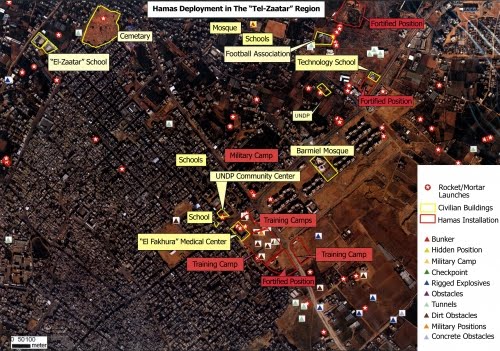
The two maps in this post are neither from the 'Bank of Palestine' (I could not find that map) nor from Google maps. They are IDF intelligence maps showing all the booby trapped buildings in Gaza City during Operation Cast Lead. They tell you what you really need to know about Gaza City, which is why none of you will be going there anytime soon.
The title of this post.... When I was around high school graduation bumper stickers appeared all over America that said "Visit San Clemente! You paid for it!'" San Clemente (California) was then-President Nixon's western White House. You've paid far more for Gaza City than you ever paid for San Clemente.
Heh.
Labels: Gaza City, maps, Palestinian tourism
Spain and USAID wipe Israel off the map
You will recall that the other day I showed you an advertisement from 'Palestinian Authority' television that was
sponsored by the Spanish government and that urged a boycott of Israel. Spain subsequently
denied that it had sponsored the ad. Well, maybe. But now Spain and USAID are sponsoring an ad urging travel to an imaginary country called 'Palestine.' And surprise:
Israel isn't on the map.
Now it seems as though Spain is funding the website Travel to Palestine. (h/t ElderofZiyon).This website is known for its ad in the UK which said that Palestine was the area from the Mediterranean to Jordan, thus eliminating Israel.
Hmmm.
Note
this: Palestine lies between the Mediterranean Coast and the Jordan River, at the crossroads between Africa and the Middle East. The individual faces in any Palestinian town remind you of this rich history of cross-cultural influences. Today Palestine is proud to offer comfortable, stylish accommodations, fabulous restaurants, refined artists and galleries, exquisite handicrafts, innumerable archeological and religious sites, and antiquities from all ages.
From the River to the Sea....
And yes, if you click on enough links there, you will find both the Spanish government and USAID.
Labels: Palestinian denial of Jewish history, Palestinian tourism, Spain, USAID

 It's only been a week since I noted that with the granting of 60,000 tourist visas for 'Palestinians' this summer, Tel Avivians would have to scrounge for 'Palestinians' to 'import' illegally into their city for their own pleasure and for that of the international media. But give Tel Aviv credit. With at least half its denizens living in tent cities to protest the fact that the government isn't handing out free apartments on Bograchov and Dizengoff, the remainder managed to sneak into Judea and Samaria, find 'Palestinians,' smuggle them back into Israel and get them photographed on the beach by an eager New York Times photographer.