Israeli officials are calling US Secretary of State John FN Kerry's 'security plan' 'unsophisticated' and 'unusable' and are complaining that the man does not even know how to read a map.
The officials, quoted in Yisrael Hayom, said that Kerry had
been rushing hither and fro in and attempt to hammer out details of what
is expected to be the framework of what he would like to see
implemented in order to pave the way for a final-status agreement. The
framework is expected to lay out the final goals and eventual shape of a
final-status deal, with Israel committing to give up land in Judea and
Samaria, and the PA expected by Kerry to recognize Israel as a Jewish
state and to back off on some of its demands.
But based on Kerry's public statements and conversations with them,
the officials quoted said they don't expect anything useful to emerge
from the process. “Kerry is here in the region a lot, but he has almost
no understanding of how things work in the Middle East.
“As a result, the American plan is unsophisticated, and does not
answer the needs of both sides,” the officials said. “There is no
connection between the positive statements Kerry is making in public and
the details of the deal. He is, to put it mildly, very unfamiliar with
the roots of the conflict, and as a result is incapable of bringing true
solutions to the table. He can't even read maps of the region
properly,” the officials added.
Security expert shows why any 'Palestinian state' would leave Israel indefensible
On CBN's Erik Stakelback Watchman show, security expert Mark Langfan uses three topographical maps to how any 'Palestinian state' would leave Israel indefensible.
With its Cairo embassy ransacked, its ambassador to Turkey expelled and the Palestinians seeking statehood recognition at the United Nations, Israel found itself on Saturday increasingly isolated and grappling with a radically transformed Middle East where it believes its options are limited and poor.
“We need not apologize,” Netanyahu thundered Sunday — and repeated the phrase three times. He’s opted for a needless road to an isolation that weakens Israel and undermines the strategic interests of its closest ally, the United States. Not that I expect Obama to raise his voice about this any more than he has over Dogan.
From Israel adrift At Sea by Thomas Friedman (New York Times, September 17, 2011)
Unfortunately, Israel today does not have a leader or a cabinet for such subtle diplomacy. One can only hope that the Israeli people will recognize this before this government plunges Israel into deeper global isolation and drags America along with it.
An extremely important point to note is how completely Arabs, and especially Palestinians, threw away the greatest opportunity they’ve ever had to gain more U.S. support and widen the cracks between Washington and Jerusalem into a chasm. If properly motivated, the Obama Administration was ready to become the most actively pro-Palestinian government in American history, to offer more concessions to the Palestinian Authority (PA), and to put more pressure on Israel than ever seen before. Instead, they refused to cooperate with Obama and rejected his initiatives. The PA wasted Obama’s entire term in refusing even to negotiate with Israel. Snatching defeat from the jaws of victory, the PA repeatedly showed the U.S. government that it was the intransigent party. And even if American officials would never publicly admit this, they certainly had to give up as a result. I provide this list not to rejoice at the misfortunes of others, even those who are hostile, because their people are the real victims. But these misfortunes are the result of decisions they made. This is the reality of the Middle East today.
In the cases of Cohen and Friedman note the contempt in which they held Israel. I don't expect either (Cohen is on a sabbatical right now) will revisit this issue and acknowledge that [Israel] has successfully waited out many of the reasons for its isolation.
But, as Andrew Sullivan suggests, rightly (when he's right, he's right), Palestinians aren't the only ones who publish maps that subvert the idea of a two-state solution. Click here to see the photograph of a Jewish National Fund pushke, a modern version of the age-old Jewish fund-raising device. The map on the JNF collection can depicts the West Bank as indivisibly part of Israel. A two-state solution, an idea to which the current, Likud Party prime minister says he is committed, would of course mean that most of the West Bank would be within the territory of Palestine. If I were a Palestinian looking at this collection can, I might ask myself if the Israelis are actually committed to the idea of territorial compromise.
First of all as Jonathan Schanzer tweeted, Goldberg (and Sullivan) were reading too much into a highly stylized picture.
Getting Talmudic here, Gaza is removed & button covers a chunk of WB. "Extremism" is everywhere, but a stretch in this case.
More generally, Israel over the past nineteen years has made significant concrete concessions giving land, money and even weapons to the Palestinian Authority and, for the most part, found peace further than before it started. And yes, Israel does promote peace even if it doesn't receive it in return. The maps on the Palestinian side are emblematic of the way the PA treats peace; they are not isolated exceptions.
Maps prepared by the Foreign Ministry set the latitude and longitude of Israel's waters and its maritime borders.
The resolution submitted to the government says that Lebanon's claims and maps that it proposed to the UN contradict maritime boundaries it previously agreed to with Cyprus.
Earlier, Foreign Minister Avigdor Lieberman told Israel Radio on Sunday that reports that the United States backed Lebanon on the maritime border dispute are "nonsense."
Deputy Foreign Minister Danny Ayalon also commenting on the maritime proposal on Sunday told Army Radio that he is confident the UN will accept Israel's position on its marine border with Lebanon.
He said, "The dispute over the border with Lebanon was created by the Lebanese. It is incorrect that the Americans sided with Lebanon in this dispute. There are very objective and organized rules, and I think that Israel will have no problem proving its ownership of the maritime areas that are ostensibly in dispute."
Ayalon added, "We've been in contact with Lebanon for a very long time. We have an interest in demarcating and setting all the borders, but they refuse. Even the current land border, which is recognized by the UN, is without Lebanese involvement or recognition. After the huge gas reserves were discovered, they suddenly woke up.
"Our position was that if the maritime borders are demarcated, the land border should be jointly demarcated as well. Now that they've suddenly sent maps, we have no choice but to set the borders ourselves."
I wish I could be convinced that the United Nations will treat us fairly. Unfortunately, we have too much experience with that in the past. To date, at least, the United Nations has refused to get involved in the maritime dispute. In light of that, I wonder if that last paragraph I quoted from Ayalon above is a good idea. Maybe we should just let the UN confirm the maritime border and leave the land border (supposedly confirmed by the UN previously) for another day.
Meanwhile, in Lebanon, they have not even started exploring their own territorial waters. No matter, all can be blamed on Israel.
“They were trying to ram through a Petroleum Law, to get the exploration going,” said Prof. Brenda Shaffer, an expert on energy policy and management in the School of Political Science at the University of Haifa, referring to a Lebanese law passed last August.
“So they’re trying to get people to think ‘bad Israel,’ let’s just get this law going.”
And the energy experts think Lebanon has 'no chance' - at least at the gas fields that Israel has so far discovered.
While energy experts believe that Lebanon wouldn’t stand a chance if it were to claim Israel’s large Tamar (some 50 km. west of Haifa) or Leviathan (roughly 130 km. west of Haifa) reserves, other more northern, yet-to-be-explored areas are more perhaps more in question.
“According to our understanding, Tamar and of course Leviathan – which is southwest of Tamar – are south of the claimed marine border as planned by Lebanon,” Amit Mor, CEO and energy specialist at the Herzliya Pituach-based Eco Energy consulting firm, told the Post on Sunday. “Nevertheless, the Lebanese are claiming sovereignty over areas that are claimed by Israel and to which exploration rights have already been granted to various companies by the Israeli government.”
For Lebanon, discovery and drilling of its own natural gas will be crucial for its energy supply, most of which currently comes from imported oil, Shaffer explained. There isn’t much known about the amount of gas located off Lebanon’s shores, but a European company did conduct a survey and saw “promising signs,” according to Shaffer.
“Their only gas that they get is from Egypt to Jordan, Jordan to Syria and Syria to Lebanon,” she said.
But the weakness of their claim won't stop Lebanon from protecting its 'rights.'
"Lebanon has warned that it insists on protecting its borders and resources," said Ali Hamdan, spokesman for Lebanese Parliament Speaker Nabih Berri, in a telephone interview from Beirut.
The Israeli Cabinet decision “comes late, as it is proof that they want to drill to see where there might be oil and gas, and then demarcate the border,” Hamdan added.
And of course the Lebanese line conflicts with the Israeli one. This is Prime Minister Netanyahu.
"The area we are discussing borders in the north with Lebanon and Cyprus. The [maritime] line that Lebanon presented to the UN is significantly south of the Israeli line," he said. "It contradicts the line Israel has agreed upon with Cyprus, and what is more significant to me is that it contradicts the line that Lebanon itself concluded with Cyprus in 2007. Our goal is to establish the position of Israel regarding its maritime boundary, according to international maritime law."
So who is trying to adjust the map based on where the gas has been discovered? What could go wrong?
A Gaza City university is betting that you would if you could, and it has produced a 'tourist map' of all the Gaza City sites. Of course, the article that introduces the map is one of the most biased pieces I have ever seen coming out of Gaza. Until the last two paragraphs, the article makes it sound like the only reason there is no tourism in Gaza is because of the 'Israeli blockade.'
Maliha denied that foreigners feared Gaza for internal reasons, although they certainly had good reason to. In April, Italian peace activist Vittorio Arrigoni was abducted in Gaza and brutally executed by an extremist Islamic group. In March 2007, BBC correspondent Alan Johnston was kidnapped in Gaza by the Army of Islam, another extremist group, and held in captivity for nearly four months.
Tourism sites have also been targeted by local fundamentalists. The Crazy Water Park, opened on May 2010 to serve Gaza's upper class, was burned to the ground four months later. The park had been shut down by the Hamas government in August because it allowed men and women to mix.
Gee, maybe that's why a lot of tourists aren't particularly excited about visiting Gaza.
By the way, one of the funniest parts is the explanation of why this 'tourist map' was produced.
The map, which debuted this week, is the brainchild of students and lecturers at the Geography Department of the city’s University College of Applied Sciences (UCAS). Besides documenting its archaeological and tourist sites, the map includes practical information such as hospitals and government buildings. Funded by the Bank of Palestine, the English-language map is handed out free of charge.
"We decided to give Gaza its due," Amir Shurrab, a lecturer at UCAS's Information Technology Department and head of Midad, the company that implemented the mapping project, told The Media Line. "Gaza is the world's fourth-most-ancient city. This project was our dream and aspiration, which we finally realized."
Gaza boasts unique archeological sites dating back millennia. The tomb of Prophet Muhammad's grandfather Hashem and the recently unearthed Hellenistic site of Tel Al-Rafah near the Egyptian border, where 1,300 silver coins were discovered, are only some of the city's highlights.
Shurrab said there are enough tourists in the city, and plenty more visiting political activists to justify creating the map. Until now, the only tool available for them to navigate the city was a printout from Google Maps, which he said isn’t detailed enough.
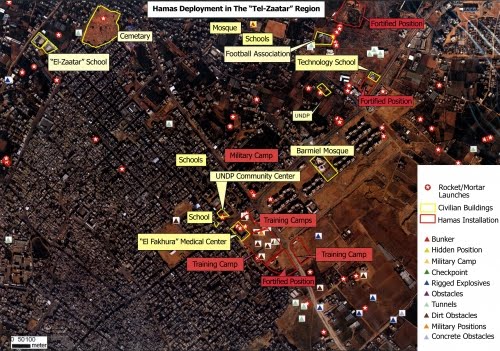
The two maps in this post are neither from the 'Bank of Palestine' (I could not find that map) nor from Google maps. They are IDF intelligence maps showing all the booby trapped buildings in Gaza City during Operation Cast Lead. They tell you what you really need to know about Gaza City, which is why none of you will be going there anytime soon.
The title of this post.... When I was around high school graduation bumper stickers appeared all over America that said "Visit San Clemente! You paid for it!'" San Clemente (California) was then-President Nixon's western White House. You've paid far more for Gaza City than you ever paid for San Clemente.
Egypt Air, the largest airline in Egypt, has removed Israel from the map – literally. On its website, Ynet has learned, Jordan's land reaches the Mediterranean Sea.
The airline's subsidiary, Air Sinai, flies to Israel regularly, but customers seeking flights to Ben Gurion National Airport will have a hard time finding them. On the map are the names of the Mideast capitals – Amman, Beirut, and Damascus – but Israel is nowhere to be found.
Egypt Air is the first large airline to have omitted the state from its map of destinations. Other airlines based in Muslim countries, such as Turkish Airlines and Royal Jordanian, include Israel and Tel Aviv on its maps.
The omission is especially odd seeing as the company continues to fly to Israel four times a week. Cairo-Tel Aviv flights were temporarily halted following the recent uprising that overturned the government, but were then reinstated.
There has also been an increase in passengers on Air Sinai's flights. According to the Airports Authority, the airline saw an increase of 27% in 2010 from the year previous.
Of course, those travelers were nearly all Israelis or foreigners and very few Egyptians. And now, with Mubarak gone, the cold peace is going to get colder.
David Makovsky has published a 34-page pdf with maps and calculations that are designed to show what a 'two-state solution' could theoretically look like on a map. I found the 7.5 meg daunting, and decided not to spend a lot of time on it. It merited a small article buried inside the Jerusalem Post on Sunday.
But the New York Times took it very seriously (Hat Tip: Memeorandum), and so, something needs to be said about it.
To some seasoned observers, the significance of the maps is less what they show than where they come from.
The Washington Institute was founded in 1985 by scholars affiliated with the American Israel Public Affairs Committee, the influential pro-Israel lobbying group. While the institute has earned a reputation for solid scholarship, and has wholeheartedly supported the peace process, it has remained a staunch supporter of Israel.
Still, this latest effort to prod Mr. Netanyahu and Mr. Abbas back into negotiations resonates with a broader frustration at the impasse among many American Jews.
“There is an increasing trend toward an ‘oy vey’ angst over how to save the two-state solution from the settlement juggernaut and by extension how to save Israeli democracy,” said Daniel Levy, a senior research fellow and co-director of the Middle East Task Force at the New America Foundation.
“The specifics of his proposed one-to-one border swaps are interesting,” Mr. Levy continued, “but the subtext reads: ‘Yikes! We need a border and an end to the settlement phenomenon now.’ ”
Mr. Levy, an unabashed liberal, said he was particularly struck by Mr. Makovsky’s so-called maximalist map, which shows that Israel could absorb 80 percent of its settler population by swapping land with the Palestinians equivalent to less than 5 percent of the West Bank.
That is less than a previous Israeli prime minister, Ehud Olmert, proposed to Mr. Abbas in 2008, when the two discussed land swaps. Mr. Olmert wanted a swap equivalent to 6.3 percent of the territory Israel seized in the 1967 Arab-Israeli war; Mr. Abbas wanted to transfer only 1.9 percent. Mr. Netanyahu has not taken a position on the swaps. To some right-wing Israelis, any such maps are taboo.
They're taboo for a very good reason: The 'Palestinians' have already turned down far better deals. The 'Palestinians' still insist that Israel concede everything on borders and 'settlements' before the 'Palestinians' will even deign to come to the table. But borders and 'settlements' are the only area in which Israel has anything to concede (unless you count Jerusalem separately). Israel would be left with security, 'refugees,' Jerusalem and water (among others) with absolutely no bargaining power. The concentration on borders gives the illusion of hope. But there is no hope, and there will not be any hope until the 'Palestinians' are willing to accept a compromise and to stop teaching their children to murder Jews. No map is going to cause those things to happen.
I am an Orthodox Jew - some would even call me 'ultra-Orthodox.' Born in Boston, I was a corporate and securities attorney in New York City for seven years before making aliya to Israel in 1991 (I don't look it but I really am that old :-). I have been happily married to the same woman for thirty-five years, and we have eight children (bli ayin hara) ranging in age from 13 to 33 years and nine grandchildren. Four of our children are married! Before I started blogging I was a heavy contributor on a number of email lists and ran an email list called the Matzav from 2000-2004. You can contact me at: IsraelMatzav at gmail dot com