Surprise (not): Former Generals say we can do without the Jordan Valley
In an earlier post, I told you that I believe that what Israel really needs for its security is the
mountainous areas of Samaria and not the Jordan Valley. A group of
former IDF Generals has now confirmed that. Well, sort of confirmed that.
The retired
generals, all members of the Council for Peace and Security, cast doubt on the
claim that the Jordan Valley is today an essential strategic
asset.
Maj.-Gen. (res.) Shlomo Brom, former director of the Strategic
Planning Division of the General Staff and a senior researcher at the Institute
for National Security Studies, called for “leaving the slogans behind” and a
purely strategic discussion of the consequence of leaving the Jordan
Valley.
Classic military threats from the east, characterized by an
invasion of organized Arab armies, vanished by the early 1980s, he argued, and
in recent years, “the reality has changed completely.”
Iraq as a military
power has disintegrated, and it will take “many years” before it can reappear on
the military map.
The threat of an Iraqi task force moving through Jordan
to attack Israel is nonexistent.
“There are no Iranian army divisions
threatening us. Iran does not have the ability to project ground-based military
power,” Brom said.
“It bought some Russian tanks, but most of its
investment is in surface to surface missiles, its navy, and its nuclear
program,” he added.
The Gulf Arab states are in a form of partnership
with Israel, and Jordan itself has an interest in maintaining a strategic
partnership with Israel that goes beyond the peace treaty, Brom said. Syria may
have thought of using Jordan as a staging ground to strike at Israel in the
past, but this threat is gone, too.
At the same time, Brom said, the IDF
has been at the forefront of a revolution allowing it to observe and strike
targets at a distance like never before.
He stressed the rapidly changing
nature of firepower and maneuvering, the introduction of long-range, standoff
weapons available to a range of platforms, and intelligence capabilities that
allow Israel to observe developing threats in real time; meaning that a future
threat can be dealt with differently.
“This changes the way of thinking,”
Brom said.
Asked about the threat of Jordan becoming a failed state, allowing
hostile military or terrorist forces to transit through it towards Israel, Brom
said that in such a scenario, the whole of Jordan would become a
battlefield.
Developing threats should be struck well before they reach
the Jordan Valley, he added. “It [the Valley] is today an artificial strategic
asset,” he said.
“My impression is that even [Prime Minister Binyamin]
Netanyahu and [Defense Minister Moshe] Ya’alon understand this.”
What about the Philadelphi corridor scenario of weapons smuggling? Denial ain't just a river in Egypt.
The
second type of threat inherent in leaving the Jordan Valley centers on the
possibility that it will turn into a second Philadelphi Corridor, like that on
the border between Gaza and Sinai, under which countless weapons have been
smuggled into the Strip. Not only weapons might cross the Jordan Valley, but
also “information and terrorists as well,” Brom warned.
This can be
answered through the introduction of a third party, a reliable military force
like NATO, to staff border passages, and to respond to intrusions along the
border in between the passages. As for the border areas between passages, Brom
envisaged a gradual process, in which Israel would first control the border,
then international forces, and finally, after years, Palestinian forces would
control their own border, after Israel becomes convinced that they are capable
and willing to do so.
“In the first years, Israel must be there to see
what is happening. If things works out, it can relinquish control to a
third party,” he added.
“If you look at who staffs border passages, who
is there? Police and customs, not military. Customs finds smuggled
goods,” Brom said. A reliable third party wouldn’t endanger itself or fight, and
Israel can monitor events through surveillance, he added. “This has to be done
correctly. If entities like NATO take part, it will underline the international
commitment to border security.”
Just like EUBAM maintained security in the Philadelphi corridor and
ran away as soon as Hamas arrived. International forces are mostly useless in this region. If anything, they're a hindrance because they become human shields.
The Council for Peace and Security is a Leftist organization with an agenda. They're at least partly right about the Jordan Valley but aren't even being asked about maintaining the high ground of Samaria - which is much more important.
Read the whole thing.
Labels: EUBAM Rafah, Gaza, Hamas, Jordan Valley, Judea and Samaria, NATO, Philadelphi corridor, Samaria
Report: Kerry proposed putting US forces in Jordan Valley, Netanyahu refused
I am embedding two tweets from Amir Mizroch, who is the managing editor of Israel Hayom.
This sounds like it's just one point in the plan that Barack Hussein Obama plans to impose on Israel. Haaretz reports that
the 'settlement' will be 'proposed' in January. I trust that Americans - who wanted their armed forces out of Iraq and Afghanistan - will be just thrilled to have those same armed forces protecting the 'Palestinians.'
What could go wrong?
Labels: Barack Hussein Obama, Binyamin Netanyahu, John Kerry, Jordan Valley, Philadelphi corridor
Why Israel should retake the Philadelphi Corridor
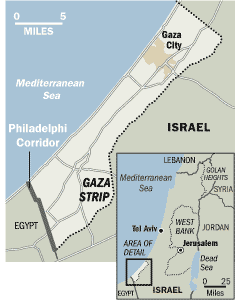
The Philadelphi Corridor was a regular topic of discussion on this blog in 2006 and 2007, when Israel was still trying to do something about weapons smuggling into Gaza aside from the blockade. Allowing ourselves to be railroaded into giving it up by Condi Clueless, and handing over control to a group of cowardly European 'peacekeepers' known as EUBAM Rafah was a huge mistake from Day One, and was something that was never envisioned even by the most optimistic architects of the Gaza expulsion. Daniel Mandel argues that the time has come to reverse the mistake and to
take back the Philadelphi Corridor.
First, there was never a sound reason to leave the corridor. It occurred purely as an unintended byproduct of a flawed Israeli decision to leave Gaza. This unilateral withdrawal was widely criticized by the most senior military and security figures, including the former and then-serving heads of the Shin Bet (Israel Security Service), the former IDF chief of staff, deputy chief of staff and chief of IDF Intelligence, and two former heads of the Mossad.
Even so, leaving Philadelphi was not part of the original plan. That outcome was due to unexpectedly strong pressure from the George W. Bush administration, secretary of state Condoleezza Rice in particular. In short, even those who supported the unilateral withdrawal did not reckon on relinquishing control of the Gaza/Egypt border.
Second, following the withdrawal, the evidence rapidly accumulated that the system of Egyptian troops, Israeli intelligence and international monitors instituted to replace direct Israeli supervision of the border was no substitute. Instead, there was an exponential increase in the quantity of offensive weaponry entering Gaza from Egypt.
Already in 2006, the former OC Southern Command, Maj.-Gen. Doron Almog, said that “there is a need for a permanent IDF presence in the area,” while the late doyen of military analysts, Zeev Schiff, observed that “even though Israel’s security and intelligence services have given the Egyptians a list of the names of those involved in the gun running... in practice nearly nothing is being done to prevent large-scale smuggling through the Philadelphi Route.”
Third, alterations last year to the security annex of the Egyptian/Israeli peace treaty to enable Egypt to deploy a further 2,500 troops in Sinai, in addition to the 700 already on the border, have achieved nothing. The reason is not hard to find and indeed is even more obvious now than when the annex was altered: the Egyptian forces are too much in sympathy with the terrorists and too loath to clash with Hamas to engage in a thorough- going campaign of terrorist suppression.
Egyptian forces will be brutal on terrorists that attack them, but will not interfere with Hamas and other forces bringing weaponry into Gaza.
It is therefore not a matter of troop numbers but of will. Where the efforts to stamp out the traffic in men and arms are tepid, grudging and spasmodic, large battalions will not avail. And nothing – least of all the change of regime in Cairo – suggests that the willpower that was once lacking has been found.
Fourth, the recent murderous attack on Egyptian soldiers underscores all of the foregoing, while providing Israel with an opportune moment to act. The security threats from Gaza to Israel have multiplied. Terrorism emanating from Sinai has also reared its head. Last August, it claimed Israeli lives; this August, Egyptian lives. Border clashes between Israel and Egypt, once a rare occurrence, look like becoming routine. All such incidents carry the risk of putting the nail in the coffin of Egyptian/Israeli peace treaty and even producing a war.
While I definitely believe that we ought to take back Philadelphi, what is the likelihood that the Egyptians will go along? If not, are we willing to take it back by force? Is this really our top priority in light of Hezbullah and Iran in the waiting? Don't get me wrong - I'm all in favor of doing this. But the timing is somewhat of a concern.
Labels: Condoleeza Rice, Gaza-Egypt border, Philadelphi corridor, weapons smuggling
Egypt to destroy Gaza smuggling tunnels?

Better late than never, Egypt is planning to
destroy the Gaza smuggling tunnels.
Egyptian security forces were mapping the network of tunnels running between the Sinai peninsula and the Gaza Strip in preparation to destroy the smuggling tunnels, Egyptian newspaper Al-Shorouk quoted official sources as saying on Wednesday.
In addition, the security forces are tightening security at the Philadelphi Corridor, the line that separates Sinai and Gazan sides of the city of Rafah, in an attempt to bring the Sinai peninsula under tighter control.
Egypt has been in pursuit of elements believed to be connected with acts of sabotage in Sinai, notably, repeated attempts to blow up the pipeline which carries natural gas to both Jordan and Israel. In efforts to restrict the movement of these elements, Egypt has coordinated with Hamas to prevent infiltration across the border in either direction, according to the report. The report added that Egypt has made it clear to Hamas that any Palestinians caught infiltrating into Sinai will be handed over to Egyptian security authorities.
The Egyptian military has reinforced its security along the border with Israel in the aftermath of last week's multi-stage terror attack, emanating from Sinai, in which killed eight Israelis.
The day after the attack, a number of Egyptian security personnel were reportedly killed and wounded after a suicide bomber blew himself up on the Egyptian side of the Philadelphi Corridor.
Israeli security officials said that the suicide bomber appeared to belong to the Popular Resistance Committees (PRC), which was behind the well-planned multi-stage attack near Eilat. Egypt denied that the soldiers were killed by a suicide bomber and said that they were hit in an explosion caused by bombs that were planted along the border, likely by the terror cell.
Someone please remind me again why we
rushed to apologize to Egypt for those deaths. Ah wait, those were Friday deaths, not Thursday's. We apologized for Thursday's deaths. But maybe it wasn't us after all?
In any event, I will be thrilled if Egypt actually shuts down the tunnels, but I'm not holding my breath waiting for it to happen even if the Egyptians have finally recognized that it's in their interest to shut them down.
Read the whole thing.
Labels: Egyptian army, Eilat, Palestinian terrorism, Philadelphi corridor, smuggling tunnels
Egypt carrying out massive military operation in Sinai with Israel's approval

With Israel's approval, the Egyptian army has launched a massive military operation in the Sinai Peninsula, which is aimed at cleaning out
al-Qaeda terrorists and Bedouin gangs.
Egypt launched a massive military operation on Sunday to stop al-Qaida and Bedouin terrorists and to restore order to the Sinai Peninsula which fell into anarchy following the revolution in the country earlier this year.
Israeli defense officials said they were aware of the operation, known as Operation Eagle, and that head of the Defense Ministry’s Diplomatic-Security Bureau Amos Gilad had visited Cairo earlier this month to discuss a wide-range of issues with the interim Egyptian government including the operation in the Sinai.
In February, Israel gave the Egyptian government approval to deploy military forces in the Sinai Peninsula to crack down on Bedouin violence and to protect a gas pipeline that supplies natural gas to Israel. The deployment was made under the condition that the troops would withdraw the moment they are asked to by Israel.
...
The operation launched on Sunday includes about 1,000 soldiers and a few hundred armored personnel carriers which flooded into the Sinai over the weekend and took up positions near el-Arish and Rafah. Israeli officials said they welcomed the operation which they expressed hope would also lead to a crackdown on weapons smuggling into Gaza which has significantly climbed since Hosni Mubarak’s regime fell in February.
Does anyone believe that the Egyptians are going to automatically withdraw their troops as soon as Israel asks them to do so? And what if Israel doesn't ask until after the Egyptian elections, and by then the Muslim Brotherhood is in charge? What could go wrong?
Labels: Egyptian Revolution, Egyptian-Israeli peace treaty, El Arish, Muslim Brotherhood, Philadelphi corridor, Sinai
Hamas patrolling Gaza-Egypt border?
Stratfor reports that
Hamas is patrolling the border fence between Gaza and Egypt, including the Rafah crossing.
The following is a report from a STRATFOR source in Hamas. Hamas, which formed in Gaza as an outgrowth of the Egyptian Muslim Brotherhood (MB), has an interest in exaggerating its role and coordination with the MB in this crisis. The following information has not been confirmed. Nonetheless, there is a great deal of concern building in Israel and the United States in particular over the role of the MB in the demonstrations and whether a political opening will be made for the Islamist organization in Egypt.
The Egyptian police are no longer patrolling the Rafah border crossing into Gaza. Hamas armed men are entering into Egypt and are closely collaborating with the MB. The MB has fully engaged itself in the demonstrations, and they are unsatisfied with the dismissal of the Cabinet. They are insisting on a new Cabinet that does not include members of the ruling National Democratic Party.
Security forces in plainclothes are engaged in destroying public property in order to give the impression that many protesters represent a public menace. The MB is meanwhile forming people’s committees to protect public property and also to coordinate demonstrators’ activities, including supplying them with food, beverages and first aid.
Hamas is the Muslim Brotherhood -
they are one and the same.
Israel is deeply concerned with the prospect of the Muslim Brotherhood taking over in Egypt. It would surely be the end of the Camp David accords. Israel would be facing an Egyptian army that is far more powerful than the Egyptian army was in 1967, and it would be facing it from the 1967 armistice lines.
What could go wrong?
Labels: Gaza-Egypt border, Hamas, Philadelphi corridor, Politics, Rafah, World Politics
Breaking: Egypt closing down al-Jazeera offices

Israel Radio reported on its 11:00 am news on Sunday that the Egyptian information ministry has ordered al-Jazeera's Egyptian operation shut down. Apparently, they didn't like what al-Jazeera was broadcasting.
Israel Radio also reports that the Egyptian army has increased forces in Northern Sinai and along the Philadelphi Corridor border between Egypt and Gaza. The Rafah border crossing between the two is closed until further notice. I assume that the smuggling tunnels are still operating although if it's raining as much there as it is here, I wouldn't want to be in the tunnels today.
Labels: al-Jazeera, Egypt, Egyptian riots, Gaza, Philadelphi corridor, Politics, Rafah, World Politics
Great news: Bedouin smugglers control Egyptian towns closest to Gaza

Time Magazine reports that Bedouin smugglers opposed to the Mubarak regime now control the
two Egyptian towns that are closest to the Gaza Strip. The towns are not named, but we have heard reports relating to both El Arish and Rafah over the past few days.
And a prominent Bedouin smuggler in the Sinai peninsula told TIME that Bedouin are now in control of the two towns closest to the Gaza Strip, and that they planned to press on to attack the Suez Canal if Mubarak does not step down. He also said that police stations in the south Sinai would be attacked if Bedouin prisoners were not released.
And in Israel, the IDF may not have a Chief of Staff in two weeks, because Defense Minister Barak's candidate for the position has been
accused of perjury.
What could go wrong?
Labels: Ehud Barak, El Arish, Gaza-Egypt border, IDF Chief of Staff, Philadelphi corridor, Politics, Rafah, World Politics, Yoav Galant
Hamas terrorists escape Egyptian prisons, returning to Gaza

Well, isn't
this great news?
Hamas sources have reported that a few Palestinian detainees have escaped Egyptian prisons as result of the unrest, and are making their way to the Gaza Strip.
Egypt has arrested Hamas operatives that have infiltrated the Rafah border in the past. The most senior of the arrestees is the commander of the Izzedin al-Qassam brigade, who was arrested in 2008 and accused of planning a terrorist attack on Egypt.
By the way, is anyone watching the border at Rafah? Or is Hamas now smuggling unimpeded?
Labels: Egyptian riots, EUBAM Rafah, Gaza, Philadelphi corridor, Politics, World Politics
What if Gazans broke down the border fence with Egypt again?

On Thursday, riots in Egypt
spread to the northern Sinai, blocking the road to Rafah. Rafah is right across the border from Gaza (the town is actually divided in half and has been ever since Israel returned the Sinai to Egypt).
Riots have resumed in the city of Suez in Egypt, Al Jazeera reported Thursday. Protesters torched a building and are hurling stones at police forces. According to the report, police are using tear gas to disperse the protest. Meanwhile, protests have resumed in north Sinai and the road leading to Rafah has been blocked.
Will Gaza riot in sympathy for Egypt? For example, might they try to break down the border fence again as happened three years ago (see picture)? Hmmm.
Aren't you glad we listened to Condi Clueless and let the EUBAM (European forces) 'patrol' the Philadelphi corridor (the border between Egypt and Gaza) until they ran away in 2007? Bigger hmmm.
Labels: Cairo 25 January 2011, Condoleeza Rice, EUBAM Rafah, Gaza, Hosni Mubarak, Philadelphi corridor, Politics, World Politics
Lieberman tries to call Europe's bluff

The European Union recently issued a paper called "Conclusions on the Middle East Peace Process," which called for an "immediate, sustained and unconditional opening of crossings" to and from Gaza. Foreign Minister Avigdor Lieberman tries to
call their bluff.
The unconditional removal of Israel's defensive measures would be counterproductive and only help Hamas's military build-up, which continues largely at the behest of Iran. Moreover, if the crossings were unconditionally opened, Iran will immediately take advantage of this situation through its proxies such as Hamas and Hezbollah. These terrorist groups will be able to destabilize the Palestinian Authority in Judea and Samaria. Such a demand is irresponsible, immoral and unjustified.
The EU also seems to ignore the plight of Israeli soldier Gilad Shalit. Kidnapped by Hamas more than four years ago, he remains cut off from the world and his family. To this day, not even the Red Cross has been allowed to visit him, in utter disregard of the most fundamental humanitarian principles. Rather than pressing for Gilad Shalit's release and searching for ways to effectively stem the flow of weapons, the EU is pressuring Israel to rescind the necessary restrictions.
As existing and previous attempts to stanch the smuggling have clearly failed, a different approach needs to be considered. If the EU wishes to genuinely address the source of the problem, it should contemplate stationing an effective European or international force along the Philadelphi Corridor and at the Rafiah Crossing, the Egyptian-Gaza border areas under which most of the tunnels for weapons smuggling into Gaza have been built. To elicit a change in the situation, such a force would have to be robust in both operational capabilities and mandate and willing to confront Hamas. We cannot allow a return to the ineffective EUBAM mission, which unilaterally vacated its positions at the Rafiah Crossing upon Hamas's seizure of power in Gaza.
I can affirm that a cessation of the smuggling will lead to the lifting of restrictions. However, the State of Israel cannot be expected to forgo its fundamental security interests without the removal of this grave threat and the ongoing assault against Israeli towns that it continues to fuel.
Yes, but....
Do we really want another 'international force' on our border, which will just be in the IDF's way and will run away the second they are called on to do anything (as happened when Hamas threw Fatah out of Gaza in 2007)?
And even if you assume that an 'international force' can be effective (which Lieberman does), why should we completely open the crossings without Gilad Shalit's release?
Third, even if the smuggling stops, do we really want open borders to allow terrorists in from Hamastan?
Fortunately, the Europeans hate us only slightly less than they are scared of Hamas, and therefore they are likely to flee the second they are asked to put their money where their collective mouth is. But if Lieberman actually believes that what he's proposing is plausible, we have bigger problems than just needing to answer the Europeans.
Labels: Avigdor Lieberman, EUBAM Rafah, Gilad Shalit, Hamas, Philadelphi corridor
In the event of war, UNIFIL will flee to Israel

I'm sure you'll all be shocked - just shocked - to hear that in the event of war,
UNIFIL plans to flee to Israel. No, that's not what this article says, but let's read between the lines.
The United Nations Interim Force in Lebanon has devised a plan to evacuate its wounded to Israel in case of the eruption of a war, reported Al-Akhbar on Monday.
The plan, which was set ten days ago, will be implemented in a joint maneuver with the Israeli army.
The paper said that the army contacted UNIFIL command after it received news of the maneuver to confirm it, after which the army command said that the step would be a negative development that demonstrates UNIFIL's ties with Israel.
Come on, does anyone really believe UNIFIL will turn their weapons on the Lebanese Armed Forces or Hezbullah? Does anyone believe that they'll actually wait to be wounded to evacuate? Does anyone believe that those troops who are evacuating the wounded troops will return to Lebanon? Does anyone really believe that UNIFIL troops will knowingly risk their lives to protect persons from Israel or Lebanon in the event of a war? Remember the European multi-national force that was watching the Philadelphi corridor on the edge of Gaza, and fled to Israel when Hamas took over?
Aren't international forces great?
Labels: Hezbullah, IDF, Lebanese Armed Forces, Philadelphi corridor, UNIFIL