Egypt shuts Gaza border indefinitely, world silent
Egypt has indefinitely shut the Rafah border crossing that provides the only exit from the strip for Gazans, stranding 'hundreds' of Gazans on the other side in the process. Of course, since it's not Israel that's doing this,
the world is silent.
The move could mark a dramatic escalation in
the closures faced by Gaza’s residents. Rafah is the Gaza Strip’s only
exit point not controlled by Israel, which has imposed a blockade on its
own border with Gaza in an effort to curtail arms smuggling by the
territory’s Hamas rulers.
Egyptian authorities have closed the border
crossing intermittently since the military deposed president Mohammed
Morsi on July 3. It was closed last week over the Eid al-Fitr holiday,
and the terminal’s operating hours have been sharply curtailed since
July, when they were shortened from nine hours a day to just four.
According to Egyptian officials, the restrictions led to a drop in the
number of people crossing each day from about 1,200 to just 150.
Egyptian forces have also worked to shut down
the large network of smuggling tunnels between the Strip and Sinai,
leading to severe shortages inside the Palestinian territory, according
to Gazans and UN officials.
Thousands of workers in Gaza have also been
laid off over the past month due to the closures, while some of the tens
of thousands of Palestinians studying and working in Egypt are keeping a
low profile for fear being targeted in an anti-Hamas backlash. Hamas is
an affiliate and ally of the Muslim Brotherhood and has been vocal in
its criticism of Morsi’s overthrow.
The latest closure, which is not time-limited,
has left hundreds of Palestinians stranded on either side of the
crossing, according to AFP.
The Egyptian move comes as part of the
military’s efforts to curtail violence and terror attacks in the Sinai
Peninsula, which spiked in the wake of Morsi’s ouster, with authorities
in Cairo saying that many of the fighters in the peninsula came from
Gaza.
Boo. Hoo. Maybe Egypt will consider retaking the Strip and throwing Hamas out. Given that Israel is no longer in Gaza, Egyptian rule looks like a better alternative than Hamas.
Labels: Egyptian apartheid wall, Gaza, Gaza blockade, Gaza plenty, Gaza-Egypt border, Rafah
Egypt closes Rafah crossing to Gaza 'indefinitely'
Egypt has
closed indefinitely the Rafah border crossing with Gaza due to the security situation.
Maher Abu Sabha, director of border crossings in Gaza says Egypt told Hamas of the indefinite closure.
The
Egyptian director of the Rafah terminal, Sami al-Mitwali, said the
crossing was closed due to security unrest, Palestinian news agency
Ma'an reported.
Nilesat an Egyptian company, that controls a
series of Egyptian communications satellites, removed Hamas TV al Quds
from the air in recent days.
The closure comes after Islamist
gunmen staged multiple attacks on security forces in Egypt's troubled
Sinai Peninsula early Friday, two days after the army overthrew elected
Islamist President Mohamed Morsi, security sources and state television
reported.
Isn't it amazing what the Egyptian government can do when they want to do it?
Labels: Gaza-Egypt border, Rafah
Why Israel should retake the Philadelphi Corridor
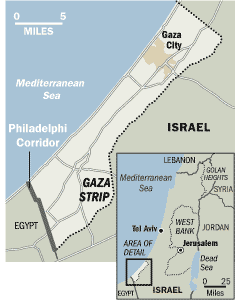
The Philadelphi Corridor was a regular topic of discussion on this blog in 2006 and 2007, when Israel was still trying to do something about weapons smuggling into Gaza aside from the blockade. Allowing ourselves to be railroaded into giving it up by Condi Clueless, and handing over control to a group of cowardly European 'peacekeepers' known as EUBAM Rafah was a huge mistake from Day One, and was something that was never envisioned even by the most optimistic architects of the Gaza expulsion. Daniel Mandel argues that the time has come to reverse the mistake and to
take back the Philadelphi Corridor.
First, there was never a sound reason to leave the corridor. It occurred purely as an unintended byproduct of a flawed Israeli decision to leave Gaza. This unilateral withdrawal was widely criticized by the most senior military and security figures, including the former and then-serving heads of the Shin Bet (Israel Security Service), the former IDF chief of staff, deputy chief of staff and chief of IDF Intelligence, and two former heads of the Mossad.
Even so, leaving Philadelphi was not part of the original plan. That outcome was due to unexpectedly strong pressure from the George W. Bush administration, secretary of state Condoleezza Rice in particular. In short, even those who supported the unilateral withdrawal did not reckon on relinquishing control of the Gaza/Egypt border.
Second, following the withdrawal, the evidence rapidly accumulated that the system of Egyptian troops, Israeli intelligence and international monitors instituted to replace direct Israeli supervision of the border was no substitute. Instead, there was an exponential increase in the quantity of offensive weaponry entering Gaza from Egypt.
Already in 2006, the former OC Southern Command, Maj.-Gen. Doron Almog, said that “there is a need for a permanent IDF presence in the area,” while the late doyen of military analysts, Zeev Schiff, observed that “even though Israel’s security and intelligence services have given the Egyptians a list of the names of those involved in the gun running... in practice nearly nothing is being done to prevent large-scale smuggling through the Philadelphi Route.”
Third, alterations last year to the security annex of the Egyptian/Israeli peace treaty to enable Egypt to deploy a further 2,500 troops in Sinai, in addition to the 700 already on the border, have achieved nothing. The reason is not hard to find and indeed is even more obvious now than when the annex was altered: the Egyptian forces are too much in sympathy with the terrorists and too loath to clash with Hamas to engage in a thorough- going campaign of terrorist suppression.
Egyptian forces will be brutal on terrorists that attack them, but will not interfere with Hamas and other forces bringing weaponry into Gaza.
It is therefore not a matter of troop numbers but of will. Where the efforts to stamp out the traffic in men and arms are tepid, grudging and spasmodic, large battalions will not avail. And nothing – least of all the change of regime in Cairo – suggests that the willpower that was once lacking has been found.
Fourth, the recent murderous attack on Egyptian soldiers underscores all of the foregoing, while providing Israel with an opportune moment to act. The security threats from Gaza to Israel have multiplied. Terrorism emanating from Sinai has also reared its head. Last August, it claimed Israeli lives; this August, Egyptian lives. Border clashes between Israel and Egypt, once a rare occurrence, look like becoming routine. All such incidents carry the risk of putting the nail in the coffin of Egyptian/Israeli peace treaty and even producing a war.
While I definitely believe that we ought to take back Philadelphi, what is the likelihood that the Egyptians will go along? If not, are we willing to take it back by force? Is this really our top priority in light of Hezbullah and Iran in the waiting? Don't get me wrong - I'm all in favor of doing this. But the timing is somewhat of a concern.
Labels: Condoleeza Rice, Gaza-Egypt border, Philadelphi corridor, weapons smuggling
Sinai attackers 'Palestinians'?
Egypt's Independent publishes a translation from al-Masry al-Youm that indicates that the evidence points to last Sunday's attackers being '
Palestinians.'
The initial forensic report on the bodies of the Rafah checkpoint attackers suggests that the perpetrators were wearing military uniforms made in Nablus, Palestine at the time of the attack.
Five bodies were 99 percent burned from an explosion, while a sixth had gunshots throughout his body. They were all men in their thirties with reportedly Arab features. Their DNA was taken to be matched against that of criminals currently wanted by the police.
Israel handed over four bodies to Egypt on Monday, saying its forces killed them after they seized an armored truck from the Egyptian side and attempted to cross the border.
They're addicted to terrorism.
Labels: Egypt, Gaza-Egypt border, Palestinian terrorism
Hamas patrolling Gaza-Egypt border?
Stratfor reports that
Hamas is patrolling the border fence between Gaza and Egypt, including the Rafah crossing.
The following is a report from a STRATFOR source in Hamas. Hamas, which formed in Gaza as an outgrowth of the Egyptian Muslim Brotherhood (MB), has an interest in exaggerating its role and coordination with the MB in this crisis. The following information has not been confirmed. Nonetheless, there is a great deal of concern building in Israel and the United States in particular over the role of the MB in the demonstrations and whether a political opening will be made for the Islamist organization in Egypt.
The Egyptian police are no longer patrolling the Rafah border crossing into Gaza. Hamas armed men are entering into Egypt and are closely collaborating with the MB. The MB has fully engaged itself in the demonstrations, and they are unsatisfied with the dismissal of the Cabinet. They are insisting on a new Cabinet that does not include members of the ruling National Democratic Party.
Security forces in plainclothes are engaged in destroying public property in order to give the impression that many protesters represent a public menace. The MB is meanwhile forming people’s committees to protect public property and also to coordinate demonstrators’ activities, including supplying them with food, beverages and first aid.
Hamas is the Muslim Brotherhood -
they are one and the same.
Israel is deeply concerned with the prospect of the Muslim Brotherhood taking over in Egypt. It would surely be the end of the Camp David accords. Israel would be facing an Egyptian army that is far more powerful than the Egyptian army was in 1967, and it would be facing it from the 1967 armistice lines.
What could go wrong?
Labels: Gaza-Egypt border, Hamas, Philadelphi corridor, Politics, Rafah, World Politics
Great news: Bedouin smugglers control Egyptian towns closest to Gaza

Time Magazine reports that Bedouin smugglers opposed to the Mubarak regime now control the
two Egyptian towns that are closest to the Gaza Strip. The towns are not named, but we have heard reports relating to both El Arish and Rafah over the past few days.
And a prominent Bedouin smuggler in the Sinai peninsula told TIME that Bedouin are now in control of the two towns closest to the Gaza Strip, and that they planned to press on to attack the Suez Canal if Mubarak does not step down. He also said that police stations in the south Sinai would be attacked if Bedouin prisoners were not released.
And in Israel, the IDF may not have a Chief of Staff in two weeks, because Defense Minister Barak's candidate for the position has been
accused of perjury.
What could go wrong?
Labels: Ehud Barak, El Arish, Gaza-Egypt border, IDF Chief of Staff, Philadelphi corridor, Politics, Rafah, World Politics, Yoav Galant










