Gaza burial? 2013 World Press Photo of the Year was 'enhanced'
The 2013 World Press photo of the year was 'enhanced' using Photoshop according to a computer expert who spotted the fraud a mile away.
The photo, dubbed Gaza
Burial, was purportedly captured on November 20, 2012 by Paul Hansen.
Hansen was in Gaza City when Israeli forces retaliated in response to
rocket fire from Palestinian rocket fire. The photo shows two of the
casualties of the Israeli attack, carried to their funeral by their
uncles. Now, the event itself isn’t a fake — there are lots of other
photos online that show the children being carried through the streets
of Gaza — but the photo itself is almost certainly a composite of three
different photos, with various regions spliced together from each of the
images, and then further manipulation to illuminate the mourners’
faces.
This revelation comes from Neal Krawetz,
a forensic image analyst. There were two main stages to the analysis:
First an interrogation of the JPEG’s XMP block, which details the file’s
Photoshop save history, and then pixel-level error level analysis
(ELA). To begin with, the XMP data shows that the original, base image
was converted from Raw format and opened in Photoshop on November 20,
2012 (the same date that it was taken). Then, on January 4, 2013, the
XMP block shows that a second Raw image was opened and added to the
original.
An hour later, a third image was spliced in. Finally, 30
minutes later the photo chimera was actually saved to disk. The January 4
date is interesting because it shows that the final photo was only
edited a couple of weeks before the January 17 submission deadline, not
soon after original photo was taken in Gaza — in other words, it was
edited specifically for the contest.
...
Take a look at the man on the
far left, carrying the child’s feet — his magically, digitally
illuminated face is clearly shown on the ELA map. In fact, almost every
face in the picture has been brightened, as have the children’s shrouds.
The
final nail in the coffin is good ol’ shadow analysis. At the time the
photo was taken — 10:40am, in the winter — the sun should be fairly low
in the sky. The shadows on the left wall are consistent with a sun
location (shown below) that should cast deep, dark shadows on the
mourners’ right sides — but, as you can see, those magical light rays
seem to be at work again.
The only reason this photo was subject to such rigorous analysis was the fact that it won a major prize. One cannot help but wonder how many other images from the Israeli - 'Palestinian' conflict were similarly altered.
The technology for altering photos, and for detecting alterations, have both improved greatly since fauxtography first burst into the headlines seven years ago. Maybe this type of analysis is something that ought to be done regularly (and no, I'm not volunteering and don't know how to do it).
'Palestinian' fauxtography being used to rile up the natives over Abu Hamdiyeh
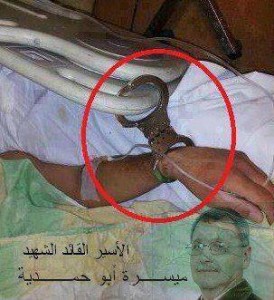
Since it's been widely publicized that Maissara Abu Hamdiyeh, the 'Palestinian' terrorist who died this week, died of esophageal cancer, some of you might be wondering how the 'Palestinians' are convincing their 'people' that it was Israel's fault. The picture above is one example of 'Palestinian' fauxtography in action (Hat Tip: Asher G).
Today a photo appeared on the internet, passed off as being an image of Maysara Abu Hamdiya, a Palestinian prisoner who died this week in an Israeli prison. Hamdiya suffered from cancer, and the allegation is that he did not receive the medical treatment he needed. The photo shows him handcuffed to a hospital bed and insinuates that he received cruel, inhumane treatment during his prison sentence.
The Israeli Prison Services spokeswoman, Sivan Weizman, explained that the prison had taken all the necessary precautions for Abu Hamdiya’s health, including transferring him to a prison closer to hospital facilities should he need them.
Can you guess what's wrong with the picture above?
Here's the original:
The image implies that Abu Hamdiya handcuffed to a hospital bed. In reality, the arm pictured above is a cropped portion of a photo taken in Syria of a hospitalized rebel. The photo was originally published on December 8th, 2012.
UN refuses to disclose details of investigation into employee who posted incendiary false tweet
You will recall that in March 2012, a UN employee posted the photo above on her twitter account as if it had just happened, when in fact it happened in 2006.
Subsequently, at the urging of Israeli ambassador to the United Nations Ron Prosor, the UN opened an investigation into the tweet. In February, we were told that the employee had been 'de facto' fired.
Ambassador Prosor asked for details about the investigation and the 'firing' and the UN has now refused to give them.
In his letter last month, Prosor wrote that on March 13, 2012, he had
written to Amos demanding Badawi’s firing, only to be told that OCHA
had “begun an inquiry” into her actions.
“Since then l have sent
several letters – on 20 March, 11 June, and 14 August – requesting
information about the status of this investigation. One did not need the
detective skills of Agatha Christie to realize that something is amiss
here. A case like Ms. Badawi’s does not exactly require the assistance
of an NYPD forensics team,” he wrote.
“A year has passed since my
initial complaint,” Prosor continued, “and my government still has yet
to receive any substantive answers from USG Amos’s office. OCHA’s
constant evasiveness in responding to my letters has forced me to
question the seriousness with which they undertook Ms. Badawi’s inquiry. OCHA’s behavior casts doubt on its ability to conduct an honest, professional, and transparent investigation.”
Amos’s
response came a week later. In her letter she reiterated what she wrote
soon after the affair first broke, that Badawi’s personal Twitter
account did not reflect OCHA’s views.
“I remain concerned about
the negative impact her actions have had on the relationship between
OCHA and the Government of Israel,” she wrote.
Amos said that an official inquiry was conducted by the UN Development Program’s audit and investigations office.
She said that due process was ensured for everyone involved, and that the investigation was concluded.
But,
she added, since this is “an internal personnel issue, the United
Nations is bound by rules of confidentiality and cannot disclose the
results of the investigation or other related information regarding Ms.
Badawi, who is no longer a UN staff member.”
She closed by saying
that the UN “remains committed to ensuring and safeguarding the
neutrality and impartiality of the Organization.”
Pigs fly: UN 'de facto fires' employee who tweeted falsely about Gaza
It took a year, but the United Nations has cut all ties with Kulhood Badawi, the woman who posted the tweet above. The tweet, which as you can see claimed to be current in 2012, was actually a picture taken in 2006. The United Nations has now cut all ties with Badawi. That's a nice way of saying that she was fired.
UN under-secretary-general for humanitarian affairs Valerie Amos, while
not disputing Badawi¹s actions, publicly questioned whether the world
body could be held accountable for "personal" tweets.
As such,
she launched the inquiry that Israel's UN mission charged was a
"whitewash," with Ambassador Ron Prosor repeatedly insisting that Badawi
be fired.
Amos then explained she was awaiting conclusions and
recommendations. Yet weeks turned into months, with the investigation
having been concluded in October 2012, and repeated inquiries to Amos
for updates produced nothing.
On Wednesday, an email from the UN
revealed that all facets of the fact-finding mission had finally been
completed, and that the organization had opted not to renew Badawi's
contract.
Name and shame?
If she's the same Badawi as this one, she has not had a good year. Maybe time for some self-reflection....
Dr. Allon Friedman, who sent it to me, sent the Journal the following letter in response:
Sir,
I
wish to bring your attention to a highly suspicious photograph that was
included on page A8 of the WSJ print edition yesterday (12/1/12) in an
article
entitled “Israel pushes housing after U.N. vote.”
The photograph’s caption states:“A Palestinian girl tries to push an Israeli soldier at a demonstration in the West Bank village of al-Masara…”
Even a brief perusal of the photograph raises a number of troubling observations:
1.The girl’s arms are fully outstretched with her fingertips touching the plastic shield of the Israeli soldier.Judging by her stance and the position of her arms, there is no
sense of physical strain on her part nor of force being exerted either
by her or the soldier.In fact, the girl does not look like she is trying to push anything.Rather, it looks very much like what one would expect with a staged photo, where someone has asked the girl to walk up to the soldier and put her hands on the shield for a photo-op.
2.In addition, the “demonstration” is odd in that, at least in the photo, there is no sense of urgency or tension at all.Note the soldier in the background who is looking down at something as well as the empty space that surrounds the girl.
In summary, the photo was most likely staged.Unfortunately, there is copious documentation that the Western media frequently publish staged and/or manipulated photos of the Arab-Israeli conflict.Invariably, the photos fit an anti-Israel narrative, like the one I describe here (oppressed child vs. oppressor soldier).Often the photos can be traced back to Arab stringers or
photographers who are simply biased against Israel or, on certain
occasions, actually on the payroll of Israel’s adversaries.
This would not be the first time that a staged photo was used in the propaganda war against Israel, but it is very troubling that a reputable newspaper
like the WSJ has chosen to publish it.
I look forward to hearing back from you about this matter.
I am an Orthodox Jew - some would even call me 'ultra-Orthodox.' Born in Boston, I was a corporate and securities attorney in New York City for seven years before making aliya to Israel in 1991 (I don't look it but I really am that old :-). I have been happily married to the same woman for thirty-five years, and we have eight children (bli ayin hara) ranging in age from 13 to 33 years and nine grandchildren. Four of our children are married! Before I started blogging I was a heavy contributor on a number of email lists and ran an email list called the Matzav from 2000-2004. You can contact me at: IsraelMatzav at gmail dot com