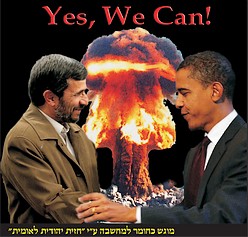
I don't know when on Thursday this press release from IAEA director Yukia Amano was posted - it only has a date, but no time on it. But as I've reported already, the IAEA's agreement with Iran has been posted by AP despite Amano. Here's what the IAEA director had to say (Hat Tip: Memeorandum).
I am disturbed by statements suggesting that the IAEA has given
responsibility for nuclear inspections to Iran. Such statements
misrepresent the way in which we will undertake this important
verification work.
The separate arrangements under the Road-map agreed between the IAEA
and Iran in July are confidential and I have a legal obligation not to
make them public – the same obligation I have for hundreds of such
arrangements made with other IAEA Member States.
However, I can state that the arrangements are technically sound and
consistent with our long-established practices. They do not compromise
our safeguards standards in any way.
The Road-map between Iran and the IAEA is a very robust agreement,
with strict timelines, which will help us to clarify past and present
outstanding issues regarding Iran’s nuclear programme.
If I were sitting in a press conference with Mr. Amano, here's what I would ask:
Mr. Amano, can you name another country aside from Iran in which the IAEA relies solely on photos, videos and soil samples provided by the country under inspection?
Can you name any other country in which an IAEA inspection is merely a 'courtesy visit'?
If Olympic athletes were allowed to provide urine samples without anyone ensuring that they were their own, would you consider that reliable? How could you ensure their authenticity?
How can you ensure the authenticity of a soil sample that you did not watch being taken?
Unbelievable. This whole 'inspection' is a farce. And Amano has been caught with his pants down (I will assume he released that statement before AP released the agreement).
When I went to sleep last night, a Max Fisher piece attacking that report was trending. Fisher's report was largely based on conversations with Jeffrey Lewis, a guy known on Twitter as @ArmsControlWonk.
"If true" turns out to be a major issue here, as upon closer
examination the inflammatory headline, as it has been widely
interpreted, appears to largely not be true.
In fact, the text of the article said something much more modest. It
said that in a one-time set of inspections at one military facility
known as Parchin, Iranians, rather than nuclear inspectors, would take
"environmental samples" (such as soil samples). It said that nuclear
inspectors would not be permitted to visit, and that Iran would not
provide photos or videos of the site. But still, it was concerning.
"The story was the Iranians would take the samples under some kind of
IAEA monitoring," Jeffrey Lewis, the arms control expert, told me. "The
details of that monitoring were not provided, so it's hard to say how
weird that is. Some IAEA officials say that it's not unusual to let a
country physically take the samples if there's an IAEA inspector
present."
The sourcing in the story, though, seemed to water it down a bit
more. The report was not based not on an actual agreement, but rather on
a copy of a draft agreement. The anonymous source who showed AP the
document said there was a final version that is similar, but
conspicuously refused to show AP the final version or go into specifics.
"The oldest Washington game is being played in Vienna," Lewis said.
"And that is leaking what appears to be a prejudicial and one-sided
account of a confidential document to a friendly reporter, and using
that to advance a particular policy agenda."
1. Iran will provide to the Agency photos of the locations, including
those identified in paragraph 3 below, which would be mutually agreed
between Iran and the Agency, taking into account military concerns.
2. Iran will provide to the Agency videos of the locations, including
those identified in paragraph 3 below, which would be mutually agreed
between Iran and the Agency, taking into account military concerns.
3. Iran will provide to the Agency 7 environmental samples taken from
points inside one building already identified by the Agency and agreed
by Iran, and 2 points outside of the Parchin complex which would be
agreed between Iran and the Agency.
4. The Agency will ensure the technical authenticity of the
activities referred to in paragraphs 1-3 above. Activities will be
carried out using Iran's authenticated equipment, consistent with
technical specifications provided by the Agency, and the Agency's
containers and seals.
5. The above mentioned measures would be followed, as a courtesy by
Iran, by a public visit of the Director General, as a dignitary guest of
the Government of Iran, accompanied by his deputy for safeguards.
6. Iran and the Agency will organize a one-day technical roundtable on issues relevant to Parchin.
For the International Atomic Energy Agency: Tero Varjoranta, Deputy Director General for Safeguards
For the Islamic Republic of Iran: Ali Hoseini Tash, Deputy Secretary of Supreme National Security Council for Strategic Affairs
What I want to know is, why can the AP get this stuff when Congress couldn't?
Iran: Nuclear weapon site won't be inspected, Amano didn't disclose agreement to Congress
An Iranian spokesman said on Monday that IAEA Director General Yukia Amano was warned not to disclose Iran's agreement with his agency to the US Congress when he testified there. The spokesman also said that the agreement abides by Iran's red lines, which include no inspection of military facilities. That would include Parchin where the Iranians worked on nuclear weapons.
"In a letter to Yukiya Amano, we underlined that
if the secrets of the agreement (roadmap between Iran and the IAEA) are
revealed, we will lose our trust in the Agency; and despite the US
Congress's pressures, he didn’t give any information to them," Spokesman
of the Atomic Energy Organization of Iran (AEOI) Behrouz Kamalvandi
said in a meeting with the Iranian lawmakers in Tehran on Monday.
"Had he done so, he himself would have been harmed," he added.
In relevant remarks early this month, Iran's Envoy
to the International Atomic Energy Agency Reza Najafi warned the UN
nuclear watchdog to avoid disclosing its secret agreements with Tehran.
"The agreements signed between a member country
and the IAEA are definitely secret and cannot be presented to any other
country at all," Najafi said.
Referring to the discussions at the US Congress
during which the US officials elaborated on the nuclear agreement
between Iran and the Group 5+1 (the US, Russia, China, Britain and
France plus Germany), he said, "The discussions revealed that the secret
texts between Iran and the Agency have not even been provided to the US
administration."
"For the very same reason, they cannot be presented to the Senate members either," Najafi added.
...
Amano and Head of the AEOI Ali Akbar Salehi signed a roadmap of cooperation in Vienna on July 14.
The roadmap contains secret arrangements stated in
one or two documents entailing on the methods to be used by the two
sides in their cooperation.
Senior Iranian nuclear officials have said that
all IAEA member states have such secret agreements and the UN nuclear
watchdog is duty bound to keep them secret to any third party individual
or state.
After the roadmap was signed, Salehi announced
that the new agreement would fully settle all unresolved issues
pertaining to Tehran's nuclear activities in the past.
"All past issues will be resolved completely after
Iran and the Agency adopt some measures," Salehi told reporters after
signing an agreement called the Iran-IAEA Cooperation 'Roadmap'.
He said that all agreements, including the
measures decided for Parchin military site, will be implemented with
full respect to Iran's redlines.
Iran had earlier announced that inspection of the country's military sites are one of its redlines.
Iran denying IAEA inspectors access to PMD materials
The ink on the sellout isn't even dry yet and the IAEA is reporting that Iran is refusing it access to scientists whom it needs to interview as part of its investigation into PMD's (possible military dimensions) of Iran's nuclear program.
But during an interview in Washington, Mr. Amano said Iran still hasn't agreed to provide access to Mr. Fakhrizadeh or other top Iranian military officers and nuclear scientists to assist the IAEA in completing its probe. Mr. Amano visited Capitol Hill on Wednesday in a bid to assure skeptical U.S. lawmakers the IAEA is capable of implementing a vast inspections regime of Iran's nuclear facilities and clarifying the weaponization issue.
Senate Republicans and skeptical Democrats, however, left the 90-minute closed-door meeting frustrated that Mr. Amano refused to share the agency's classified agreements on access to Iranian military sites, scientists and documents.
"I would say most members left with greater concerns about the inspection regime than we came in with," Senate Foreign Relations Committee Chairman Bob Corker (R., Tenn.) told reporters. "It was not a reassuring meeting."
The IAEA has declined to make public the specifics of its investigation, citing confidentiality agreements it maintains with Iran and other countries participating in safeguards programs. Mr. Amano said Wednesday that it was his "legal obligation" to protect confidential information, stressing that such arrangements ensure the IAEA's independence.
"Imagine if a country provides me with confidential information and I do not honor that commitment," Mr. Amano told reporters after the meeting. "No country will share information with me," he said, noting the agency also protects U.S. information.
Many senators remained dissatisfied with his answers, saying they doubted the strength of the inspection regime. Sen. John Barrasso (R., Wyo.) said he was concerned that Iran would be responsible for collecting its own samples, rather than the international agency.
"It's like asking an NFL player to mail in their own urine sample instead of the collection being done so you can verify what you're getting is real," Mr. Barrasso said. "My impression listening to him was that the promises the president made are not verifiable."
...
U.S. lawmakers are specifically concerned that the IAEA won't get access to a sprawling military base south of Tehran, called Parchin, where the testing of explosive devices allegedly occurred in the early 2000s.
The agency repeatedly has been denied access to Parchin, and Mr. Amano has charged Tehran in the past with trying to sanitize the site.
On Wednesday, the Institute for Science and International Security, a Washington think tank, published satellite photos taken after the Vienna agreement was signed that appeared to show bulldozers moving more land at Parchin.
"These activities could be related to refurbishment or cleanup prior to any IAEA inspection or the taking of environmental samples," the Institute for Science and International Security said in a report accompanying the pictures.
Mr. Amano said Wednesday he couldn't discuss the details of any future inspections of Parchin.
But the Obama administration's lead nuclear negotiator with Iran, Under Secretary of State Wendy Sherman, told a congressional hearing on Wednesday the IAEA could do its work at the base even if its inspectors weren't physically at the site. She said soil sampling overseen by Iran could provide the necessary assurances about the activities at Parchin.
"You know, you don't have to be physically present on every site in this technological world to get done what is necessary," Ms. Sherman said.
Mr. Fakhrizadeh is under U.N., U.S. and EU sanctions for his alleged role in Iran's nuclear weapons program. Under the terms of the Vienna agreement, the penalties on him would be lifted by 2024.
Ah yes... Wendy Sherman... the dork who gave nukes to the Norks....
The Israel Project's Omri Ceren adds (by email):
Administration spokespeople spent the last several years assuring lawmakers and the public that uncertainties related to Iran's past military-related nuclear work - the possible military dimensions (PMDs) of Iran's nuclear program - would have to be resolved in any deal.
The White House had no choice. It had caved on all the conditions that would have physically precluded the Iranians from cheating: dismantling centrifuges, shuttering facilities, and so on. All they had left was the claim that verification would catch the Iranians as they cheat, and resolving PMDs is a prerequisite to a robust verification regime, and so administration officials were adamant they'd secure the access the IAEA needed: Sherman in Dec 2013: "the comprehensive agreement [will] address... their possible military dimensions" [a]; Sherman in Feb 2014: "we have required that Iran come clean on its past actions as part of any comprehensive agreement" [b]; Kerry Apr 2015: "They have to do it. It will be done. If there's going to be a deal; it will be done." [c]; Kirby Jun 2015: "we have to resolve our questions about it with specificity. Access is very, very critical. It's always been critical from day one; it remains critical" [d].
"Access" in the context of Iran PMDs is divided into access to information/documents, sites, and people [f]. The WSJ revealed on July 26 that the administration had given up on forcing to provide the necessary information/documents detailing their past weaponization work [g]. The AP revealed two days later that instead of the IAEA getting access to sites like Parchin, where they conducted experiments relevant to warhead detonations, the Iranians would be allowed to take their own samples and hand them over [h], which Congressional lawmakers believe will now be established as a precedent [i].
And last night the WSJ confirmed that inspectors aren't getting access to the people they want either. IAEA director-general Amano is now hoping that maybe the Iranians will give the agency access to other people who might be able to clarify their concerns some other way.
Iran so far has refused to allow United Nations inspectors to interview key scientists and military officers to investigate allegations that Tehran maintained a covert nuclear-weapons program, the head of the U.N.'s nuclear watchdog said in an interview Wednesday... Mr. Amano said Tehran still hasn't agreed to let Mr. Fakhrizadeh or other Iranian military officers and nuclear scientists help the IAEA complete its investigation. The Japanese diplomat indicated that he believed his agency could complete its probe even without access to top-level Iranian personnel.
"We don't know yet," Mr. Amano said about the agency's interview requests... Amano said Iran still hasn't agreed to provide access to Mr. Fakhrizadeh or other top Iranian military officers and nuclear scientists to assist the IAEA in completing its probe.
That completes the trifecta: no access to information/documents, no access to sites, and no access to people.
IAEA Chairman Yukiya Amano will appear at a Senate Foreign Relations Committee meeting on Wednesday to privately brief members of the committee on the nuclear sellout to Iran.
The director general’s visit to Washington comes amid questions from
many in Congress over separate agreements between Iran and the
Vienna-based IAEA that are linked to the overall nuclear deal negotiated
between Iran, the U.S. and five other world powers.
Critics of
the talks with the longtime U.S. nemesis have cast the agreements as
“secret side deals” and have demanded that their contents be revealed.
The
State Department has described the documents as “technical arrangements
with the IAEA [that] are as a matter of standard practice not released
publicly or to other states” but added that U.S. officials have been
briefed on them.
Some lawmakers also have questioned whether the
U.S. should have a more direct role in inspecting Iran’s nuclear
facilities, even though the Islamist-led government in Tehran doesn’t
want American inspectors on its soil.
I would love to be a fly on the wall for that session. Maybe I should call the Mossad....
Iran's Envoy to the International Atomic Energy
Agency Reza Najafi objected to the US Senate's demand for being briefed
about the contents of the recently signed roadmap of cooperation between
Tehran and the IAEA, warning the UN nuclear watchdog to avoid
disclosing its secret agreements with Tehran.
"The
agreements signed between a member country and the IAEA are definitely
secret and cannot be presented to any other country at all," Najafi said
in an interview with the Iranian students news agency on Saturday.
Referring to the discussions at the US Congress
during which the US officials elaborated on the nuclear agreement
between Iran and the Group 5+1 (the US, Russia, China, Britain and
France plus Germany), he said, "The discussions revealed that the secret
texts between Iran and the Agency have not even been provided to the US
administration."
"For the very same reason, they cannot be presented to the Senate members either," Najafi added.
Elsewhere in an interview with another Iranian
news agency, the envoy said Tehran has already warned the IAEA chief
against the repercussions of a disclosure of its agreement with the UN
nuclear watchdog agency.
"Iran has clarified it to Amano that the text of
its understanding with the IAEA cannot be presented to the Senate,"
Najafi reiterated.
He further warned that "the Agency knows what it means to disclose a secret document".
This is worse than Obamacare. The Congress was told it could read about Obamacare once they signed the bill. This time, they cannot even do that.
As President Hussein Obama prepares to appease Iran, Yukia Amano, the chairman of the body that will be asked to monitor any agreement with the mullahcracy, says that his agency, the International Atomic Energy Agency, is unable to verify whether Iran is developing nuclear weapons due to Iran's refusal to cooperate.
The head of the
United Nations' nuclear watchdog said on Monday Iran had still not
handed over key information to his staff, and his body's investigation
into Tehran's atomic program could not continue indefinitely.
"Iran has yet to provide
explanations that enable the agency to clarify two outstanding practical
measures," chief Yukiya Amano told the body's Board of Governors in
Vienna, echoing a report seen by Reuters last month.
The
two measures relating to alleged explosives tests and other measures
that might have been used for bomb research should have been addressed
by Iran by last August.
"The Agency is not in a position to provide
credible assurance about the absence of undeclared nuclear material and
activities in Iran, and therefore to conclude that all nuclear material
in Iran is in peaceful activities," Amano said.
...
The Agency remains ready to accelerate the
resolution of all outstanding issues, he added, but "this process cannot
continue indefinitely".
International Atomic Energy Agency (IAEA) director Yukiya Amano
revealed last Friday that Iran is refusing to answer questions about
whether or not its nuclear program has included activities to build a
nuclear bomb.
Amano said at the Brookings Institute
in Washington DC that his agency is waiting for information on
"possible military dimensions," which Iranian President Hassan Rouhani
has promised to deliver - and never gotten around to doing.
"What is needed now is action," said Amano, enumerating a list
of around a dozen issues that Iran has refused to elaborate on for
years, reports the New York Times.
"We cannot provide assurance that all material is for peaceful
purposes," admitted the IAEA head. "The international community still
has its doubts - it still wants clarification. That inquiry process will
depend on Iran's level of cooperation."
...
Amano continued, saying "Iran has a case to answer. I talked to
President Rouhani, Iran is willing to accelerate the process of the
clarification of the...issue. For now the progress is limited."
He added that limited funds and increased demand for their
service has the IAEA stretched thin, monitoring via satellite imagery
from Vienna. The organization considers "state capabilities as a whole rather than focusing on individual facilities," Amano said.
An expert on the issue who asked for anonymity told International Business Times that
the problem is with IAEA's resources, as only three people from the
agency are investigating the military aspects of Iran's nuclear program.
The 'deadline' for reaching a deal with Iran is November 24. What could go wrong?
Breaking: NY Times Tehran bureau chief: Iranian newscaster denies reports of deal on nukes
In an earlier post, I reported that IAEA chief Yukiya Amano said on Tuesday that a deal over Tehran's nuclear program would be signed 'quite soon.' Now the New York Times' Tehran bureau chief, Thomas Erdbrink, is reporting that a Tehran newscast on Tuesday night denied reports of a breakthrough between Iran and the IAEA. According to Erdbrink, the newscaster said that Iran asked the IAEA to 'implement its promises.'
IAEA Head Amano: Deal to be signed with Iran 'quite soon'
IAEA Chief Yukiya Amano told a news conference in Vienna on Tuesday that he expects an agreement with respect to Iran's nuclear program to be signed 'quite soon.'
Yukiya Amano, head of the International Atomic Energy Agency (IAEA), spoke a day after holding rare talks in Tehran and a day before Iran and six world powers will hold broader negotiations on the extent of Tehran's nuclear program.
"(A) decision was made to conclude and sign the agreement ... I can say it will be signed quite soon," Amano told reporters at Vienna airport after returning from Tehran.
Amano, who had been looking for a deal giving his inspectors a freer hand to investigate suspected atomic bomb research in Iran, described the outcome of his meetings in Iran as an "important development".
He said "some differences" remained but that Iranian chief nuclear negotiator Saeed Jalili had told him these would not pose an obstacle to an agreement.
...
He said he had raised the issue of access to the Parchin military site - an IAEA priority in its inquiry - and that this would be addressed as part of the agreement's implementation.
Senior officials in Jerusalem are not optimistic over the reports of an agreement with Iran vis-à-vis nuclear supervision.
According to one official, "when the Iranians agree to supervision it means they have either halted activities in those specific facilities where they are willing to accept supervision or they have other tricks in mind."
Robert Wood, the acting US envoy to the IAEA, said in response to the Amano's statement that Iran must cooperate urgently with the UN nuclear watchdog in its investigation into Tehran's atomic activities.
"While we appreciate the efforts (by the IAEA) to conclude a substantive agreement, we remain concerned by the urgent obligation for Iran to take concrete steps to cooperate fully (with the agency)," Wood said.
"In recent weeks, I have heard those who have cast doubt on Iran's intentions. They said that when Iran's leaders declare that they will wipe Israel off the map, they really mean something else in Persian. It would be interesting to hear what they think of the Iranian Chief-of-Staff's remarks yesterday: 'Iran is committed to the complete destruction of Israel.' This is clear and simple. Iran's goals are clear. It wants to annihilate Israel and is developing nuclear weapons to realize this goal.
Iran threatens Israel, peace and the entire world. Against this malicious intention, the world's leading countries must show determination, not weakness. They do not need to make concessions to Iran. They need to set clear and unequivocal demands before it: Iran must halt all enrichment of nuclear material. It must remove from its territory all nuclear material that has been enriched up until now and it must dismantle the underground nuclear facility in Qom. Only thus will it be possible to ensure that Iran will not have a nuclear bomb. This is Israel's position; it has not changed and it will not change."
You know where this is heading folks.... The IAEA is going to cut a Chamberlainesque deal with Iran and Israel is going to have to attack on its own anyway.
Iran warns West to 'act free of Zionist pressures'
Just three days before the P 5+1 talks are due to resume in Baghdad, and one day before IAEA chief Yukiya Amano is due to arrive in Tehran Iran is warning the West to 'act free of Zionist pressures.'
In a statement released Sunday, the Iranian parliament called on the West "to give up their strategy of deceit and dual-track" policy.
"We warn the Group 5+1 (sic) to respect the rights of the Iranian nation, act on the basis of the Non-Proliferation Treaty, which is an internationally accepted norm and free from the Zionists' pressures and change the policy of confrontation with the Islamic Republic to a policy of interaction," FARS quoted Iran's parliament as saying.
[D]iscussing the upcoming talks in Baghdad, Minister Moshe Ya'alon said that it would be preferable for the Iranian nuclear program to be stopped without a military operation.
"Anyone who has experienced war understands that war is the last thing (you want) even though you always have to be prepared," Ya'alon noted and expressed his support for sanctions and political isolation towards Iran.
Ya'alon added that "at this stage the Iranians are still maneuvering in order to play for time…" noting that he "hoped the western representatives who are currently negotiating with Iran over Tehran's nuclear program "don't fall into the Iranian trap as they did in the past – of maneuvering in order to play for time."
My view: They'll have a few hours of inconclusive but 'productive' talks on Wednesday, and they'll agree to meet again in late June or early July.
In an earlier post, I reported that former IAEA chief Mohamed ElBaradei (pictured at top left as Egghead, a villain on Batman 40 years ago - courtesy of MR, daughter #3 Child #5) had done more to bring about an Iranian nuclear weapon than anyone this side of AQ Khan. 'Former IAEA officials' confirm that assessment, lamenting new IAEA chief Yukiya Amano's 'pro-western bias.'
However, the British newspaper [Guardian] said, some former IAEA officials are saying that the agency has gone too far. Robert Kelley, a former US weapons scientists who ran the IAEA action team on Iraq at the time of the US-led invasion, told The Guardian there were worrying parallels between the west's mistakes over Iraq's supposed weapons of mass destruction then and the nuclear watchdog's assessment of Iran now.
"Yukiya Amano is falling into the Cheney trap. What we learned back in 2002 and 2003, when we were in the runup to the war, was that peer review was very important, and that the analysis should not be left to a small group of people," Kelley was quoted as saying.
"So what have we learned since then? Absolutely nothing. Just like (former US vice-president) Dick Cheney, Amano is relying on a very small group of people and those opinions are not being checked."
According to The Guardian, other former officials have also raised concern that the current IAEA is focused on suspicions over Iran's program, without the "vigorous debate" that characterized the era of Amano's predecessor Mohamed ElBaradei.
"They point to Amano's decision, in March last year, to dissolve the agency's office of external relations and policy co-ordination (Expo), which under ElBaradei had second-guessed some of the judgments made by the safeguards department inspectors," the report said.
One former agency official told the British daily, "There has been a concentration of power, with less diversity of viewpoints," adding that Amano has surrounded himself with advisors who have the same approach to Iran.
Amano's critics would have preferred it if his opponent - Abdul Minty, a South African diplomat who championed the interests of developing countries organized in the Non-Aligned Movement - would have become chairman of the IAEA three years ago.
IAEA Chief Yukiya Amano has told CNN that Iran is not telling us everything.
Let's go to the videotape (more below).
The P-5+1 will be issuing a statement to the IAEA on Thursday. The statement's issuance will be a bid to show Iran that it is isolated and that even Russia and China are not in its court.
Also Wednesday, a Western diplomat here said that the five permanent members of the U.N. Security Council, plus Germany -- the so-called P5-plus-1 -- have agreed on a joint statement on Iran, which will be delivered Thursday to the IAEA.
"The statement underlines our concerns about Iran's nuclear activities, including its uranium enrichment activities at Natanz and Fordow," the diplomat said. "It calls on the director general of the IAEA to report back on Iran's progress in fulfilling its obligations."
Diplomats at the IAEA say the statement is notable because it represents a unified message from a group that has often had difficulty speaking with one voice.
"The hope is it helps isolate Iran and indicates that Russia and China are in the West's camp in calling on Iran to comply," the diplomat said.
Iran cannot be trusted to voluntarily give up its nuclear weapons program. In fact, I doubt they will even go so far as to claim that they are giving it up since they have always claimed that they don't have one. How long will the world continue to go along with this charade? What could go wrong?
IAEA: Indications of 'unusual activity' at Iran's Parchin military base
You should note at the outset that the title of this post is based on Israel Radio's 6:00 pm news report and not on the title of the article I link below.
IAEA Chief Yukiya Amano says that his agency has indications of 'unusual activity' at Iran's Parchin military base just outside Tehran, and urges inspection by his agency as soon as possible.
"We have some indication that activities are ongoing at the Parchin site. It makes us believe that going there sooner is better than later," Amano told a news conference.
His comments confirmed comments made by IAEA-accredited diplomats to Reuters last week, with one referring to reports "we have heard about possible sanitation" of the Parchin facility that he called "very concerning."
Last year's IAEA report laid bare a trove of intelligence pointing to research activities in Iran relevant for developing the means and technologies needed to assemble nuclear weapons, should it decide to do so.
One key finding was information that Iran had built a large containment chamber at Parchin southeast of Tehran in which to conduct high-explosives tests that the IAEA said are "strong indicators of possible weapon development."
Amano also confirmed that Iran, instead of Parchin, had offered access to another site mentioned in an IAEA report in November that pointed to a nuclear weapons agenda in the Islamic state.
Diplomats told Reuters last week that Iran had made a last-minute offer, during talks in Tehran last month, of a visit to a site in Marivan but that this had been turned down by the IAEA.
Amano said the IAEA team, led by the agency's global chief of inspections, only learnt about the alternative site a few hours before it was due to leave Tehran. "With that we cannot do a serious job. That is why we didn't go to Marivan," he said.
It looks like sanctions are having a real effect, aren't they?
The good news is that Parchin is not an underground site. It's a sitting duck except for the fact that it's been built way too close to civilian residences.
IAEA: Iran triples higher enriched uranium since November
The apparently straight-shooting IAEA chairman Yukiya Amano (whose predecessor spent years covering for Iran) is making it very difficult for President Obama and other world leaders not to confront the reality of a nuclear Iran. Amano reports that Iran has tripled its production of higher enriched uranium, and expresses concern for the military dimensions of Iran's nuclear program.
Yukiya Amano, director general of the International Atomic Energy Agency, also told the IAEA's 35-nation board of governors about the lack of progress in two rounds of talks between the Vienna-based UN agency and Tehran this year.
...
During meetings in the Iranian capital in January and February, Iranian officials stonewalled the IAEA's requests for access to a military site seen as central to its investigation into the nature of the Islamic state's nuclear activity.
"The agency continues to have serious concerns regarding possible military dimensions to Iran's nuclear programme," Amano told the closed-door meeting, according to a copy of his speech.
The IAEA "is unable to provide credible assurance about the absence of undeclared nuclear material and activities in Iran, and therefore to conclude that all nuclear material in Iran is in peaceful activities," he added.
...
Since the IAEA's previous report in November, Amano said Iran has tripled monthly production of uranium refined to a fissile concentration of 20 percent - well above the level usually needed to run nuclear power plants.
Though indicated by the IAEA's confidential report last month, it was the first time Amano spoke in public about this rapid increase in Iran's enrichment activities, which has stoked Western and Israeli suspicions about Tehran's nuclear agenda.
Despite intensive discussions with Iran, Amano said, there had been no agreement on a "structured approach" to resolve outstanding issues with its nuclear programme during the talks held in January and February.
Iran "did not address the agency's concerns in a substantive manner," Amano said.
Making clear, however, that he would keep trying to engage Iran on the issue, he added: "Regarding future steps, the agency will continue to address the Iran nuclear issue through dialogue and in a constructive spirit."
The agency also reported that Syria is using its 'delicate situation' as an excuse for not complying with IAEA requests. Read the whole thing.
IAEA Director General Yukiya Amano wants to meet with the heads of Iran's nuclear weapons program to discuss the findings in the IAEA's report, which was released last week.
The UN nuclear watchdog wants to send a special high-level mission to Iran to address mounting concerns the country may be seeking to design nuclear weapons, its head said on Thursday.
International Atomic Energy Agency chief Yukiya Amano said he had written to the head of Iran's Atomic Energy Organization earlier this month to suggest the visit, which would air issues raised by the IAEA's latest report on Iran.
Last week's report presented the agency's clearest findings to date that Iran has been conducting research and experiments relevant to developing a capability to build nuclear bombs, and that some activities may continue.
Iran denies that it is seeking atomic weapons, dismissing intelligence information in the IAEA report as fabricated.
"I hope a suitable date can be agreed soon. It is essential that any such mission should be well planned and that it should address the issues contained in my report," Amano told an IAEA Board of Governors meeting in Vienna.
"I ask Iran to engage substantively with the Agency without delay and provide the requested clarifications regarding possible military dimensions to its nuclear program," he said, according to a copy of his statement to the closed-door meeting.
Okay, long time readers, what is it called when you do the same thing over and over again and expect a different result? You got it: Insanity.
Italian legislator Fiamma Nirenstein writes that there is a hero and a villain in the current drama over Iran's nuclear weapons, and that the villain is the guy who is holding the Nobel Peace Prize. It's time to change that.
The hero is a Japanese, the Director General of the International Atomic Energy Agency, Yukiya Amano: notwithstanding the pressures from China and Russia – and notwithstanding who knows what steps Iran may take– he was as brave as a lion in presenting to the world what instead had been concealed, downplayed and minimized by his predecessor, Mohammed El Baradei, in the same role, from 1997 to 2009.
El Baradei had a nice group of technicians to study the situation in Iran. And they reported to him who decided what to use and what to select. And he did select a lot, even if everybody already knew the truth. Actually, the intelligence agencies from half of the world (including the Arab ones) gave him information that proved reliable when compared to the facts on the ground. It was well known – as Amano’s report plainly reveals – that up to 2003, the uranium enrichment preparatory work took place in various sites and that they received assistance from very important providers, such as Russia and China. And that, after the Ayatollahs’ regime had tried to cover it up by masking it as a civilian effort, this activity was increasingly pushed underground. But this was no secret to anybody, it was just a pretence to ignore its objectives, not to understand why these plants were being built so secretly and with the help of so many foreign technicians.
This work appears to be more clearly designed for war purposes. Amano says it, El Baradei did not reveal it even if he had all the elements to do so. And yet, surprise, surprise, he was awarded the Nobel Peace Prize in 2005 «for his effort in preventing the use of nuclear energy for war purposes». The well-meaning ideological approach of the Nobel Organizations made many mistakes, but now they have committed a blunder. El Baradei has obliged the world to face today a nightmare that could have been avoided if the IAEA had timely certified that a crazy, Islamist, extremist, anti-Western, anti-Semitic Iran was preparing an atomic bomb that can now be built in a very short time (some say it takes one year to build up a whole arsenal, some say two.... but two bombs, a trifle, can already be built today for most experts). And that he was experimenting warheads that are able to hit not only Jerusalem, but also the European capitals. And so, in addition to the categorical imperative to act contained in Amano’s report, (that at least the USA and Europe should act blocking the Iranian bank through sanctions, by ignoring Russia and China) we would like to make a sensible humble proposal to the Nobel Prize Organizers: if you want to save your face before future generations, at least take his Nobel Prize back.
Unfortunately, if they didn't take Arafat's prize back in 2000, they're not going to take ElBaradei's prize back either.
Aren't you glad that the Obama administration pushed the reset button with China and Russia? They're so much more cooperative now, especially on issues like Iran....
The diplomatic note to International Atomic Energy Agency chief Yukiya Amano points to an East-West rift among the five permanent members of the UN Security Council over how to deal with concerns about Iran’s nuclear activities.
The United States, Britain and France want Amano to share what his agency knows or suspects about Iran’s alleged weapons experiments with the IAEA’s 35-nation board at its meeting next month. But Russia’s and China’s opposition likely will delay Western hopes of having the board report Tehran to the Security Council for the second time for its nuclear defiance, a referral that could open Iran to more sanctions.
In the note, Moscow and Beijing warn Amano against “groundless haste” and urge him to “act cautiously,” adding that “such kind of report will only drive the Iranians into a corner making them less cooperative.”
An international official familiar with the matter said Amano plans to go ahead nonetheless, arguing that it is his duty to inform the decision-making board of evidence pointing to such experiments.
Russia, China, the United States, Britain, France and Germany are formally unified in trying to persuade Iran to meet concerns over its nuclear program. But a diplomat briefed on the matter said he was told that the Russians and Chinese went to Amano without consulting the other nations.
The diplomat suggested that the fractures within the group may hinder any new attempt to engage Iran in talks over its nuclear program. He, like others who consented to talk about privileged issues, asked for anonymity.
Asked about the Chinese-Russian note, chief US delegate Glyn Davies said Washington supports “IAEA’s efforts to address questions about the possible military dimensions of Iran’s nuclear program. The burden remains on Iran to answer the IAEA’s questions, which it has thus far refused to do,” he said.
I don't know where this 'international official' is coming from but if Amano's support from the US is weak (and France and Britain are clearly not in the same league as World powers), I cannot see Amano facing down Russia and China on his own.
Well at least someone is worried about Iran tripling uranium production
With everything else going on over the last couple of weeks it's good that someone still has an eye on Iran. The bad news is that there doesn't seem to be a whole lot that IAEA director Yukia Amano can do about it.
The UN nuclear chief said on Wednesday that he planned to meet with Iran's foreign minister next week and that he was "quite concerned" over plans by Tehran to triple uranium production capacity.
Yukiya Amano, director general of the UN International Atomic Energy Agency (IAEA), told Reuters in the Colombian capital, Bogota, that he planned to meet Iranian Foreign Minister Ali Akbar Salehi next week, but had no firm details.
"The most important message for Iran is that they need to fully implement the safeguard agreement and other relevant obligations. Further cooperation is needed to restore the confidence of the international community," he said.
"We are quite concerned about that," Amano said, confirming that the IAEA had received a "very simple" letter from Iran about the plans.
Iran announced last month it would shift its production of higher-grade uranium to an underground bunker and triple output capacity in a defiant move that further fueled Western unease about Tehran's intentions.
Confirmed: IAEA admits Israel destroyed Syrian nuclear reactor in 2007
The IAEA has confirmed for the first time that the Syrian facility that was destroyed by Israeli warplanes in 2007 was a nuclear reactor.
The head of the UN atomic watchdog, Yukiya Amano, on Thursday said for the first time that Syria tried in the past to secretly build a nuclear reactor, which was destroyed by Israeli warplanes five years ago, The Associated Press reported.
Syria denies that the building which was bombed actually contained any nuclear facilities.
For over two years, Syria has refused IAEA follow-up access to the remains of a complex that was being built at Dair Alzour in the Syrian desert when Israel bombed it to rubble in 2007.
The IAEA carried out an agreed inspection of another Syrian plant earlier in April as part of a long-stalled probe into suspected covert nuclear activity.
"The inspection is being conducted as planned," an official of the Vienna-based International Atomic Energy Agency (IAEA) said, giving no further detail.
The way things are going right now, a Western coalition may thank Israel in the not too distant future for destroying that plant. Just like George Bush and Dick Cheney thanked Israel in 1991 for destroying Iraq's Osirak reactor in 1981.
I am an Orthodox Jew - some would even call me 'ultra-Orthodox.' Born in Boston, I was a corporate and securities attorney in New York City for seven years before making aliya to Israel in 1991 (I don't look it but I really am that old :-). I have been happily married to the same woman for thirty-five years, and we have eight children (bli ayin hara) ranging in age from 13 to 33 years and nine grandchildren. Four of our children are married! Before I started blogging I was a heavy contributor on a number of email lists and ran an email list called the Matzav from 2000-2004. You can contact me at: IsraelMatzav at gmail dot com