Senior IAF commander: Hamas use of human shields endangers Israeli lives
The IAF commander in charge of intelligence gathering says that Hamas' embedding itself among the civilian population of Gaza has resulted in
the loss of Israeli lives.
"We don’t have bombs on our planes; we have cameras that do intelligence work,
and our job is to make sure that the bombs hit the right targets and
only the right targets," said Lt. Col. Y, commander of the squadron, as
reported by the IDF Blog this Monday.
The commander admitted "sometimes it’s very frustrating because you actually see rockets being launched from mosques, schoolyards - from
places you can’t attack. And a lot of the time, it’s from the vicinity
of these facilities. When it’s nearby, we try to clear the place."
"If the situation is unclear, the attack will be aborted.
Maybe we would return to strike the target at a different time, or
maybe not hit the site at all," added Lt. Col. Y, noting how Hamas's
callous use of the Gaza populace is harming the IDF's ability to defend
Israel.
Noting on the effect of the strike abortions, Lt. Col. Y added
"it's not easy during battle, because you sabotage your operational
achievement. Nevertheless, we do it because we believe its important."
At least one MK describes Israel's aborting strikes to avoid civilian casualties as 'misplaced pity.'
MK Moshe Feiglin (Likud) has blamed Israel's "misplaced pity" for
Gaza residents as being responsible for the deaths of IDF soldiers. In
one case, reports indicated that a strike was called off on a booby-trapped UN clinic, forcing soldiers to go in without air cover; three soldiers were killed as the building exploded, and seven more were wounded.
And you thought things had changed since the IDF got 23 boys killed in 2002 going house to house in Jenin to avoid civilian casualties, only to be accused of a 'massacre' afterward?
Read the whole thing.
Labels: civilian casualties, Gaza, Hamas, human shields, IDF, Jenin, Operation Protective Edge
Ode to a terrorist
It's the kind of 'reporting' we've come to expect from Israel's Hebrew 'Palestinian' daily.
On Saturday, the IDF killed Hamza Abu al-Haija, whom it described as a
ticking time bomb, who was being directed to carry out a mass terror attack against Israelis in Judea and Samaria. Abu al-Haija was the son of Sheikh Jamal Abu al-Haija, the Hamas Sheikh in Jenin, who has been held in an Israeli jail since Operation Defensive for 12 years. Jamal was sentenced to nine life sentences for his role in sending a suicide
attacker to the Meron junction in August 2002 to carry out an attack
that killed nine Israelis. The IDF came to arrest the son, Hamza, but Hamza
came out firing from his hiding place and was killed. Haaretz's Gideon Levy turns Abu al-Haija into a
martyr.
Hamzi didn’t act like a wanted man. He was spending the day in his
family home, acting normally; he wasn’t armed nor did he betray any
signs of the nervousness typical of men on the run that I’ve met over
the years. Wearing sweats, he was playing with his little niece and
joined the conversation we were having with his mother. He smiled a lot
and said he was not afraid.
He
told us that on the evening of December 18 soldiers had come to his
home to arrest him while he was celebrating the birth of a nephew with
friends. They heard suspicious noises from the street and at first
thought it was a force from the Palestinian Authority, which has also
been trying to arrest Hamas men in the camp. Only when he and his three
friends ran to the roof and looked down did they realize it was the
Israel Defense Forces.
Hamzi
managed to escape by fleeing over the roofs and through the alleys, but
his friend, Nafaa Saidi, was shot and killed by the soldiers. In the
three ensuing months, no one tried to arrest him and Hamzi continued
with his routine; during the day he would stay in his family’s home, but
at night he would sleep elsewhere.
Of course, he didn't act like a wanted man. He just happened to be on the run all the time. But don't let that stop Levy from trying to humanize him.
I first met Hamzi in June 2003. He was 11, with both parents and his
oldest brother in jail, and the five remaining children, all of then
young, were forced to fend for themselves. I described Hamzi then as a
scared and quiet boy. His mother, Asmaa, was placed in administrative
detention (arrest without trial). She spent nine months in prison, all
the while suffering from a brain tumor. The family home was destroyed in
2002 by a missile fired by an Apache helicopter, but was rebuilt and is
now roomy, pleasant and well-tended, with pictures of the father and
his sons on a large poster in the living room. Two of Hamzi’s brothers,
Abed and Amad, are also imprisoned in Israel.
Ater
hearing that her son had been killed Saturday, Asmaa was hospitalized.
When we parted from him two weeks ago and told him to take care of
himself, he told us, “There’s nothing to worry about.”
I'm sure there was no reason - no reason at all - for that home to be destroyed or for Israel to try to arrest the son. /sarc But in fact, there were
many reasons.
According to the IDF, Israeli security forces surrounded Abu
al-Hija’s house, where he barricaded himself. After refusing to come
out, soldiers stormed the hideout where a shootout took place. Abu
al-Hija was the only person in the building after everyone else
evacuated.
When he attempted to escape, Abu al-Hija opened fire first on
an army dog sent inside the building and then on troops. The IDF
returned fire and shot Abu al-Hija dead.
Abu al-Hija was “wanted for numerous shooting and bombing attacks as
well as planning future acts of terrorism.” The Palestinian Ma’an News
agency reported that an IDF bulldozer was used to demolish part of the
house where Abu al-Hija was hiding.
IDF Spokesman Lt. Col. Peter Lerner confirmed that Abu al-Hija opened
fire on security forces while attempting to escape. Lerner said that
Abu al-Hija was a “ticking time bomb,” waiting to carry out numerous
terrorist attacks against Israel.
Abu al-Hija’s father, Jamal Abu al-Hija, is a famous Hamas leader who
was arrested in 2002 by Israel. Sentenced to nine life sentences, Jamal
Abu al-Hija took part in at least six known terrorist attacks,
including the Jerusalem Sbarro pizza shop bombing in 2001 that killed 15
people.
In a statement from prison, Jamal Abu al-Hija extolled his son’s
“heroism” and “blessed his confrontation with occupation forces until
his last bullet.” He added that he had been praying for his son’s
martyrdom from prison.
What nice people. Just give them a mistake, and I am sure that they will stop trying to murder everyone around them. /sarc.
Labels: Haaretz, Hamas, Israel's Hebrew Palestinian daily, Jenin, Palestinian terrorists
Nahal Charedi soldiers play key role in elimination of three terrorists in Jenin
Soldiers from Nachal Charedi (not these guys) played a key role in the
liquidation of three terrorists in Jenin in the wee hours of the Sabbath morning. You can watch video from inside one of the soldiers' helmet cameras
here. This is from the first link.
The unit was instrumental in surrounding the house where Hamza Abu Alheja, 20, a member of the Hamas military wing, was hiding. An Islamic Jihad terrorist and a Palestinian Arab civilian
from the Palestinian Authority were also killed in the clashes, which
erupted after Jenin residents rioted at IDF soldiers; two SWAT members
were injured during the operation.
Netzach Yehuda oversees a large swath of Palestinian
Authority-controlled territory, including the Jenin area. This is not
the first time the hareidi unit has been instrumental in a crucial IDF
raid.
The Nahal Haredi Foundation noted that last year the battalion was
responsible for nearly 300 arrests in Jenin and Tulkarm, and helped
wound 14 terrorists rioting against IDF soldiers - the highest record in
the infantry and paratroop battalions.
Tell that to the next person who tells you that there are no Haredim in the IDF.
Labels: Haredim, IDF, Jenin, Nachal Charedi, Palestinian terrorists
IDF saves life of 13-year old dialysis patient
On Sunday, the IDF
saved the life of a 13-year old 'Palestinian' dialysis patient from Jenin.
"We received a call around nine in the morning from the Chief Medical
Officer of the Judea and Samaria Division informing us that there was a
boy hospitalized in the Jenin hospital in need of further intensive
care," said Lt. Abed Rabah, Medical Officer of the Menashe Regional
Brigade in the Judea and Samaria Division, according to the blog of the
Israel Defense Forces.
The Division Medical Officer was contacted when the child's condition
escalated after he had been anesthetized and attached to a breathing
tube, which resulted in pulmonary edema – fluid accumulation in the air
spaces of the lungs. The IDF transferred him to the Rambam Healthcare
Campus in Haifa, whose Meyer Children's Hospital specializes in
Pediatric Nephrology Dialysis.
"The most critical issue for us in the first stage was to get him to
breathe on his own again, not mechanically," said Cpl. Jonathan
Friedland, a paramedic with the Judea and Samaria Division.
"The doctors
at the Jenin hospital were unable to get him out of his mechanical
breathing."
The team – consisting of an ambulance driver, a paramedic and a
medical officer – received the child and his mother at the Gilboa-Jalame
crossing, from where they were transported immediately to the Rambam
Health Care Campus, according to the IDF Blog.
"Throughout the ride, we continued supporting him with anesthetics
and kept him connected to a breathing tube," explained Lt. Rabah.
The boy arrived safely at the Haifa healthcare facility and is in stable condition.
"The Muslim boy was taken care of by a Jewish paramedic [and] a Druze
medical officer and was transported in an ambulance driven by a
Christian soldier," said Lt. Rabah.
I wonder what would have happened if God forbid it had been a Jewish patient and members of the 'Palestinian' 'security forces.'
Never mind.... We won't go there....
Labels: IDF, Israeli medical care, Jenin, Palestinians
Soccer Dad's Middle East Media Sampler

Here's Soccer Dad's Middle East Media Sampler for Sunday, July 1.
1) Dueling headlines
The Washington Post: Egypt’s president is U.S. critic, but he could be an ally
The New York Times: Egypt’s New Leader Takes Oath, Promising to Work for Release of Jailed Terrorist
Because nothing says "ally" better than advocating for the release of a terrorist.
The New York Times article reported by David Kirkpatrick is disturbing for the way it downplays Morsi's brazenness. First there's:
Mr. Morsi referred briefly to Mr. Abdel Rahman in an almost offhand aside in the context of a vow to free Egyptian civilians imprisoned here after military trials under the rule of the generals. “I see signs for Omar Abdel Rahman and detainees’ pictures,” he said. “It is my duty and I will make all efforts to have them free, including Omar Abdel Rahman.”
A Brotherhood spokesman said later that Mr. Morsi intended to ask federal officials in the United States to have Mr. Abdel Rahman extradited to Egypt on humanitarian grounds. He was not seeking to have Mr. Abdel Rahman’s convictions overturned or calling him a political prisoner.
An Obama administration official, speaking on the condition of anonymity, shrugged it all off as empty talk, saying, “There is zero chance this happens.”
That wasn't an "offhand" remark. In comparing the "Blind Sheikh" to the detainees, Morsi was making an equivalence, one that should be offensive to the United States. The spokesman must have realized how awful Morsi's comment must have sounded to most Americans (at least those who aren't newspaper reporters) and tried to walk it back. The spin, accepted uncritically by Kirkpatrick, is not convincing.
Later Kirkpatrick reports:
In an interview with Shadi Hamid of the Brookings Doha Center, Mr. Morsi once said he harbored suspicions that unknown hands might have played a role in the attacks on the World Trade Center on Sept. 11, 2001.
“When you come and tell me that the plane hit the tower like a knife in butter, then you are insulting us,” Mr. Morsi said, according to an article Mr. Hamid wrote in Foreign Policy magazine. “How did the plane cut through the steel like this? Something must have happened from the inside.”
Although it is nearly impossible to find an Egyptian who supports terrorist attacks like those on Sept. 11 or the 1993 car bombing of the World Trade Center garage, many are very skeptical of official American accounts about who was responsible.
Again, this is reported uncritically. So what if "many" Egyptians are skeptical of American claims? How does that excuse Morsi, a political leader, for feeding that paranoia.
Mr. Morsi’s pledge to seek Mr. Abdel Rahman’s extradition may also play well with Egyptians who perceived Mr. Mubarak as a lackey to Washington. But it runs sharply counter to assiduous efforts over many years by Brotherhood leaders to convince the West that their group advocates only peaceful reform and does not condone violence.
The premise of this paragraph is that those "assiduous efforts" were sincere. Kirkpatrick doesn't allow that Morsi's statements were, indeed, representative of the Brotherhood true intentions. Kirkpatrick and his ilk have been doing their best to help the Brotherhood convince the West of its peaceful intentions. He doesn't give himself enough credit.
2) Correction
Last week, I criticized an article that appeared ten years ago in the New York Times for failing to acknowledge that Israel lost thirteen soldiers in one battle as it attempted to defeat the terrorist infrastructure in Jenin. I was wrong. The reporter, James Bennett, wrote:
Israeli soldiers and Palestinians said Palestinian fighters had salted the camp with booby traps.
From the second floor of one home, Palestinians pointed to an area, by a blackened building and a palm tree, where they said 13 soldiers died in an ambush. The area is now leveled. In all, 23 soldiers died in the fighting.
I still believe my criticism of the article is valid. My point was that those soldiers died in an attempt to limit the collateral damage. In no way does Bennett suggest that Israel limited the damage they caused by risking troops instead of bombing from planes. In fact the gist of the article is to suggest that Israel used disproportionate force. No claim of excessive force is ignored and no effort was made to verify the claims. In fact at the beginning, Bennett tips the scales subtly:
Israel says Jenin was a center of terrorism, which it is determined to weed out. Israeli officials have spoken of 100 to 200 dead here, and Palestinians have estimated two, three, or four times that number. No one yet knows how many were killed in fighting that has lasted 11 days, and is now all but over, but already the battle here seems certain to be argued over in the contest between the Israelis and Palestinians.
Israeli officials "have spoken" and Palestinians "have estimated." Which verb is more definitive? We know now that even the Israeli estimate was high and that the Palestinian number was wildly exaggerated. What did Bennett think at the time? My guess is that he was more convinced of the Palestinian narrative and numbers; he wasn't willing to consider any evidence that Israel's response was measured or justified.
3) Yitzchak Shamir
Barry Rubin shares a personal recollection of a meeting with Yitzchak Shamir on the eve of the Gulf War, along with a number of American diplomats. ("Mr. Bird" is one of the diplomats.)
Shamir sought to break the ice with a friendly question. “So,” he said to the delegation’s leader, “how long are you planning to be here? A week?”
I don’t know if he was joking about the impending deadline but a look of pure fear and panic leaped onto Mr. Bird’s face. “Are you kidding!” His voice shook with dismay. “We’re getting out of here tomorrow!” (Those were his precise words.)
Almost immediately, however, he realized that he was making himself look like a fool. He tried to calm down and recover. So he added, albeit with equal ham-handedness, “But I guess you have to stay here.” (Honest, that’s what he said.)
Rubinstein answered with a big smile on his face: “Oh, no. We don’t have to stay here. We just happen to like it here.” I will never forget the even bigger smile on Shamir’s face. Mr. Bird and all the little birds who fancied themselves great statesmen and Middle East experts had no idea what had just happened.
Prof Rubin recalls, also that the United States didn't keep its pledge to protect Israel from Scuds and reward it for its cooperation (in not joining the fight against Saddam.) In fact Shamir got the back of President Bush's hand and King Hussein of Jordan who helped arm Saddam was invited to the White House.
He also noted that Shamir was not charismatic, a fact that hurt him in numerous instances. It allowed opponents to define him.
For example in 1988, Prime Minister Shamir referred to Israel's enemies (or critics) as grasshoppers. Charles Krauthammer debunked the charge, showing it to be a textbook example of media distortions of Middle East coverage:
Now, it turns out that Shamir did not say that Palestinians will be crushed like grasshoppers. The word "crushed" serves to make the grasshopper reference look sadistic and bloodcurdling, but it is pure invention. What Shamir did say is that "those who would destroy what we are building . . . they are in our sight like grasshoppers."
Here is where the ignorance comes in. Anyone who is familiar with Hebrew culture would know that the grasshopper reference, which to begin with is an odd political metaphor, is a quotation from perhaps the most famous story of national panic and dissension in the Old Testament. When wandering in the wilderness, the Israelites sent spies to scout the Promised Land. Upon returning, they delivered a report of abject defeatism: "And there we saw giants . . . and we were in our own sight as grasshoppers, and so we were in their sight" (Numbers 13:33). (The news so alarmed the Israelites that they demanded to return to the safety - and slavery - of Egypt. They were punished for their faithlessness by being made to wander 40 years in the wilderness.)
Anyone in Shamir's audience would have recognized the reference. The meaning of the metaphor is clear: It refers to size and strength only, not to the presence or absence of human characteristics. The Biblical spies were saying: In comparison to our enemies we felt small and weak. They were not saying (they were, after all, speaking of themselves): We felt subhuman, insect-like.
The fact that Krauthammer debunked Shamir's critics in 1988, didn't stop Andrew Sullivan from dredging up the charge last year. Ron Kampeas rebutted Sullivan.
Also, after he was defeated for re-election Shamir was quoted as saying he would stall peace talks with the Palestinians. As a New York Times headline said, Shamir Is Said to Admit Plan To Stall Talks 'for 10 Years'.
What Shamir said (and I was told that the interviewer agreed) was that he expected negotiations to take ten years, not that he intended to stall negotiations. Furthermore note that even Yitzchak Rabin didn't intend to cede as much territory as is now considered "what everyone knows" is necessary to bring peace. (The obituary is incorrect in explaining Shamir's succession of Begin as Prime Minister. It was a subsequent election when Shamir and Peres agreed to a rotating premiership as part of
In an otherwise hostile obituary to Shamir (written by the one time Israel correspondent, Joel Brinkley) in the New York Times:
In 1988, at a meeting of the political party Herut, he sat slumped on a sofa, gazing at the floor as party stalwarts heaped praises on him. Shortly thereafter, he said: “I like all those people, they’re nice people. But this is not my style, not my language. This kind of meeting is the modern picture, but I don’t belong to it.”
Shamir was not much concerned with the polish that is so important to politicians nowadays. This incident shows the degree to which he was aware that he was not playing the game the way he was expected to. Was Shamir's obituary less ambiguous than Arafat's?
In Simcha Raz's biography of Rabbi Aryeh Levin, he told the story of how Shamir met his wife and married while underground. One of Shamir's contacts noticed that the female courier who reported to Shamir cared very much for him and suggested that Shamir marry her. Shamir demurred claiming that he couldn't very well register with the authorities to marry. So his contact brought the matter to Rabbi Levine who arranged a number of prominent Rabbis officiate at the unofficial wedding.
The Shamir's son Yair, a former CEO of Israel Aircraft Industries was an early investor in Mirabalis that created the ICQ network, which was later bought by AOL for its instant messaging service. The younger Shamir, was one of the pioneers of Israel as a "start-up nation."
Labels: Jenin, Middle East Media Sampler, Mohammed Morsy, Operation Defensive Shield, Soccer Dad, Yitzchak Shamir
Soccer Dad's Middle East Media Sampler

Here's Soccer Dad's Middle East Media Sampler for Friday, June 29.
The unappreciated sacrifice
There's a tribute to Israelis killed in terror attacks at Israel's Foreign Ministry website. There are 15 soldiers who were killed on April 9, 2002. Thirteen of them were killed in an ambush as they entered the refugee camp in Jenin.
The IDF chose to send the soldiers in to reduce the chance of killing civilians had it bombed the area from the air.
In the aftermath of the battle, the New York Times reported, THE OFFENSIVE; Refugee Camp Is a Scene of Vast Devastation:
A three-hour tour here today, made with local guides who picked paths around Israeli tanks, showed destruction on a scale far greater than that seen in the other Palestinian cities that have fallen before Israel's offensive, its biggest ground operation in 20 years.
Israel says Jenin was a center of terrorism, which it is determined to weed out. Israeli officials have spoken of 100 to 200 dead here, and Palestinians have estimated two, three, or four times that number. No one yet knows how many were killed in fighting that has lasted 11 days, and is now all but over, but already the battle here seems certain to be argued over in the contest between the Israelis and Palestinians.
...
Israel says that its soldiers were careful to avoid shooting civilians, and that most of the dead were fighters. Residents of the camp said many civilians were killed.
There is no mention in the article of the dead soldiers, just this:
A public relations struggle is under way over this ruined place. The battle for the Jenin camp is already becoming another significant, harshly contested episode in the history of both peoples.
On the Palestinian side that struggle was marked by the false claim of a massacre in Jenin. The New York Times failed to report on one of the most relevant details in debunking that libel.
Recently Israel Hayom interviewed Prof. Asa Kasher, the ethicist of the IDF. Along with Gen. Amos Yadlin, Kasher developed the guidelines for addressing the issues of ethical dilemmas in fighting terrorism. One of Prof Kasher's responses addressed Israel's decision in 2002 (h/t Elder of Ziyon):
Q. Can the IDF code of ethics undergo changes?
“The code is stable. The more abstract the values are, the less they change. The doctrines can change because we are in new situations all the time. The doctrine of combating terror, which I dealt with together with Maj. Gen. Amos Yadlin, who was the head of the Military Intelligence Directorate, includes a new situation in which terrorists live among civilians. We must free ourselves from the attitude that regards others’ lives with fear and trembling while holding the lives of our own combat soldiers in complete contempt. International law wants to impose a position on us whereby soldiers are a consumable resource and that the lives of enemy civilians must be protected more than the lives of our own combat troops. Bandages are a consumable resource. Water is a consumable resource. Human beings are not.
“If we warned the terrorists’ neighbors to leave the area, in Arabic, in any way — flyers, telephone calls, television broadcasts, a warning noise — and they stay anyway — why are they staying? Because they choose to be human shields for terrorists. I do not want to kill a human being only because he is a human shield, if he is not a threat to me. But should a soldier of mine risk himself for him? Is the blood of a human shield any redder than the blood of my soldier? A soldier has no choice other than to be in Gaza, in that alleyway. But to be sent inside — why? In the battle in Jenin, in the middle of Operation Defensive Shield, the IDF knew that the refugee camp was booby-trapped. But they still insisted on not bombing from the air in order to keep from harming civilians, and they suffered terrible losses. That was a mistake. They should have made an effort to get the civilian population out of the terrorist environment, and then there would have been no need to send in the infantry.”
Even ten years later it's astounding to reflect on how oblivious the world is to the care Israel's takes to avoid collateral damage.
In 2002, Israel was fighting operation Defensive Shield, its ultimately successful effort to destroy Arafat's "suicide factory." Israel didn't start Defensive Shield until after the horrific Park Hotel massacre. Yet Israel found itself judged daily for the necessary force it deployed to protect its citizenry.
Actually, I find it comforting to hear that Professor Kasher recognizes that not bombing Jenin from the air was a mistake. That recognition will likely save the lives of many IDF soldiers in the future.
Labels: Asa Kasher, IDF ethics, Jenin, Middle East Media Sampler, Operation Defensive Shield, Soccer Dad
Soccer Dad's Middle East Media Sampler

Here's Soccer Dad's Middle East Media Sampler for Tuesday, May 29.
1) Iran vs. the world
The Washington Post reports U.S. officials among the targets of Iran-linked assassination plots:
The threat, many details of which were never made public, appeared to recede after Azerbaijani authorities rounded up nearly two dozen people in waves of arrests early this year. Precisely who ordered the hits, and why, was never conclusively determined. But U.S. and Middle Eastern officials now see the attempts as part of a broader campaign by Iran-linked operatives to kill foreign diplomats in at least seven countries over a span of 13 months. The targets have included two Saudi officials, a half-dozen Israelis and — in the Azerbaijan case — several Americans, the officials say.
In recent weeks, investigators working in four countries have amassed new evidence tying the disparate assassination attempts to one another and linking all of them to either Iran-backed Hezbollah militants or operatives based inside Iran, according to U.S. and Middle Eastern security officials. An official report last month summarizing the evidence cited phone records, forensic tests, coordinated travel arrangements and even cellphone SIM cards purchased in Iran and used by several of the would-be assailants, said two officials who have seen the six-page document.
Strikingly, the officials noted, the attempts halted abruptly in early spring, at a time when Iran began to shift its tone after weeks of bellicose anti-Western rhetoric and threats to shut down vital shipping lanes. In March, Iranian officials formally accepted a proposal to resume negotiations with six world powers on proposals to curb its nuclear program.
That last paragraph is bewildering. The arrests mentioned occurred in the middle of March. Couldn't that have accounted for the attacks halting "abruptly," rather than, as the "officials" suggest, that Iran was softening its stance?
How does the United States react to this apparent "clenched fist?"
The Obama administration has declined to directly link the Azerbaijan plot to the Iranian government, avoiding what could be an explosive accusation at a time when the two governments are engaged in negotiations on limiting Iran’s nuclear program. U.S. officials say they are less convinced that top Iranian and Hezbollah leaders worked together to coordinate the attempted hits, noting that both groups have a long history of committing such acts on their own, and for their own purposes.
“The idea that Iran and Hezbollah might have worked together on these attempts is possible,” said a senior U.S. official who has studied the evidence, “but this conclusion is not definitive.”
2) ????? vs. Iran
A new computer threat against Iran has been discovered. The Washington Post reports, Newly identified computer virus, used for spying, is 20 times size of Stuxnet:
Flame contains 20 megabytes of code. Though malware’s size is not per se a measure of sophistication, Schouwenberg said, in this case “its size shows that it’s taken a lot of time and work to create.”
So far Kaspersky, which has clients around the world, has identified Flame infections primarily in Iran, Israel and other Middle Eastern countries but none in Europe or North America. The infections have hit computers belonging to individuals, educational institutions and state- related organizations, Kaspersky said.
The virus’s creators seemed interested in general intelligence — e-mails, documents, even instant messages, Kaspersky said. But the lab has no evidence so far to document any data stolen.
Kaspersky is a Russian anti-virus firm. I guess (but can't be certain) that they're in the employ of Iran.
Wired has more (via Instapundit):
Symantec, which has also begun analyzing Flame (which it calls “Flamer”), says the majority of its customers who have been hit by the malware reside in the Palestinian West Bank, Hungary, Iran, and Lebanon. They have received additional reports from customer machines in Austria, Russia, Hong Kong, and the United Arab Emirates.
Researchers say the compilation date of modules in Flame appear to have been manipulated by the attackers, perhaps in an attempt to thwart researchers from determining when they were created.
“Whoever created it was careful to mess up the compilation dates in every single module,” Gostev said. “The modules appear to have been compiled in 1994 and 1995, but they’re using code that was only released in 2010.”
3) Jenin and nation building
The Washington Post reports on the Drama in West Bank city of Jenin shows cracks in Palestinian nation-building project:
The Jenin events have alarmed the Palestinian leadership in Ramallah, where officials are divided on the strategy of building state institutions as a step toward nationhood, and even defenders of the idea say its credibility has a limited shelf life.
“The calm and stability that you achieve in the occupied territories cannot be maintained for a long period of time without any sort of political progress toward a final agreement,” said Qais Abdul-Karim, a Palestinian lawmaker who said he never supported the state-building project. Today, he said, “there is a lot of unrest in the security services.”
What's frustrating about this way of portraying the security issue is that it ignores other factors.
One is that it is Abbas who has refused to negotiate. The lack of political progress is the fault of the Palestinians.
Two, even as Abbas insists that he is interested in peace with Israel, he seems a lot closer to Hamas. The New York Times reports, Hamas Takes Step Toward Palestinian Unity Government:
Mr. Haniya began talks with officials from the Central Elections Commission, a group appointed by President Mahmoud Abbas of the Palestinian Authority to begin registering voters in preparation for an election.
Hamas — among its many disputes with Mr. Abbas’s Fatah party and the Palestinian Authority — had banned the elections commission from operating in Gaza. That move had delayed a deal that Qatar brokered in February between Hamas and Fatah that envisioned the appointment of a transitional government that would rule both the West Bank and Gaza in preparation for elections.
Hanna Nasser, the head of the elections commission, told reporters after the meeting that Mr. Haniya had “blessed” its role in Gaza. “Now, the C.E.C. works in complete confidence,” he said.
This will likely amount to nothing as neither Hams nor Fatah seems willing to subordinate its will to the other. But Hamas should be beyond the pale if Fatah is interested in peace. Time after time, though, Abbas seeks agreements with Hamas without insisting that it change its official position regarding Israel.
Finally, the complaint that the security cooperation has a "shelf life" would be more convincing if the official Palestinian media wasn't regularly calling for the destruction of Israel.
Contrary to the Palestinian Authority's claim that it recognizes Israel's right to exist, PA TV and official cultural events continue to reinforce the message of non-recognition of Israel by depicting all of Israel as "Palestine."
This month marked the 27th broadcast by official PA TV of a song that presents all of Israel's land as Palestinian land. The song was originally performed at a Fatah event last year in the presence of PA Chairman Mahmoud Abbas and many other senior PA officials. The Palestinian singer declares that "my land" and "our coast" span from Rosh Hanikra in Israel's north to Rafah in the Gaza Strip in the south, and from Haifa on Israel's western coast to Beit Shean on Israel's eastern border.
Nation building isn't the only obligation of the Palestinian Authority. Rejecting terror and promoting coexistence are parallel obligations that the PA still seems reticent to fulfill.
4) Not Jordan
Last week I wrote about Sen. Mark Kirk's efforts to have Palestinian refugees accounted for. I wrote that Jordan was against the effort.
An alert reader pointed out that I didn't read carefully enough:
An intensive background set of discussions took place between Leahy, the State Department, Kirk's office, and the Jordanian Embassy, two congressional aides told The Cable. Initially the Jordanians were inclined to oppose the amendment and agreed with Leahy, but after being given the final text, decided not to weigh in on what is essentially an internal U.S. government reporting requirement.
"The government of Jordan has informed congressional staff they do not oppose the Kirk amendment," one senior GOP Senate aide said. "That is definitely the correct decision for a foreign government, as this is simply a request for info on behalf of the U.S. taxpayer to the U.S. state department."
Labels: Abu Mazen, computer virus, Hamas-Fatah reconciliation, Iranian assassination plots, Iranian nuclear threat, Jenin, Jordan, Middle East Media Sampler, Palestinian Authority Television, Soccer Dad
Soccer Dad's Middle East Media Sampler

Here's Soccer Dad's Middle East Media Sampler for Thursday, May 10.
1) The bet on Jenin
In 2008, Ethan Bronner of the New York Times reported on Jenin as A West Bank ruin, reborn as a peace beacon:
Pessimism is a steady companion these days for advocates of Middle East peace. A lame-duck Israeli government is negotiating with a weak Palestinian leadership in the twilight of an unpopular American administration. Few forecast success.
But a quiet revolution is stirring here in this city, once a byword for the extremes of violence between Israelis and Palestinians. In 2002, in response to a wave of suicide bombers from Jenin, Israeli tanks leveled entire neighborhoods.
From that rubble, now newly trained and equipped Palestinian security officials have restored order. Israeli soldiers have pulled back from bases and are in close touch with their Palestinian colleagues. Civilians are planning economic cooperation — an industrial zone to provide thousands of jobs, mostly to Palestinians, and another involving organic produce grown by Palestinians and marketed in Europe by Israelis. Ministers from both governments have been visiting regularly, often joined by top international officials. Israeli Arabs are playing a key role.
Last week the governor of the Jenin region, Qadoura Moussa, died after an altercation with gunmen at his home. A few days ago, the Jerusalem Post reported (h/t Challah Hu Akbar):
Palestinian Authority security forces arrested dozens of Palestinians in Jenin and surrounding villages in the past 48 hours, sources in the city said Sunday. Many of those arrested are Fatah members and officers working for various PA security branches.
…Many residents blamed Fatah gangs for the chaos. They also held senior Palestinian security commanders responsible for maintaining close ties with the gangs.
…Radi Asideh, commander of the PA security forces in the Jenin area, said that his men were conducting a "huge manhunt after outlaws and thuds." He said that scores of suspects have been arrested since the start of the security operation over the weekend. "The criminals will be brought to justice," Asideh said without revealing the number of people who had been arrested.
Now the New York Times has reported (and has an accompanying slide show, A death rattles a West Bank City) Moussa's death, Jenin loses Leader as West Bank Violence returns:
General Assidi traced the resurging lawlessness back about a year, to the murder of the legendary director of the Freedom Theater, an oasis for decades of so-called cultural resistance. The violence picked up over the past seven or eight months, he said, and escalated in an April confrontation in the nearby village of Bir al Basha between police officers and a man wanted for killing his cousin. The wanted man’s brother fired on the police and ended up dead, General Assidi said, and many here believe that the attack on the governor’s home was retaliation.
“Unfortunately, our leadership in Ramallah heard the bell ringing late,” General Assidi said in an interview at his headquarters here, not yet entirely rebuilt after having been destroyed during the intifada. “We informed them that some members of the security establishment have no loyalty, but nobody paid attention to our request.”
On Monday, General Assidi said, nine of his counterparts from across the West Bank met here with the authority’s top security official, part of a crackdown in which the leadership has vowed to question, arrest and try anyone connected with the attack on Mr. Moussa’s house, the Bir al Basha affair and other recent flare-ups. A new governor, Talal Dwaikat, arrived Sunday, walking the streets for an hour to proclaim his commitment to safety.
(The reporter quoted, Prof. Mark Rosenblum in the article and identified him as a "left leaning ... historian." Really he's more than that. He is one of the founders of American for Peace Now. The quote isn't partisan, so the identification isn't important in this case. Still why not give his organizational affiliation?)

According to Khaled Abu Toameh (cited by bloggers, Israel Matzav, This Ongoing War and Elder of Ziyon) the situation is more urgent than the New York Times portrays it. Abu Toameh writes in How Journalists allowed the Palestinian Authority to fool them:
Radi Asideh, the security commander of the Jenin area, admitted that it was the Palestinian security establishment that was responsible for the anarchy and lawlessness. "There is a defect inside the security establishment and officers were responsible for this," he revealed.
The biggest mistake, Asideh added, was that the Palestinian leadership had turned its back to the defect, allowing the situation to deteriorate at the expense of the people's security.
Palestinians say that anarchy and lawlessness are to be found also in other areas in the West Bank where the Palestinian Authority claims to have imposed law and order. And, they add, in most cases it is the Palestinian Authority's security forces that are responsible for the chaos and corruption.
The Palestinian Authority had every incentive to maintain the law and order. They didn't. They spent lots of time promoting their statehood bid in the UN last year but didn't pay any attention to the nuts and bolts of actually governing.
In Ready for Statehood Norway's foreign minister, Jonas Gahr Store concluded:
So the answer to my initial question — whether the Palestinians can actually run a state — is yes. By building robust and well-functioning institutions, the Palestinians and the donor community have taken a bottom-up approach to the peace process. The final status issues — borders, security, refugees and Jerusalem — can only be settled through negotiations, which is an example of a top-down approach. In an ideal world, these two approaches should have converged. Regretfully, they haven’t. This is the core of the Israeli-Palestinian impasse.
When U.N. member states consider how to cast their vote on the Palestinian issue, they should bear in mind that no resolution will resolve the final-status issues. Only real, serious negotiations will. But the main obstacle to the realization of Palestinian statehood is the occupation. The Palestinians are otherwise fully capable of running a state.
Given the latest news from Jenin, that last sentence seems quite hollow. It isn't just journalists who have been covering for Palestinian malfeasance.
2) Obama's other expert tells Netanyahu what to do
Last year in Obama Seeks Reset in Arab World, Mark Landler wrote:
At night in the family residence, an adviser said, Mr. Obama often surfs the blogs of experts on Arab affairs or regional news sites to get a local flavor for events. He has sounded out prominent journalists like Fareed Zakaria of Time magazine and CNN and Thomas L. Friedman, a columnist at The New York Times, regarding their visits to the region. “He is searching for a way to pull back and weave a larger picture,” Mr. Zakaria said.
According to this article, the President appreciates the expertise of Thomas Friedman and Fareed Zakaria.
Right now, Friedman's claim that Binyamin Netanyahu was the "Mubarak of the peace process" (i.e. someone who is heading to his own downfall because he doesn't understand the forces around him) seems awfully inappropriate, as Netanyahu has just consolidated his power.
Being wrong is no problem for Friedman, nor it appears does it much bother Obama's other expert, Zakaria. In Under Netanyahu Israel is stronger than ever, Zakaria writes:
Netanyahu’s coalition now commands the largest parliamentary majority in Israeli history. He faces no plausible rival as prime minister. When pushed on the Palestinian issue, Netanyahu has often cited the constraints of his coalition to explain why he had not taken bolder steps toward resolution. Perhaps he liked being constrained: He refused to form a national unity government in 1996 (with Shimon Peres) and refused again in 2009 (with Tzipi Livni). But now he has a broad enough base of support — with many moderates — and could move toward a peace settlement without endangering his hold on power.
I don't know what he means by "Netanyahu has often cited the constraints..." Coalition constraints or not, Netanyahu withdrew Israel from most of Hebron in 1997. And again in 2010, Netanyahu responding to pressure from President Obama instituted a building freeze in Judea and Samaria, but that didn't get Mahmoud Abbas to negotiate seriously with Israel. I don't recall the conditions in 1996, but after the 2009 elections (though maybe not immediately) Netanyahu did indeed invite Livni to form a unity government. It was she who rejected the deal. This paragraph contains two easily verifiable errors.
Of course the particulars aren't really important. How did Mahmoud Abbas respond to Israel's new governing coalition?
Abbas reiterated the demand on Tuesday. "I will not return to the negotiations without freezing settlement activities," he said, enunciating each word to give with added emphasis.
Try as he might to blame Israel in the failure of negotiations, Zakaria can't get around the fact that is Mahmoud Abbas who refuses to make peace; not Israel.
Towards the end Zakaria writes:
In the past, Netanyahu has fiercely embraced the ethic of survival. For decades he has argued that Israel was in imminent danger of extinction, making comparisons to the Nazi threat to Jews in 1938. Long opposed to a Palestinian state, he railed in 1993, when Yitzhak Rabin and Peres signed the Oslo accords, that Peres, then foreign minister, was “worse than [Neville] Chamberlain.” In the book Netanyahu published that year, he argued that dismantling Jewish settlements would produce a “Judenrein” West Bank (“free of Jews,” a phrase the Nazis used). When he reissued his book in 2009, those phrases were still in the text. Since then, perhaps recognizing the demographic dangers to Israel, he has said he now supports a two-state solution, but he has done nothing to move toward it.
What exactly is Zakaria's point here? When Israel withdrew from Gaza, all Jews had to leave. (Even the one farmer who wanted to stay!) So Gaza was Judenrein. What Zakaria demands for there to be peace is for all settlements to be uprooted. No Jew is allowed to stay in areas ruled by the PA. The term is harsh, but it is accurate. (Nor does it bother Zakaria that the Palestinians don't need to tolerate the presence of Jews in their country.)
As noted above, Netanyahu on two occasions has made significant efforts to advance the cause of peace. Zakaria's wrong to suggest that Netanyahu has only recently come around to the idea of a two state solution. Even if he didn't state it explicitly, his actions during his first term as Prime Minister showed his commitment (even if it was reluctant) to the peace process. Finally, the "demographic dangers," as recently observed by Emanuele Ottolenghi, are bogus.
At the end Zakaria writes:
Israel faces real dangers. It sits in a hostile neighborhood, with anti-Semitism rising. Obstacles to Israel-Palestinian peace include the weakness of Palestinian Authority President Mahmoud Abbas and radicalism from the terror group Hamas. But a politician of Netanyahu’s skill can find ways to navigate this terrain. The larger questions are: Does he see an opportunity to become a truly great figure in Israeli history? Can he use his power for a purpose other than his own survival?
History will judge Netanyahu by how Israel fares generally under his watch. The Palestinian issue is one of many facing Israel. Contrary to Zakaria, it is not the overriding issue facing Israel. The greatness (or failure) of Netanyahu will be determined by much more than the narrow and mistaken criteria that Zakaria lays our here.
Then again, being one of President Obama's favorite pundits doesn't mean that you have to be right.
Labels: Abu Mazen, Barack Hussein Obama, Binyamin Netanyahu, Fareed Zakaria, Jenin, Middle East Media Sampler, Palestinian Authority, Soccer Dad, Tom Friedman
Did the 'Palestinian Authority' fool the journalists or did the journalists play along with the 'Palestinian Authority'?

Khaled Abu Toameh reports on how the 'Palestinian Authority'
lied to journalists regarding the situation in Jenin.
But while the international, and Israeli, media were breaking the "good news" about Jenin, the journalists failed to understand what was really going on in Jenin and its surrounding villages. Some journalists, in fact, chose to turn a blind eye to the grim reality on the ground.
The murder of Israeli Arab actor and film producer Julian Mar-Khamis in Jenin last year should have sounded an alarm bell among the media representatives. His killers have never been caught, sparking a wave of unconfirmed reports about the involvement of influential Fatah gangsters and Palestinian security officers in the case.
A Western journalist who wanted to do an investigative report into the case was warned by senior Palestinian security officers that she would be putting her life at risk if she insisted on carrying out this mission.
Last week, the truth about the situation in Jenin finally exploded in the faces of everyone: the local governor died of a fatal heart attack following an unsuccessful assassination attempt.
For the Palestinian Authority leadership, the assassination attempt was what lifted the veil: Palestinian leaders in Ramallah realized that they could no longer continue to hide the truth about what was really happening in Jenin.
Palestinian security forces have since arrested dozens of Fatah "outlaws" and police officers for various crimes -- including murder, extortion, abductions, sexual harassment and armed robberies.
Radi Asideh, the security commander of the Jenin area, admitted that it was the Palestinian security establishment that was responsible for the anarchy and lawlessness. "There is a defect inside the security establishment and officers were responsible for this," he revealed.
The biggest mistake, Asideh added, was that the Palestinian leadership had turned its back to the defect, allowing the situation to deteriorate at the expense of the people's security.
Palestinians say that anarchy and lawlessness are to be found also in other areas in the West Bank where the Palestinian Authority claims to have imposed law and order. And, they add, in most cases it is the Palestinian Authority's security forces that are responsible for the chaos and corruption.
It is more likely than not that most of the journalists were not fooled, but as Abu Toameh acknowledges is possible, they turned a blind eye to the reality of Jenin. Some of them may have done so out of fear for their lives, and some may have been fooled by their mandatory 'Palestinian' handlers. But many, many more come here with preconceived notions that require suspending all inquisitiveness and giving the 'Palestinian Authority' a pass. Until that changes (and that's unlikely in the foreseeable future), most of the reporting from Judea and Samaria will be biased and inaccurate.
Read the whole thing.
Labels: anti-Israel media bias, freedom of the press, Jenin, Khaled Abu Toameh
'Palestinian Authority' arrests dozens after shots fired at Jenin governor's home

Dozens of 'Palestinians' have been arrested after shots were fired at the home of the governor of Jenin. Kadoura Musa survived the shooting unharmed, but
died of a heart attack later.
Radi Asideh, commander of the PA security forces in the Jenin area, said that his men were conducting a "huge manhunt after outlaws and thuds."
He said that scores of suspects have been arrested since the start of the security operation over the weekend.
"The criminals will be brought to justice," Asideh said without revealing the number of people who had been arrested.
The Palestinian security forces were searching for the men who opened fire at the governor's house and other outlaws and criminals involved in various crimes, including extortion and murder, he added.
Eyewitnesses said at least 2,000 PA policemen and officers were taking part in the operation.
They said that the forces were conducting house-to-house searches and combing fields and mountains.
"They are even searching in the caves for wanted men," said Ahmed Abu al-Rub, a merchant from Jenin. "This is the biggest operation ever."
Among those arrested are Zakariya Zubeidi, the commander of Fatah's armed militia, Aqsa Martyrs Brigades, in the Jenin refugee camp.
Zubeidi, who was once wanted by Israel for his role in terror attacks, was pardoned a few years ago and later became a member of the PA security forces.
I wonder whether any of those arrested will be going on hunger strikes.
Labels: freedom of speech, Jenin, Palestinian Authority, Palestinian democracy
IDF soldiers thwart major terror attack near Jenin
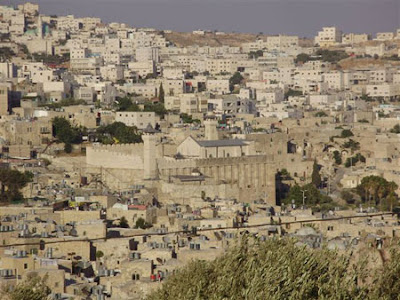
IDF troops arrested four 'Palestinians' on Sunday,
preventing a major terror attack against the Samaria military court in Jenin.
IDF soldiers captured close to a dozen pipe bombs at the Salem Crossing near Jenin in the northern West Bank on Sunday, thwarting what appears to have been a major terrorist attack, possibly against a nearby military court.
Four Palestinians were arrested at the crossing and were found to be in possession of 11 pipe bombs, a homemade pistol and a commando knife. They were transferred to the Shin Bet (Israel Security Agency) for interrogation.
The four were last in line to enter the Samaria Military Court when one of the soldiers stationed at the crossing, from the Military Police, spotted wires protruding from under his jacket.
The soldiers shut down the crossing and ordered the Palestinian to undress and discovered three pipe bombs. Another eight were discovered in his bag together with a homemade pistol, several bullets and a commando knife.
“I don’t remember such a large cache of bombs caught on one person,” Lt.-Col. Erez, commander of the Haruv Battalion said.
Three other Palestinians who were in line with the man carrying the weapons were also detained. The IDF suspects that the attack was planned against the Samaria Military Court, since the line the Palestinians were standing in only goes into the court and back out.
Hmmm.
Labels: Jenin, Palestinian terrorism
Why Juliano Mer-Khamis' murder is unlikely to be 'solved'

The Guardian reports that a leaflet in Jenin this week justified the murder of Juliano Mer-Khamis, the Jewish (via his mother), 'Palestinian' (via his father) theater director who was murdered in broad daylight in Jenin last week. That makes it unlikely that the 'Palestinian Authority' will bother trying to
punish the killer.
Inside the camp, rebuilt since its partial destruction in 2002, people were reluctant to speak about Mer-Khamis. A group of elderly women sitting by the roadside, gave their opinion: "God only knows what happened but the theatre was a shameful place."
A butcher was more forthcoming. Standing in a small room with a portrait of Saddam Hussein and a sparsely stocked cold cabinet, he said he and others were offended by the theatre. "We are Muslims. We have traditions. We looked for our children and found them at the theatre dancing. If he came here to bring jobs that would be good but instead he comes here to corrupt our girls and make women of our boys," he said.
The leaflet justifying the killing of Mer-Khamis also demands the closure of the theatre and other western organisations, including the British Kenyon Institute, under threat of "jihadi action".
The leaflet attacks Mer-Khamis for his belief in co-existence between Israelis and Palestinians, "as if we could live with those who stole our land and killed our children".
It goes on to attack his plays: "What kind of resistance [to occupation] is the play Animal Farm, which made the young men of Palestine bark like dogs and lick the ground in shame and the young women wear the costumes of pigs and roll around the ground in degeneracy?"
The leaflet describes Mer-Khamis as a Jew, a communist and an infidel. "He was not killed for a scene in a play. He was killed for the accumulation of his activities since he came here," it says.
Mer-Khamis's most recent project, Spring Awakening, is singled out for particular criticism. The play by Frank Wedekind was banned in Germany in 1891 for its portrayal of teenage sexuality. In recent years a musical adaptation won awards in London and New York.
The leaflet then refers to a telephone conversation between Mer-Khamis and the Arab-Israeli actor, Makram Khouri, in which Khouri advises his friend not to stage the play. According to theatre staff, very few people were aware of the conversation.
The leaflet then praises the man from Jenin refugee camp who carried out the killing. "He did not do it with a silencer, or in the dark but in broad daylight, face to face, and he made sure not to harm the woman and child who were in the car at the time," the leaflet says.
Palestinian police say that their investigation into the murder continues.
Islamic society kills those who do not conform. Literally. Why Mer-Khamis ever thought it would be otherwise is not clear.
Read the whole thing.
Labels: Islamic terrorism, Jenin, Juliano Mer Khamis, Palestinian intolerance
Jewish 'Israeli Arab' actor murdered in Jenin

Jewish 'Israeli Arab' actor
Juliano Mer Khamis was murdered by masked 'Palestinians' outside the theater company he founded in Jenin (northern Samaria) on Monday.
Mer Khamis, 52, was the son of a Jewish mother and an Arab father - a rarity in a land where the two populations almost never intermarry. His split identity fueled a long career as an actor and a vocal activist against Israel's policies toward the Palestinians, with whom he had come increasingly to identify.
But some Palestinians objected to the theater in principle. He reported threats, and the theater was vandalized.
The theater's program director, Samia Staiti, told The Associated Press that she saw the killing. "He was on his way to his car when a masked man stopped him, shot him and ran away."
Staiti said he had received death threats from people in the community who felt he was going against "conservative Palestinian traditions."
"They are trying to kill what Juliano tried to spread - peace and freedom. We will keep on going on," Staiti said.
He starred in several critically acclaimed Israeli films, and also appeared in the 1984 American film "The Little Drummer Girl."
In 2006, he opened an amateur theater company in Jenin, a city that had been torn by violence since the second Palestinian uprising began six years earlier.
With the uprising fizzling out by that point, the company, known as the Freedom Theater, was meant partly as a way of restoring normalcy to the town's youth and opening their minds to the world beyond the harshness of their surroundings.
In the largely quiet years since, Jenin - like much of the West Bank - has become more safe and prosperous, making Monday's shooting all the more shocking.
Mer Khamis was an
Israeli citizen.

Mer-Khamis' mother, Arna Mer, was an Israeli Jewish activist for Palestinian rights. His father, Saliba Khamis, was a Christian Palestinian. Mer-Khamis was born and raised in Nazareth.
...
Based in Israel, Mer-Khamis was affiliated with the local theater in Jenin, established by his mother in the 1980s. In 2006, Mer-Khamis opened the Freedom Theater in Jenin, along with Zakariya Zubeidi, the former military leader of the Al-Aqsa Martyr Brigades in that West Bank city.
Zubeidi was appointed co-theater director in an attempt to subdue the ongoing threats voiced against both the institution and Mer-Khamis. The theater itself was torched twice in the past, and the threats persisted despite Zubeidei's appointment.
Some of the criticism focused on the fact that the theater offered co-ed activities, despite prohibition in the Islamic moral code.
Objectors were also outraged when Mer-Khamis staged the play "Animal Farm", in which the young actors played the part of a pig, which Islam considers an impure animal.
Mer Khamis said he had planned to stage The Lieutenant of Inishmore, a satire of armed resistance, but shelved the idea after someone smashed the window of his car.
The real story here is that someone (Hamas?) is worried that Jenin isn't Islamist enough. But that's unlikely to get the international media too excited. It's not something for which Jews can be blamed.
Labels: Hamas, Jenin, Juliano Mer Khamis, Palestinian Islamization