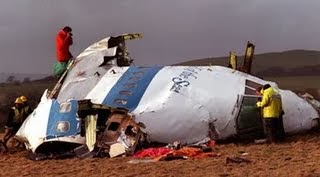
Iranian ex-spy: Khomeni ordered Pan Am 103 attack as revenge
A former Iranian spy who has defected to Germany claims that
Ayatollah Khomeni ordered the 1988 bombing attack on Pan Am Flight 103, which blew up over Lockerbie, Scotland, as revenge for the (accidental) downing of an Iranian airliner by the United States.
Let's go to the videotape.
The Lockerbie bombing was ordered by Iran and carried out by a Syrian-based terrorist group, a former Iranian intelligence officer has admitted.
Abolghassem Mesbahi, a defector to Germany, said Pan Am flight 103 was downed in 1988 in retaliation for a US Navy strike on an Iranian commercial jet six months earlier, in which 290 people died.
He claims the Ayatollah Khomeini, who was Iran’s Supreme Leader, ordered the bombing “to copy exactly what happened to the Iranian Airbus”.
Previously unseen evidence gathered for the aborted appeal hearing of Abdelbaset al-Megrahi, the former Libyan intelligence officer convicted of the bombing, supports Mr Mesbahi’s claim and suggests that the bombers belonged to the extremist group the Popular Front for the Liberation of Palestine – General Command (PFLP-GC).
Documents obtained by Al Jazeera television for a documentary called Lockerbie: What Really Happened? name key individuals said to be involved in the bombing, including the alleged bomb-maker, the alleged mastermind and the man who may have put the bomb on the doomed Boeing 747.
Read the whole thing. Hmmm.
Labels: Ahmed Jibril, Ayatollah Khomeni, Iran, Iran Air, Islamic terrorism, Libya, Pan Am 103, PFLP-GC
Fellow terrorist Ahmed Jibril said it too: Arafat had AIDS

In an earlier post, I linked to
this video interview with Arafat's personal physician, who said that Yasser Arafat had AIDS.
A month before that interview, Arafat's fellow terrorist Ahmed Jibril, the head of the PFLP-GC (Popular Front for the Liberation of 'Palestine' - General Command) told Hezbullah's al-Manar television that Arafat had AIDS. You can find that interview
here.
Viewed in context, the entire claim that Israel poisoned Arafat is part of a 'Palestinian' blood libel in which the 'Palestinian people' have never been given another narrative. Most 'Palestinians,' who view no media other than their own, have never heard anything other than 'the Israelis murdered Arafat.'
You can find a history of the Israel murdered Arafat libel
here.
Labels: Ahmed Jibril, blood libel, Palestinian incitement, Yasser Arafat
How we started trading terrorists for hostages

The man in the photo is
Ahmed Jibril, and he perfected the art of extracting 'Palestinian' terrorists in exchange for Israeli hostages (Hat Tip:
Gershon D).
In March 1978, at the conclusion of the Litani Operation in South Lebanon, five Israeli soldiers and a civilian jumped into a car and decided to go on an outing. The group took to the road in defiance of army regulations and somehow got waived through a forward checkpoint. Moments later they found themselves surrounded by heavily armed Palestinians. Four of the five soldiers were killed instantly, while the civilian miraculously made it back to Israeli lines the next day.
The fifth soldier was taken captive by the PFLP-GC, the Palestinian terror group headed by Ahmed Jibril. Up to that point, Israel had a firm policy of trading soldiers for soldiers. Terrorists sentenced to life in prison were expected to spend life in prison. Exchanges with terror groups sometimes occurred in hostage situations, but they were rare and always premised on trading one for one.
In 1970, an Israeli farmer in the northern village of Metulla was kidnapped by Palestinians and taken to Lebanon. The Palestinians demanded the release of dozens of jailed terrorists. The Israeli government held firm, and in the end the farmer’s release was secured for just one terrorist.
With this in mind, a team was assembled in Jerusalem in 1978 to negotiate the release of the soldier. A terrorism expert named Ariel Merari, circulated a memo that concluded the captured Israeli had “no market value.” Accordingly, he advised the government to set a low value and stick to it. Above all, he urged political leaders not to meet with the soldier’s family. Both pieces of advice were ignored. The family of the soldier first met with Defense Minister Ezer Weizmann. Merari later remembered that “Weizmann had a hard time standing up to the pressure, he folded, he promised and he declared that they had an open line to him whenever they wanted.” The same thing happened when the family met with Prime Minister Menachem Begin.
The initial offer from the Jibril camp was to swap the soldier for 19 Palestinians captured during the Litani Operation plus another six or seven in Israeli jails. It was deemed a reasonable offer. The 19 captured in the field were combatants, not terrorists, and the six or seven were all low value prisoners that were either sick or wounded.
Merari advised going slow. This was, after all, the way it worked in the Arab souk (market place). You showed little interest for what the other side was offering and then slowly negotiated your way to the finish line. Were Israel to accept the first offer, it would send the message that it would pay more. The general placed in charge of the negotiations wanted to wrap up the talks quickly and ignored this advice as well. With that, Merari tendered his resignation.
A year later, Merari was asked to return. Every dark prophecy of his had come true. The price from Jibril had climbed to the original 19 Palestinians captured in the field plus 76 terrorists held in Israeli jails, many of whom were murderers. Merari couldn’t believe his ears. He advised walking from the negotiating table, breaking off all contact. His advice was ignored once again. In the end, Jerusalem released the 19 combatants together with the 76 terrorists. Merari later calculated that the freed Palestinians had combined sentences remaining of over 2,800 years.
Ahmed Jibril had learned a valuable lesson. You didn’t need to hijack an airplane to free jailed terrorists. In fact, not only was it unnecessary, it was undesirable. When the Palestinians held large numbers of hostages, the Israelis sent in commandos to free them. When they held a single soldier, the Israelis refrained from any heroics because of the inevitable loss of life. The Israelis took four killed to free 106 hostages in Entebbe. But they wouldn’t take four killed to free just one soldier. Instead they gave in.
Read the whole thing.
The real question is how to put a stop to the madness. I have seen no suggestions for that other than 'just say no.' And it's been rare that suggestion has actually been implemented. I have been in this country for twenty years and I have only once seen Israel refuse to negotiate for a hostage's release: The
Nachshon Wachsman kidnapping.
Labels: Ahmed Jibril, Nachshon Wachsman, terrorists for Gilad trade
Funeral for Syrian 'Naksa day' victims turns into anti-Bashar protest

On June 8, I reported on the funerals of those Syrians killed in the 'Naksa day' attempt to breach Israel's borders with Syria. The funerals were reported to have deteriorated into a riot against the local 'Palestinian' terror groups - in particular the PFLP-GC - for
not organizing 'Naksa day' protests. There was
more to it than that.
An estimated 100,000 Palestinians – some two-thirds of the Yarmuk camp population – took part in the mass funerals, chanting slogans against the Syrian president: “Ya Bashar, ya Bashar, where, where are you? They massacred us under your eyes, where, where is the Syrian army, where are you?” Syria is home to some of the more extremist Palestinian organizations – from Hamas, which has its headquarters in Damascus, to the Popular Front for the Liberation of Palestine-General Command (PFLP-GC), led by Ahmed Jibril.
Jibril himself came to the funeral with a number of assistants and the leaders of several other extremist Palestinian organizations; however, when he tried to make a speech praising Assad and blaming Israel for the deaths, his voice was drowned by protests; he was asked to leave and let the dead be buried in peace. He refused to move, so the crowd started pelting his group with stones.
Soon the protest turned more violent, and protesters vented their anger on the PFLP-GC’s headquarters.
They burst into the offices and broke furniture before setting the place on fire. Two guards were killed in the onslaught; Jibril’s security officers opened fire, killing 14 protesters and wounding hundreds. Throughout the rioting, the masses yelled, “The people want an end to the factions” – that is, the many Palestinian groups active in Syria, meddling in their lives and fighting among themselves for influence – mimicking the call of the protesters in Cairo’s Tahrir Square, “The people want an end to the regime.”
What the refugees were saying was that they’d had enough of being manipulated by the Syrian regime through the 10 extremist Palestinian factions it supports and which do its bidding. Hamas chief Khaled Mashaal rushed to the camp in an attempt to appease protesters, but he was greeted by loud jeers and curses and was driven away.
Jibril is considered the most important of the leaders of the pro-Syrian factions; it is a well known fact that he has been acting for the Syrian government for the past 40 years. It transpired that he had been the principal mover in the planning of the mass demonstrations on the Golan on behalf of Assad, while, according to Arab media, it had been clear from the first that they were doomed to failure since Israel would not let its border be overrun. On Tuesday, the victims of the previous day were laid to rest; the heads of the factions stayed prudently away.
Some Arab media are saying there are many in the camps who feel solidarity with the Syrian protesters being massacred by the regime. In any case, the violent protests in this camp probably explain why Assad did not send more people to the Golan the following day and why his army restored the roadblocks on the road leading to it, which had been dismantled in advance of the Friday march to the border.
In the short run, don't expect to see more 'Palestinians' storming Israel's border with Syria.
In the longer run, this is quite intriguing. While the Arab countries are moving toward democracy and Islamism (and taking a harder line in favor of the 'Palestinians' - See Egypt for example), the 'Palestinians' themselves are waking up to the reality in which they are being used as pawns by the remaining Arab regimes, and may be more inclined to make a reasonable compromise with Israel, if only they had leaders capable of doing so.
Read the whole thing.
Labels: Ahmed Jibril, Golan Heights, Hamas, Naqsa day, Palestinian Authority, Palestinian refugees, PFLP-GC, Syrian uprising