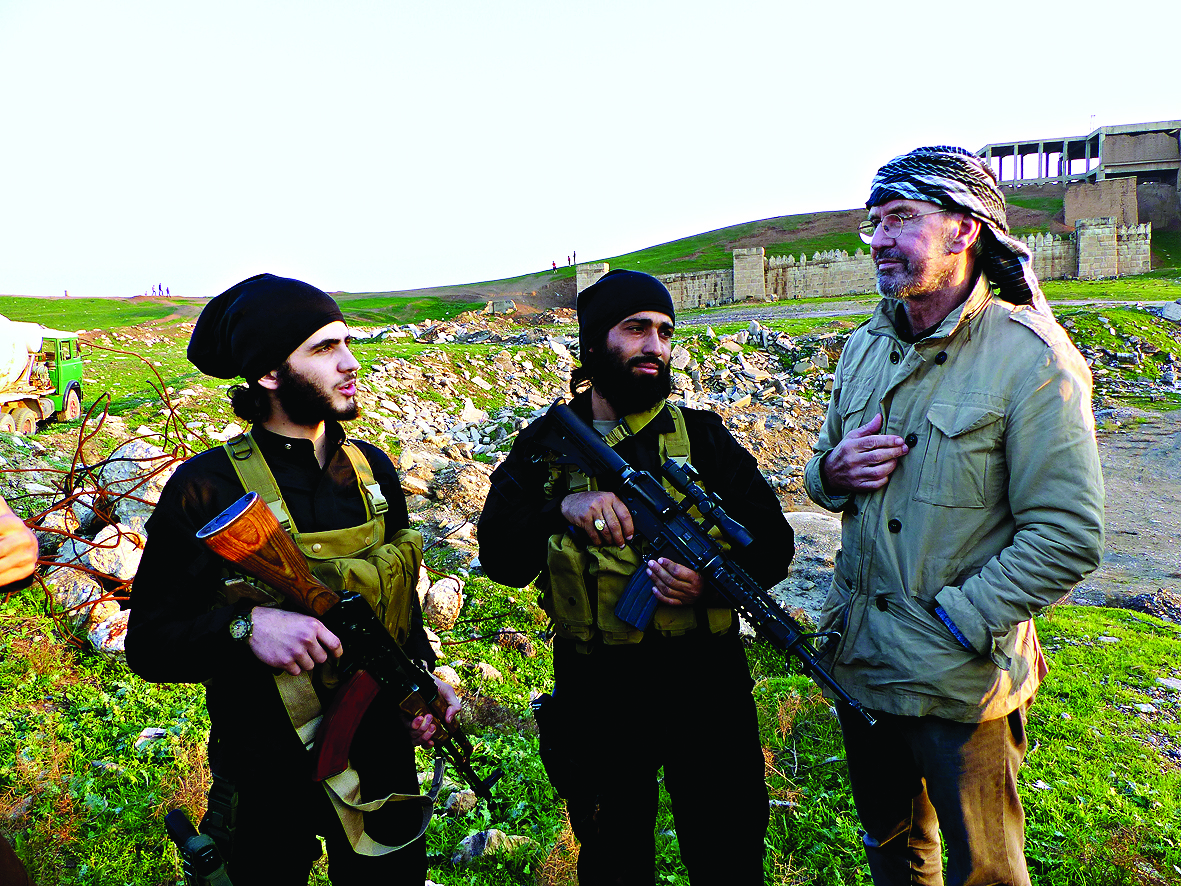
Israel's Channel 10 has a reporter in Mosul
Hmmm.
Labels: Channel 10, Iraq, ISIS, Islamic State, Mosul
Pass the popcorn....
Thirty-five years after the fact, Iraq plans to
sue Israel for destroying its Osirak nuclear reactor.
Iraq plans to sue Israel over the 1981 bombing of the Iraqi nuclear site Osirak, the deputy speaker of parliament, Humam Hamoudi, said in a statement.
The announcement, which was reported on Wednesday, comes just days after the 35th anniversary of the attack. Iraq's parliament has been working on initial steps for demanding compensation from Israel for several years.
The 1981 attack was condemned unanimously by the UN Security Council in resolution 487, which noted that the site was approved by the International Atomic Energy Agency. The resolution said Iraq was entitled to "appropriate redress."
I wonder how they think they're going to get jurisdiction over a sovereign state that's not willing to appear in court. Hmmm.
Labels: Iraq, nuclear weapons, Osirak
The only army ISIS fears is... not American or Russian... it's Israeli
German reporter Jurgen Todenhofer (right in the picture), who spent ten days with ISIS fighters around Mosul, Iraq, reports that there is only one army in the world that ISIS fears, and it's not American or Russian. It's Israeli.
It's the IDF.
The claim from German reporter Jürgen
Todenhöfer, a former member of the German Parliament, came after he
spent 10 extraordinary days behind enemy lines in Iraq and Syria,
accompanied by his son Frederic. He returned saying the group behind the
Paris attacks was “preparing the largest religious cleansing in
history” and with a “pessimistic” view on what can be done to combat it.
But the author of My 10 Days in the
Islamic State told Jewish News: “The only country ISIS fears is Israel.
They told me they know the Israeli army is too strong for them.”
IS branded the co-ordinated attacks on the French capital that claimed 132 lives as “the first of the storm”.
Todenhofer claimed it is part of ISIS’
tactics to lure in Western boots on the ground and capture US and
British soldiers. “They think they can defeat US and UK ground troops,
who they say they have no experience in city guerrilla or terrorist
strategies. But they know the Israelis are very tough as far as fighting
against guerrillas and terrorists,” he said.
“They are not scared of the British
and the Americans, they are scared of the Israelis and told me the
Israeli army is the real danger. We can’t defeat them with our current
strategy. These people [the IDF] can fight a guerrilla war.
“In Mosul there are 10,000 fighters
living among 1.5 million people in 2,000 apartments, not in one place –
so it would be difficult [for western soldiers] to fight them. ISIS
fighters are ready to die in a war against a western soldiers.”
...
The journalist – who had contact with
ISIS supporters from the media department, judges, fighters and leaders –
said the group wants to conquer all the Middle East – except Israel –
in the first stage of its fight.
The second stage is conquering the
West. “They are a very strong danger for Iraq, Syria, Jordan and Libya,
while the West will be subjected to big acts of terrorism instead of a
full blown ISIS war because they say they don’t want too many battles at
the same time.”
Perhaps those who called Prime Minister Netanyahu the
leader of the free world were not exaggerating. Hmmm.
Labels: Binyamin Netanyahu, IDF, Iraq, ISIS, Mosul
Israel sharing with France intel gleaned from eavesdropping on Syria and Iraq
The Europeans know
how to find us when they need us.
In a statement issued Saturday night about the Paris terrorism of the previous day, Israeli Prime Minister Benjamin Netanyahu said
that he had “instructed Israel’s security and intelligence forces to
assist their French counterparts and their counterparts from other
European countries in any way possible.”
Israel’s minister of intelligence, Yisrael Katz, later clarified
Netanyahu’s statement, telling reporters that intelligence cooperation
among Israel, France and other European countries is “ongoing,” but that
“intelligence material relevant to what happened has been relayed, and
we will also deepen the cooperation.”
Katz added that the information would help the French and
other countries deal with the aftermath of the attack and future
attacks, Reuters reported.
...
Israel’s Army Radio reported
Sunday that some intelligence may have come from Israel’s surveillance
of Syria and Iraq, two strongholds of the Islamic State terrorist group
that claimed responsibility for the Paris attacks.
Were it not for the fact that it's an Israeli interest to have these people neutralized, I would be inclined to tell the Europeans, 'you made your mess, now go lie in it.' (As my mother a"h would have said).
Labels: intelligence, Iraq, ISIS, Syria
Breaking: ISIS leader al-Baghdadi dead? UPDATED
The claim is that he was killed this morning when Iran bombed an ISIS convoy in Iraq. Stay tuned.
UPDATE 5:30 PM
Or maybe it wasn't Baghdadi.
Labels: Iran, Iraq, ISIS, Islamic State
Iraq sharing US (and Israeli?) intelligence with Russia?
The United States was caught totally flatfooted over the weekend after
Iraq entered into an intelligence sharing agreement with Russia.
Over the weekend, the Iraqi military’s Joint Operations Command announced that it would enter into an intelligence sharing agreement “about ISIS terrorism” with Syria, Russia and Iran.
Exactly what sort of information Iraq agreed to share with Russia, or
has shared already, was a matter of some confusion during Tuesday’s
Senate Armed Services Committee hearing. Deputy Defense Secretary Bob
Work acknowledged that the Defense Department doesn’t have a firm handle
on the sort of communications going on between the Iraqi government
and Moscow.
“We were caught by surprise that Iraq entered into this agreement
with Syria, Iran and Russia. Obviously, we are not going to share
intelligence with either Syria, or Russia, or Iran. So we are in the
process of working to try and find out exactly what Iraq has said.
Certainly we are not going to provide any classified information that
would help those actors on the battlefield.” Work said in response to a
question from Sen. Joni Ernst, R-Iowa.
Director of National Intelligence James Clapper said Russia was in
Syria primarily to bolster President Bashar al-Assad’s regime. Russian
President Vladimir Putin’s claims this week that his forces were in
Syria to defeat the Islamic State was, Clapper said, “a
belated motivation.”
Clapper suggested that mutual mistrust between the parties could
limit the scope of the Iraq’s intelligence sharing agreement. “As far as
the joint intelligence arrangement is concerned. Can’t go into detail
here in this forum … But each of the parties entering into this are a
little bit suspicious of just what is entailed here. We will have to see
how robust a capability that actually provides.”
U.S. Cyber Command commander and NSA
chief Adm. Michael Rogers identified Russia as probably the most
capable adversary the United States faces online. The recent breach of
the Joint Staff civilian email system, for instance, has been attributed
to a Russian affiliated group and affected as many as 4,000
email accounts.
In fiscal 2015, Congress appropriated more than $1.6 billion in train and equip funding
for the Iraqi military, including trucks and small arms but also some
potentially sensitive pieces of equipment related to improvised
explosive device detection. Detailed information about how U.S.
troops detect mines and explosive devices on the battlefield could
represent a vulnerability for the United States if that equipment were
to fall into the wrong hands. And then there are the people, more than
3,550 U.S. troops are in Iraq right now officially serving in train and assist roles. But that’s not all they do. In May, a U.S. Special Forces raid resulted in the death of Abu Sayyaf, an ISIS senior leader in Syria.
It's kind of hard to believe that Israel is not sharing intelligence with the US on an area that's quite close to our eastern and northern borders. Was our information shared too?
If you're looking for Obama, he's on the golf course, trying to find a way to blame Bush.
What could go wrong?
Labels: Barack Hussein Obama, cyberwar, intelligence, Iraq, ISIS, James Clapper, Russia, Syrian uprising
Aylan's father a people smuggler?
The Australian reports that a woman who was on the boat that capsized,
drowning the wife and two children of Abdullah Kurdi was being piloted by...
Abdullah Kurdi (Hat Tip:
MFS - The Other News). Yes, she is claiming that Abdullah Kurdi is a people smuggler.
Zainab Abbas said Abdullah Kurdi had lied to the world after the
image of his dead three-year-old son on a Turkish beach sparked a global
outpouring of support for Syrian refugees.
“Yes, it was Abdullah Kurdi driving the boat,” Ms Abbas told Network Ten through her cousin Lara Tahseen today.
Ms Abbas also lost two children when the boat capsized shortly after leaving Bodrum for the Greek islands.
After the tragedy, Mr Kurdi told the media he took over steering the boat after the captain panicked and jumped ship.
But
Ms Abbas said Mr Kurdi was the driver of the boat, and the man she paid
to book her passage told her it would be safe because the driver was
taking his wife and two children.
“When I lost my kids, I lost my life, how can he lie to the media?” her cousin Ms Tahseen said, translating for Ms Abbas.
“He said, ‘Please don’t dob me in.’ That was in the water.”
Ms Abbas said Mr Kurdi was speeding in the overcrowded boat, which did not have enough life jackets.
She said her husband told him to be careful just before the boat capsized, reportedly killing at least 12 people.
Ms
Abbas is now in Iraq and her family has called on the federal
government to include them in the 12,000 refugees Australia has pledged
to take in.
There are a lot of opportunistic people trying to use this to leave the Middle East for the West. And some of them belong to ISIS. What could go wrong?
Labels: Iraq, Pallywood, Syria, Syrian Kurds, Syrian refugees, Syrian uprising, Turkey
You call this an 'achievement'?
The Washington Post's Fred Hiatt discusses how President Hussein Obama has
lulled the American people into complacency about the ongoing tragedy in Syria (Hat Tip:
Memeorandum and many others).
Today the Islamic State is blowing up precious cultural monuments
in Palmyra, and half of all Syrians have been displaced — as if, on a
proportional basis, 160 million Americans had been made homeless. More
than a quarter-million have been killed. Yet the “Save Darfur” signs
have not given way to “Save Syria.”
One reason is that Obama —
who ran for president on the promise of restoring the United States’
moral stature — has constantly reassured Americans that doing nothing is
the smart and moral policy. He has argued, at times, that there was
nothing the United States could do, belittling the Syrian opposition as “former doctors, farmers, pharmacists and so forth.”
He has argued that we would only make things worse — “I am more mindful probably than most,” he told the New Republic in 2013, “of not only our incredible strengths and capabilities, but also our limitations.”
He
has implied that because we can’t solve every problem, maybe we
shouldn’t solve any. “How do I weigh tens of thousands who’ve been
killed in Syria versus the tens of thousands who are currently being
killed in the Congo?” he asked (though at the time thousands were not
being killed in Congo).
On those rare
occasions when political pressure or the horrors of Syrian suffering
threatened to overwhelm any excuse for inaction, he promised action, in
statements or White House leaks: training for the opposition, a safe
zone on the Turkish border. Once public attention moved on, the plans
were abandoned or scaled back to meaningless proportions (training 50 soldiers per year, no action on the Turkish border).
Perversely,
the worse Syria became, the more justified the president seemed for
staying aloof; steps that might have helped in 2012 seemed ineffectual
by 2013, and actions that could have saved lives in 2013 would not have
been up to the challenge presented by 2014. The fact that the woman who
wrote the book on genocide, Samantha Power, and the woman who campaigned
to bomb Sudan to save the people of Darfur, Susan Rice, could
apparently in good conscience stay on as U.N. ambassador and national
security adviser, respectively, lent further moral credibility to U.S.
abdication.
Most critically, inaction was sold not as a necessary
evil but as a notable achievement: The United States at last was
leading with the head, not the heart, and with modesty, not arrogance.
“Realists” pointed out that the United States gets into trouble when it
lets ideals or emotions rule — when it sends soldiers to feed the hungry
in Somalia, for example, only to lose them, as told in “ Black Hawk Down,” and turn tail.
...
When Obama pulled all U.S. troops out of Iraq, critics worried there
would be instability; none envisioned the emergence of a full-blown
terrorist state. When he announced in August 2011
that “the time has come for President Assad to step aside,” critics
worried the words might prove empty — but few imagined the extent of the
catastrophe: not just the savagery of chemical weapons and “barrel
bombs,” but also the Islamic State’s recruitment of thousands of foreign
fighters, its spread from Libya to Afghanistan, the danger to the U.S.
homeland that has alarmed U.S. intelligence officials, the refugees
destabilizing Europe.
Unfortunately, there are no longer any easy answers for Syria. Syrians are fleeing to Europe because they don't want to flee to Arab countries (looking at how the 'Palestinians' have been held hostage for more than six decades by their Arab brethren - including in Syria - they have no desire to follow suit) and because Europe is accessible and in some cases - notably Germany, but really all of them because of the Schengen visas - open. I don't expect this to end well. Germany is absorbing 800,000 Syrians, at least some of whom are likely to be
Islamic State terrorists. But even if that were not the case, the sheer number of 'refugees' would likely change the entire character of the German population.
I'm not suggesting that the United States take them in either. I don't think that any country should take in large numbers of them. Perhaps they should be dispersed all over the world, but only after ensuring that they don't include terrorists. The sad reality is that they likely do.
Obama could have stopped Assad in his tracks four years ago. He could have supported the Nusra Front before it became radicalized. He could have left US troops in Iraq (which he dogmatically - there is no other word - insisted on withdrawing despite all indications of a resulting disaster), and thus prevented the rise of ISIS on Syria's border. Instead, he
kissed up to Assad, insisting on
sending an ambassador to Syria, all in the interest of the one foreign policy goal about which Obama has been consistent:
Destroying the State of Israel. (God Forbid).
Read the whole thing.
Labels: Barack Hussein Obama, Golan Heights, Iraq, ISIS, Islamic State, Nusra Front, Obama's obsession with Israel, Robert Ford, Syrian refugees, Syrian uprising
Must read: How Obama is enabling the Syrian genocide
Until I read this article, I thought that Assad and Islamic State were enemies - both evil but nevertheless enemies (not uncommon here in the Middle East). I've had my eyes opened. I've also had my eyes opened to the bogus nature of the Obama administration's claims that it is working with Iran to help defeat Islamic State.
The truth - and it has become clear to me for the first time - is that Bashar al-Assad, who is Iran's most loyal client, and the Islamic State have an unwritten, unspoken agreement not to fight each other, so as to ensure that only the two will remaining standing once hundreds of thousands more Syrian civilians are murdered. And the Obama administration - through its feckless pursuit of a legacy nuclear deal with Iran -
has become Assad's and ISIS's number one enabler.
Every barrel bomb dropped on defenseless civilians by regime
helicopters is a recruiting gift to Baghdadi, the head of a vicious
criminal enterprise that combines the worst aspects of al Qaeda and
Saddam Hussein’s Baathism. Every Syrian child killed by barrel bombs or
starved to death by regime sieges convinces others that if the
“international community” can muster nothing but words, perhaps the
self-styled caliph can offer protection. Eager to help rid its Syrian
client of credible, nationalistic opponents, Iran consciously supports a
program of mass murder that only gives Baghdadi power in Syria and in
the Sunni Muslim world at large.
For Obama, who has said that his goal is to “degrade and ultimately destroy”
an organization known variously as the Islamic State, ISIL, ISIS, and
Daesh, Assad’s atrocities ought to provoke a reaction that extends
beyond the same tired rhetoric. They do not. This is because Iran — the
object of the administration’s courtship — is fully enabling the mass
homicide strategy of its Syrian client.
In
its single-minded pursuit of a nuclear agreement with Iran, the Obama
administration adopted a Syria policy rich in rhetoric and empty of
substantive action. Until June 2014, when the Islamic State used
its bases in Syria to overrun much of Iraq, the administration could use
the indifference of the U.S. and European publics to Syria’s agony to
duck the fact that Assad had continuously undermined the White House’s
credibility — ignoring the president’s loose talk about how Assad had
lost legitimacy and the chemical “red lines” that ought not be crossed.
Getting a legacy-boosting nuclear deal with Iran was everything for
the Obama administration. Nothing should be done in Syria that would
offend Iran’s supreme leader, Ayatollah Ali Khamenei, or the Islamic
Revolutionary Guard Corps’ support for Assad’s mass murder strategy.
Offending them — or so the theory went — might cause Iran to walk away
from the nuclear talks and forsake a monetary cornucopia in sanctions
relief and foreign direct investment.
Public indifference toward Syria’s hellish humanitarian crisis still
prevails. But by committing the United States to a war against the
Islamic State, the administration found its task complicated by the fact
that Assad’s atrocities and his lack of legitimacy had created the very
vacuum in eastern Syria filled by Baghdadi and his followers. From the
beginning of the uprising, Assad had proclaimed himself a bulwark
against terrorists: Yet even as his forces gunned down peaceful
demonstrators, he ejected extremists from regime prisons, seeking to
inject them directly into the bloodstream of the revolution. The Islamic
State became the Assad regime’s enemy of choice; an adversary that
would supplement regime attacks on nationalist rebels, only engaging
regime forces in combat when they sat atop something they wanted, such
as an oil field, a military base replete with weapons stockpiles, or a
town filled with priceless antiquities.
This symbiotic relationship enabled the Islamic State to sweep
through much of Iraq in June 2014, pulling American combat aviation and
ground forces back into Mesopotamia and the Levant. Iranian fingerprints
were all over the Assad regime’s scorched-earth policies, which enabled
this catastrophe. In a diplomatic tactic designed to advance the
nuclear talks, the Obama administration pretended that Washington and
Tehran were essentially on the same page with respect to the Islamic
State. But they were not, and they are not.
Iranian policies in Syria and Iraq have made vast swaths of both
countries safe for jihadis. This is an awkward fact for the Obama
administration: It now seeks, as part of its strategy to move forward
with the nuclear deal it struck with Tehran, to convince Congress that
it is not in fact blind to Iranian depredations in Syria and elsewhere
in the region. Thus far, the convincing has been all talk, and that is
why it is falling short.
Read the whole thing.
Labels: Barack Hussein Obama, Bashar al-Assad, Iranian nuclear threat, Iraq, Islamic State, Nusra Front, Syria, Syrian uprising
They're passing the popcorn - 'Palestinians' being ethnically cleansed
Khaled Abu Toameh reports that the 'Palestinians' are being ethnically cleansed, and instead of howling in protest, the 'international community' is
passing the popcorn and watching.
The Palestinians in Iraq are now also paying a heavy price. Since
2003, the number of Palestinians there has dropped from 25,000 to 6,000.
Palestinian activists say the Iraqis are waging a campaign of ethnic
cleansing against the country's Palestinian population.
The activists say that since the collapse of Saddam Hussein's regime,
Shiite militias in Iraq have been systematically attacking and
intimidating the Palestinian population over the past decade, prompting
many to flee.
The Shiites, they say, are opposed to the presence of non-Iraqi
Sunnis, including the Palestinians, in their country -- especially in
the capital, Baghdad.
In addition, they say, many Sunnis in Iraq who had opposed Saddam
Hussein have also been waging war on the Palestinians, in retaliation
for their support for him.
Thamer Meshainesh, head of the League for Palestinians in Iraq, was quoted
a few days ago as saying that Palestinians were facing "unprecedented
violations" and "increasing assaults." He warned that Palestinians in
Iraq were being targeted by various militias as part of a systematic
policy to expel them from the country.
...
The Palestinians in Iraq are paying the price for meddling in the
internal affairs of the country. This is what also happened to
Palestinians in Syria, Lebanon and Libya. Palestinians often find
themselves involved, both directly and indirectly, in the rivalries that
take place inside Arab countries. And when the fire reaches them, they
start screaming for help, as is the case today in Iraq.
Is that why the 'international community' doesn't care - because the 'Palestinians' interfered in Iraqi affairs and therefore have it coming to them? Umm... no....
But what is most interesting is the complete indifference displayed
by international human rights organizations, the media and the
Palestinian Authority toward the mistreatment of Palestinians in Arab
countries.
The PA, whose leaders are busy inciting against Israel on a daily
basis, does not have time to care about its people in the Arab world. PA
leaders say they want to press "war crimes" charges against Israel with
the International Criminal Court because of last year's war with Hamas
and continued construction in West Bank settlements.
However, when it comes to ethnic cleansing and torture of
Palestinians in Arab countries such as Iraq, Syria and Lebanon, the
Palestinian Authority leadership chooses to look the other way.
Similarly, the international media seems to have forgotten that there
are tens of thousands of Palestinians living in various Arab countries.
The only Palestinians that Western journalists know and care about are
those living in the West Bank and Gaza Strip.
International journalists do not care about the Palestinians in the
Arab world because this is not a story that can be blamed on Israel. An
Arab killing or torturing an Arab is not an item worth publishing in a
major newspaper in the U.S., Canada or Britain. But when a Palestinian
in the West Bank complains against the Israeli authorities or Jewish
settlers, many Western journalists waste no time rushing to the scene to
cover this "major" development.
Some might call the differing attitude toward alleged 'Palestinian suffering' in Israel v. the Arab countries anti-Semitism.
Read the whole thing.
Labels: Iraq, Khaled Abu Toameh, Kuwait, Lebanon, Palestinian Authority, Palestinians, Saddam Hussein, Syria
Iran prepares for hell
It's kind of hot here in Jerusalem today, but nowhere near as hot as in Iran (it's dry heat here in Jerusalem), where it's
hot enough to prepare for hell.
Due to extreme heat and humidity, Bandar Mahshahr registered an
apparent temperature of 154 F (68 C) on Thursday. "That was one of the
most incredible temperature observations I have ever seen and it is one
of the most extreme readings ever in the world," stated AccuWeather
Meteorologist Anthony Sagliani.
However, such an exceptional apparent temperature outdid itself on Friday.
The combination of an actual temperature of 115 F (46 C) and a dew
point temperature of 90 F (32 C) pushed the apparent temperature to 163 F
(73 C) Friday afternoon local time. This reading would have been even
higher if a breeze was not blowing, a factor in the calculation of the
apparent temperature.
"A strong ridge of high pressure has persisted over the Middle East
through much of July, resulting in the extreme heat wave in what many
would consider one of the hottest places in the world," stated Sagliani.
Amid this heat wave, Baghdad experienced its all-time record high on Thursday when temperatures soared to 124 F (51 C).
"Around the Persian Gulf, where water temperatures are in the lower
to middle 90s (30s C), the extreme heat combines with incredibly high
humidity to produce astounding apparent temperatures," Sagliani
continued in regards to the exceptional feeling heat around Bandar
Mahshahr.
There's no relief expected anytime soon.
Hell indeed.
Labels: Iran, Iraq
Longest-serving US commander in Iraq: 'We could have stopped ISIS'
Ray Odierno, the US Army Chief of Staff and the longest-serving US commander in Iraq, has told Fox News that the United States could have stopped Islamic State from destroying Iraq and Syria if the US had
kept troops on the ground (Hat Tip:
Memeorandum).
“It's frustrating to watch it,” Odierno said. “I go back to the work
we did in 2007, 2008, 2009, and 2010 and we got it to a place that was
really good. Violence was low, the economy was growing, politics looked
like it was heading in the right direction.”
Odierno said the fall of large parts of Iraq was not inevitable,
reiterating concerns about the pace of the U.S. troop withdrawal there.
“If we had stayed a little more engaged, I think maybe it might have
been prevented,” he said. “I've always believed the United States played
the role of honest broker between all the groups and when we pulled
ourselves out, we lost that role.”
In 2009, while still the top commander in Iraq, Odierno recommended
keeping 30,000-35,000 U.S. troops after the end of 2011, when the U.S.
was scheduled to pull out. The recommendation was not followed.
“I think it would have been good for us to stay,” Odierno said, when asked if it was a mistake to pull out.
Further, when ISIS took over large portions of Iraq last year
including its second-largest city, Mosul, the White House apparently
didn’t reach out to the Army officer who had spent more time commanding
U.S. forces than anyone else.
“All my work was given to [Joint Chiefs] Chairman [Martin] Dempsey,”
Odiernio said. “I never talked directly to the president about it at
that time, but I talked to the secretary of defense and I'm sure he
relayed all of my thoughts,” he added.
Odierno, though, is most worried about the deep cuts to the Army over
the past four years – from 570,000 troops in 2010 to near 490,000
today, a reduction of 14 percent. And the cuts are getting deeper.
“In my mind, we don't have the ability to deter. The reason we have a
military is to deter conflict and prevent wars. And if people believe
we are not big enough to respond, they miscalculate,” Odierno said.
Earlier this month, the Army announced an additional cut of 40,000
troops, which would take the Army down to 450,000 soldiers -- or
pre-9/11 levels -- the result of a decision taken two years ago.
"I believed at the time we could do that,” said Odierno. “But I said
we were on the razor’s edge that we could actually do our mission at
450.”
He added: “Two years ago, we didn’t think we had a problem in Europe.
… [Now] Russia is reasserting themselves. We didn’t think we’d have a
problem again in Iraq and ISIS has emerged.
“So, with Russia becoming more of a threat, with ISIS becoming more
of a threat, in my mind, we are on a dangerous balancing act right now
with capability.”
“When we go to 450, we are going to have to stop doing something," said Odierno.
What could go wrong?
Surprisingly, Odierno is in favor of the sellout to a nuclear Iran despite his admission that Iran is unlikely to change its behavior - maybe he figures it's something the US cannot stop anyway.
Labels: Barack Hussein Obama, Iranian nuclear threat, Iraq, ISIS, Islamic State, Syria, US Army
It's come to this: US forces sharing Iraqi base with Iran and Hezbullah
Josh Rogin and Eli Lake report that the United States is
sharing the Taqqadum military base in Iraq with Iranian and Hezbullah forces.
Two senior administration officials confirmed to us that U.S.
soldiers and Shiite militia groups are both using the Taqqadum military
base in Anbar, the same Iraqi base where President Obama is sending
an additional 450 U.S. military personnel to help train the local
forces fighting against the Islamic State. Some of the Iran-backed
Shiite militias at the base have killed American soldiers in the past.
Some inside the Obama administration fear that sharing the base puts
U.S. soldiers at risk. The U.S. intelligence community has reported back
to Washington that representatives of some of the more extreme militias
have been spying on U.S. operations at Taqqadum, one senior
administration official told us. That could be calamitous if the fragile
relationship between the U.S. military and the Shiite militias comes
apart and Iran-backed forces decide to again target U.S. troops.
American critics of this growing cooperation between the U.S.
military and the Iranian-backed militias call it a betrayal of the U.S.
personnel who fought against the militias during the 10-year U.S.
occupation of Iraq.
“It’s an insult to the families of the American soldiers that were
wounded and killed in battles in which the Shia militias were the
enemy,” Senate Armed Services Chairman John McCain told us. “Now,
providing arms to them and supporting them, it’s very hard for those
families to understand.”
The U.S. is not directly training Shiite units of what are known as
the Popular Mobilization Forces, which include tens of thousands of
Iraqis who have volunteered to fight against the Islamic State as well
as thousands of hardened militants who ultimately answer to militia
leaders loyal to Tehran. But the U.S. is flying close air support
missions for those forces.
The U.S. gives weapons directly only to the Iraqi government and the
Iraqi Security Forces, but the lines between them and the militias are blurry. U.S. weapons often fall into the hands
of militias like Iraqi Hezbollah. Sometimes the military cooperation is
even more explicit. Commanders of some of the hardline militias sit in
on U.S. military briefings on operations that were meant for the
government-controlled Iraqi Security Forces, a senior administration
official said.
In an email, Omri Ceren of The Israel Project adds:
A parade of horribles. From a political perspective, the U.S. is sharing a base with Iran-backed Shiite militias that killed American troops, which will be toxic publicly and on the Hill. From a military perspective, the U.S. is allowing itself to be spied on by groups that could use that intelligence if they're unleashed on American troops by Iran, which may deter the Obama administration from pressuring Tehran. And from a diplomatic perspective, the scoop will confirm fears across the region that the U.S. is realigning with Iran – or that, at the very least, Washington is literally and figuratively providing fuel for Iran's expansionist campaign across the region:
The U.S. is not directly training Shiite units of what are known as the Popular Mobilization Forces... but the U.S. is flying close air support missions for those forces. The U.S. gives weapons directly only to the Iraqi government and the Iraqi Security Forces, but the lines between them and the militias are blurry. U.S. weapons often fall into the hands of militias like Iraqi Hezbollah. Sometimes the military cooperation is even more explicit. Commanders of some of the hardline militias sit in on U.S. military briefings on operations that were meant for the government-controlled Iraqi Security Forces, a senior administration official said... “There’s no real command and control from the central government,” one senior administration official said. “Even if these guys don’t attack us... Iran is ushering in a new Hezbollah era in Iraq, and we will have aided and abetted it.”
The fears have straightforward implications for the viability of any nuclear agreement with Iran.
Everything - everything - relies on Saudi Arabia not nuclearizing in the aftermath of an agreement later this month. If the Saudis take a pass, then maybe a deal can hold for a time. If they purchase a weapon from Pakistan or build a bomb over the medium term, then no force in the world short of a military campaign could prevent the IRGC from matching their capabilities. No one pretends that the Iranians will sit on the sidelines while the Saudis go nuclear. That scenario then becomes the worst of all worlds: the administration will have seeded a polynuclear Middle East, detonated Washington's alliances with its traditional allies, and shredded the sanctions regime - and it won't even have a denuclearized Iran to show for it.
The Saudis have been very clear about their decision calculus: they'll go nuclear not when Iran goes nuclear, but when Riyadh concludes that it's inevitable that the Iranians will go nuclear. They're not going to wait.
The Obama administration has rolled out three arguments for why that's not going to happen, at the risk of losing the ability to rationalize the JCPOA. The first is that the Saudis are too poor to go nuclear, which is difficult to square with the existence of the North Korean program. The second is that the Saudis are too afraid of an international oil embargo to go nuclear, which is an argument that - generously - does not immediately strike analysts as in line with geopolitics as it works in our reality.
The third is that American security assurances to the Gulf - specifically, that Washington will continue to push back against Iranian regional expansionism - will sufficiently reassure that Arab states that they don't have to chart their own course. But those security assurances can't survive revelations that we're aiding Iran in creating the “Hezbollah era in Iran [I think that should be "Hezbollah era in Iraq. CiJ].” And when they do fail the Saudis will go nuclear and the Iranians will back out of the JCPOA to match. Instead of a status quo of no deal and no nukes, it'll be a Middle East of no deal and lots of nukes - and in the meantime, the U.S. will have squandered decades-old alliances and the painstakingly-built international sanctions regime against Iran.
It will be interesting to see if, by tomorrow, the administration has settled on how its intends to address the scenario.
Read the whole thing.
Labels: Barack Hussein Obama, Hezbullah, Iran, Iranian nuclear threat, Iraq, Pakistan, Saudi Arabia
Planning for a post-Obama world
A fascinating piece in the American Thinker this morning about how to
clean up the Middle East post-Obama. A couple of highlights.
The chief new reality is the de facto coalition among Israel, Egypt, and the Sunni Gulf states. This comprises a potential new source of stability in the region, a stability that has been lacking since the collapse of the Ottoman imperium. The dream of an Arab equivalent of Europe -- a region of independent nation-states united through ethnicity and religion -- lies in ruins. The possibility that it can revived are minimal. Libya, Syria, and Yemen are all failed states and, left to themselves, the UN, or Europe, will remain that way. The fantasy of nation building was punctured by Iraq and Afghanistan. These people are not only incapable of governing themselves, they are incapable of maintaining a viable social system. This role must be filled by an overarching power, as it was by the Ottomans and the European imperialists.
It must be done because we require order. This is not the 19th century. The Jihadis have clearly demonstrated a global reach. They can get at any target anywhere simply by parasitizing well-established Western communications and transportation systems. The sole way to deny them this capability is through control of the failed states that act as incubators for their mujahedin.
...
The two major goals in the Mideast are the defeat of the Jihadis and the denial of Iranian hegemony. The coalition can encompass both, with support from interested Western powers. Despite all the appeasement rhetoric, the Iranian nuclear threat can be shut down in short order. No one has considered the possibility that Israel might utilize tactical nukes fitted to bunker-buster warheads. These would “drill” deeply into the overhanging mountains before detonating, rendering the Iranian nuclear program unsalvageable with little in the way of fallout or residual radiation. This would a bold step on the part of Israel, but existential challenges encourage that kind of thing. Sanction from the Gulf States is likely to be easily obtained.
Iran would attempt to close the Strait of Hormuz, but in the age of fracking, this is nowhere near the threat it once was. Fracking could take up a large part of the oil shortfall within months. There would be a serious economic earthquake, but the West has it coming.
Turning to the Jihadis, the long war, which the U.S. and Europe have proven incapable of maintaining, would probably be best fought by nations in the area. Saudi Arabia has valuable knowledge about these people. Israel has one of the most effective intelligence agencies in the world. Pooling their efforts should bring results that would difficult for outside actors to match. The current collaboration between the Israelis and the Egyptians could act as a model here.
Failed states such as Syria and Yemen are likely to remain non-nations on the Somalia model. As such, they will have to be controlled. Civilized forces will need to enter these degraded pea-patches on an irregular basis on punitive missions, much the same as the British mounted expeditions into Afghanistan and Somalia during the imperial period. (Libya is different, virtually bordering on the West as it does -- it must be brought under control, the sooner the better.)
This is effectively a form of neocolonialism, one that should be carried out by locals with a deep understanding of the stakes. It could of course, be “better,” in the abstract, if Somalis and Syrians could govern themselves, but they can’t, and that’s the end of it. They are a problem, and a new Mideast coalition offers a solution. Such a coalition will share goals with the West: elimination of the Iranian threat, destruction of ISIS and similar Jihadi gangs, and beyond that, a new status quo. While such a solution is far from perfect, it is the best that can be expected from a horrendous situation.
What would the U.S. role be? Basically, everybody’s benign uncle. To act as an honest broker, mentor, and guide for both sides, to ease the natural conflicts between Jewish and Arab interests, to work out strategies and policies, and nudge either side in the right direction.
Even this is asking too much at this point. Obama has, of course, downgraded the U.S. relationship with Israel even as the new modus vivendi has been working itself out -- a remarkable development that he has ignored. There’s nothing that reveals Obama’s utter fatuity more than this.
Of course, if Hillary Clinton becomes President, things might not be any better. What could go wrong?
Read the whole thing.
Labels: al-Qaeda, Barack Hussein Obama, Egypt, Gulf states, Hillary Clinton, Iran, Iranian nuclear threat, Iraq, ISIS, Islamic State, Israel, jihad, Libya, Middle East, Saudi Arabia, Syria, Yemen
Saudi ex-General tells Israel time to carve up Turkey, Iraq and Iran to create Kurdistan
This actually sounds like real politique and not like it's coming out of a desire to do right by the Kurds. Still, it speaks volumes about Saudi fears of Islamist extremism (both Sunni and Shia) and about burgeoning Saudi relations with Israel.
Hmmm.
Labels: Iran, Iraq, Kurdistan, Saudi Arabia, Turkey
Islam is oh so tolerant... hundreds of Muslims gather to watch ISIS throw gay man off building roof
Israel's annual
gay pride parade will take place in Tel Aviv next Friday. Meanwhile, a few hundred miles away in Tikrit, Iraq, hundreds of Muslims gathered (see above) to watch
a gay man be thrown from the rooftop of a building to his death by the Islamic State terror organization (ISIS).
But the counterposing of those two data points won't stop the gay community worldwide from
attacking Israel and supporting the 'Palestinians' and the Muslim world in general.
And it won't stop
mendacious Jewish and Israeli academics from accusing the Jewish state of '
pinkwashing.'
It's confirmed: The world has gone mad.
Labels: defenestration, gays, Iraq, ISIS, Islam, Islamic State, pinkwashing, Tel Aviv
Obama's Middle East policy collapse a question of priorities
John Hinderaker takes note of the collapse of President Obama's (@potus) Middle East policy, highlighted by what appears to be an
imminent Islamic State takeover of Iraq (Hat Tip:
Memeorandum).
The “sovereign, stable and self-reliant Iraq” that Barack Obama and
Joe Biden hailed as one of Obama’s “great achievements” in 2014 has
regressed into chaos as a result of Obama’s premature withdrawal of
American troops. But it isn’t just Iraq. Syria is the closest thing to
Hell on Earth. Iran is working away on nuclear weapons and delivery
systems. Yemen has fallen to Iran’s proxies. Saudi Arabia is looking for
nuclear weapons to counter Iran’s. ISIS occupies an area the size of
Great Britain. Libya, its dictator having been gratuitously overthrown
by feckless Western governments that had no plan for what would follow,
is a failed state and terrorist playground.
It seems as though things couldn’t possibly get worse, but they
almost certainly will. We are seeing the fruit of a set of policies that
were based on the false premise that problems in the Middle East are
mostly the fault of the United States. Not only were such policies
misbegotten, they have been executed incompetently. The resulting
collapse is occurring with sickening speed.
John doesn't even mention that none of these hotspots is President Obama's priority for the Middle East. Indeed, the President's priority for the Middle East - indeed for all his foreign policy - is the creation of a '
Palestinian state,' which he apparently sees as a panacea for all his foreign policy miscues. He has gone so far as to threaten the new Netanyahu government with the
withdrawal of support for Israel at the United Nations.
That'll stop Islamic State, clean up Syria and convince Iran not to develop nuclear weapons....
What could go wrong?
Labels: Barack Hussein Obama, Iranian nuclear threat, Iraq, ISIS, Islamic State, Libya, Middle East peace process, Palestinian state RIGHT NOW syndrome, Saudi Arabia, US foreign policy, Yemen
For those who don't get it yet...
In an interview with Max Fisher, Michael Doran, who oversaw Middle East policy on George W. Bush's
National Security Council from 2005 to 2007 and is currently a scholar
at the Hudson Institute, explains why President Obama's agreement with Iran is a
bad deal.
Max Fisher: Whatever the end strategic goal,
certainly there may at some point be an agreement on arms control. And a
goal of that is for Iran to surrender its ambitions for a nuclear
weapon. That specific objective seems worthwhile, but is it achievable?
Michael Doran: I don't think it is
achievable without a significant coercive component. I think this is one
of the most faulty assumptions of the administration. What makes the
administration believe Iran has made a strategic shift away from a
desire to have, if not a weapon, then a turnkey capability?
I rarely see any attempt to analyze these negotiations from the
Iranians' point of view and to ask, "What are their fundamental goals,
and why do these negotiations make sense to them?" In that context, I
don't believe they have made a strategic shift, and I don't see why the
administration believes they have.
If the argument is that the very willingness of the Iranians to sit
down and negotiate with us and to stick to the agreement over the last
18 months is proof of a strategic change of some kind, I don't buy it
for a second. It's just proof to me that they want sanctions relief and
they're going to get it, and they see that they're going to get it, and
they will stick with this process as long as they get direct, immediate,
and very desirable benefits from it.
Max Fisher: What is it about Iran, you think,
that makes it so bent on a nuclear weapons program that it would take so
much to deter them from that?
Michael Doran: First of all, there's just
the record of what they've done. They have pursued this program
doggedly and at enormous cost to themselves. They have been willing to
take their economy to the brink of disaster in order to preserve this
program.
They belong to a category of regimes, like the North Koreans, that
calculates that if they can get this weapon then the world will treat
them differently.
We need to look at the fundamental nature of the regime, the ideology
of the Islamic Republic, and the mindset of the men who run it. They
have a very well-known ideology that is hostile to the American order,
that is hostile to the system in the region. They have a vision of
Iran's place in the world, in the Islamic world especially, that they
have not given up on.
If I were going to talk about basic assumptions
of the Obama administration that are wrong, one is that Iran is a
fundamentally defensive power. This reads Iran's nuclear program in a
rather bilateral fashion, to think that a show of a desire to cooperate
and find common ground on the part of the United States would generate
an equal and opposite reaction on the Iranian side.
In fact, the starting point is that the Iranians want hegemony in the
region, and they're reading American policy with respect to their
regional aspirations. The goal of Iran's nuclear weapons program is not
to defend against the United States or Israel — it's to advance its
regional agenda.
From an American point of view, in 2011 or 2012 we had them in a very
advantageous position. Because the sanctions were really biting.
Max Fisher: But the size of Iran's nuclear program was growing, the number of centrifuges was growing.
Michael Doran: But at a greater and greater cost to them, every step they took.
...
Max Fisher: I wanted to ask you about that,
about coercion. Under any reading of what Iran ultimately wants, their
incentive to stick to a nuclear deal would be the fear that if they
cheat, they'll be caught and then they'll be punished for it.
Arms control analysts I've spoken to say the inspections regime
described in the framework would be very effective at catching Iran if
it cheats. But they acknowledge that the agreement is not going to talk
about enforcement — it's not going to spell out what happens if Iran
cheats — because that's just not how these agreements work.
So then you have this big question mark of what happens if Iran gets
caught cheating. It's not just us wondering; the Iranian leaders are
surely gaming this out, as well. And I honestly
don't feel like I know what the answer is.
Michael Doran: First of all, I thank you for asking the question, because I think it is the crucial question.
The way the president has set this up, he has incentivized Iran to
pocket huge benefits up front. This has put them in a position to be
able to go for a bomb when they want in a position of much greater
economic strength and diplomatic strength. Because the very process of
the negotiation is destroying the sanctions regime we established, which
is the greatest nonmilitary instrument we have for coercing them. This
is the fundamental flaw at the heart of the coercion strategy.
He's going to use his waiver authority to free up all this money that
is in escrow accounts across the globe that is going to pour into
Iranian coffers nearly immediately. At the same time, the United Nations
Security Council is going to bless the agreement, which is then going
to free up the Europeans and others, including the Russians and the
Chinese, to engage in commercial activity with the Iranians. And so we
will have effectively gutted the sanctions regime.
Iran's status in the international community is going to be greatly
improved, and then there's going to be an international commercial lobby
and a diplomatic-military lobby, which includes the Chinese and the
Russians, in favor of the new order in which Iran is a citizen in good
standing in the international community that they can do business with.
Two comments: First, I am not as confident as Doran is that Iran is a rational actor that would scale back to suspend the nuclear program in response to crippling sanctions or a military strike. They didn't stop it for very long (if at all) in 2003 in response to the US targeting Saddam, and they didn't stop it in 2011-12 when the sanctions were at their most crippling.
Second, it bears pointing out that if Obama had not insisted against all advice and all rationality on withdrawing US troops from Iraq (a decision that he apparently made before ever receiving a national security briefing, although I'm not sure how much of a difference that would have made given Obama's inclinations and tendencies), there never would have been a situation where the US would have 'needed' Iran to control ISIS in Iraq. As I pointed out a couple of days ago, many of the people behind ISIS are
former Saddam officials who were likely underground so long as there was a US presence in Iraq.
Read the whole thing.
Labels: Ayatollah Ali Khameni, Barack Hussein Obama, Iran sanctions regime, Iranian nuclear threat, Iraq, Islamic State, P 5+1, Saddam Hussein
Must read: Who is Islamic State?
They are led by former officers in Saddam's regime. They aren't very Islamic. And their spying techniques would put George Orwell's 1984 protagonists to shame.
Those are some of the tidbits I gleaned from
this article about the inner workings of Islamic State.
Especially if you, like me, feel like you need a scorecard to understand what's going on in Iraq and Syria,
read the whole thing.
Labels: Bashar al-Assad, Free Syrian Army, Iraq, Islamic State, Islamic terrorism, Nusra Front, Saddam Hussein, Syria
Petraeus: 'I know the real enemy and it's Iran'
In a wide-ranging interview with the Washington Post, Retired General David Petraeus has contradicted the Obama administration, saying that
Iran is part of the problem in the Middle East, and not part of the solution.
"The current Iranian regime is not our ally in the Middle East. It
is ultimately part of the problem, not the solution," Petraeus said in a
wide-ranging response to written questions from
The Washington Post for a story published Friday.
"The
hard-earned progress of the surge was sustained for over three years.
What transpired after that, starting in late 2011, came about as a
result of mistakes and misjudgments whose consequences were predictable.
And there is plenty of blame to go around for that," Petraeus said,
reflecting on his time commanding U.S. troops around the 2007 surge.
"Yet
despite that history and the legacy it has left, I think Iraq and the
coalition forces are making considerable progress against the Islamic
State. In fact, I would argue that the foremost threat to Iraq’s
long-term stability and the broader regional equilibrium is not the
Islamic State; rather, it is Shiite militias, many backed by — and some
guided by — Iran," he added.
And Obama thought he had shut Petraeus up. Here's hoping to see General Petraeus on a ballot sometime soon.
Labels: Barack Hussein Obama, David Petraeus, Iran, Iranian nuclear threat, Iraq, Islamic State