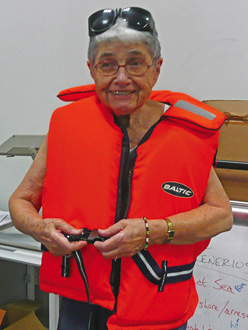
You've all seen them - the 'Holocaust survivors' who consider themselves great moral authorities and use their 'expertise' to bash Israel. Who are they? Alvin Rosenfield gives us some insight.
What makes the IJSN statement noteworthy, therefore, is not the
litany of emotionally-charged accusations against Israel but the
identities of those making these accusations. They present themselves as
“Survivors,” “Children of survivors,” “Grandchildren of survivors,”
“Great-grandchildren of survivors,” and “Other relatives of survivors.”
They total 327 people. Who are they, and what importance, if any, should attach to their proudly proclaimed pedigrees?
If we take their self-descriptions at face value,
some (a small number) had been in the Nazi ghettos and camps or claim to
have been resistance fighters. Others had been children spirited out of
Europe on the Kindertransports or were hidden by Christians during the
war. Some say they are “cousins of survivors,” or “friends of
survivors,” or “relatives of victims,” or “relatives of many victims,”
or the “spouse of a hidden child,” or grandchildren and
great-grandchildren of “refugees.” One identifies herself as “the great
niece of an uncle who shot himself”; another as a “3rd cousin of Ann
[sic] Frank and grand-daughter of NON-survivors.”
The distance from Auschwitz and Treblinka grows as
the list grows and, with it, the credibility of those on the list
plunges. Nevertheless, all claim some special connection, however
remote, to Jewish suffering during the Hitler era, and they expect
others to recognize their anti-Israel diatribe as the product of unique
insights they now possess by right of such suffering. Invoking the
historical and moral weight of the Holocaust by speaking “as Jewish
survivors and descendants of survivors,” they apply their presumed
authority to the present war between Israel and Hamas and “unequivocally
condemn” Israel.
Two thoughts come immediately to mind: Whenever
someone begins a sentence with the words “as a Jew…,” what follows is
likely to be full of political posturing and should be met with
skepticism. The same often holds true when someone opens a sentence with
the kindred formula, “as a Holocaust survivor….” On hearing those
words, one no doubt is inclined to pay attention to what follows; but as
IJSN’s ad demonstrates, the status of Holocaust survivor, let alone the
status of the children, grandchildren, great-grandchildren, and other
assorted relatives and friends of survivors, carries no special
entitlement to superior ethical insight or elevated political awareness.
The signatories to IJSN’s ad, however, invoke just
such an entitlement as they ostentatiously pull rank as Holocaust
survivors in condemning Israel. In inflating and exploiting a status
they regard as privileged, they are guilty of doing precisely what they
falsely accuse Elie Wiesel of doing: “manipulating the legacy of the
Nazi genocide to justify the unjustifiable.” Their abuse of Jewish
suffering for contemporary political ends comes especially to the fore
whenever they proudly parade forth their pedigrees as survivors to
defame Israel. Some have been doing so for years — way before Gaza. To
reflect briefly on just two of them:
Hajo Meyer, whose signature is the very first on the
list, is the author of a book entitled “The End of Judaism: An Ethical
Tradition Betrayed,” which argues that Zionism and Judaism are radical
opposites and incompatible with one another. Meyer equates Zionism with
“fascism” and “criminality” and believes that Zionists “have given up
everything that has to do with humanity.” “As a confirmed atheist,” he
boasts that he “has never been a Zionist.” And as a Holocaust survivor —
he was in Auschwitz for 10 months as a young teenager — he is certain
that Israelis “have no idea about the Holocaust. They use the Holocaust
to implant paranoia in their children.”
In innumerable speeches and interviews (the words
quoted here are from interviews on the websites “Intifada: The Voice of
Palestine” and the “Electronic Intifada”), he charges Israel with all of
the sins that are now part of the standard package of anti-Zionist
accusations: the carrying out of willful massacres, ethnic cleansing,
racist and apartheid policies, and other “blood and soil” nationalistic
actions (“just like the Nazis”). He is so convinced of Israeli
wickedness that he can “write up an endless list of similarities between
Nazi Germany and Israel.” And what if other Jews object to his
smearing the Jewish state with the Nazi brush? Meyer considers it a
“high honor” to be put in the company of Jimmy Carter, Noam Chomsky,
Norman Finkelstein and other prominent opponents of Israel and even
jokingly says that he is “very proud” to be called an anti-Semite.
Hedy Epstein, who has also signed on to the Guardian
statement, likes garnering public attention as a “survivor,” although
whether she is one is debatable. Like Meyer, she was born in Germany in
1924, but she left the country in 1939 on a Kindertransport and spent
the war years in Great Britain. Since coming to America in 1948, she has
thrown herself into political activism, often on behalf of such
celebrated Palestinian causes as the 2008 “freedom flotillas” that were
meant to challenge the Israeli blockade of Gaza, the “Gaza Freedom
March” in Cairo in 2009, and various anti-Israel activities on the West
Bank and elsewhere sponsored by the radical International Solidarity
Movement.
...
It’s hardly new that there are Jews who lend their
endorsement to causes that prove harmful for most other Jews. There is a
long history of such betrayal and the damage it has caused within
Jewish communities, so what we are seeing today has an unhappy lineage
that dates back over many centuries. One thing, however, is new:
The endorsement of the most reckless charges against
Israel — e.g., Israelis are like Nazis and are carrying out a genocide
against Palestinians — by members of a people who themselves were
victims of the twentieth century’s most determined attempt at genocide
is unprecedented and can be hugely harmful unless it is seen for what it
is: an unseemly exercise in the spread of propagandistic lies.
Everyone in the town knew it—tomorrow the Hurban of Ozerow would take place. Ozerow would cease to exist. People recalled the destruction of the first Temple by the Babylonian king Nebuchadnezzar and that of the Second Temple by Titus, the wicked emperor of Rome. People recalled the other Hurban, which had taken place 28 years before, almost to the day. On that October day of 1914, a tzarist commander, mimicking the parched earth policy of the Russian general Kozukow in the war against Napoleon, sprayed the houses with naptha, and burnt the entire town to its foundations. “Got wet hubn rahamunes,” God will have pity on the remnants of Israel. Was not Ozerow rebuilt, replacing the rotten wooden houses with those made of white rectangular stone, with a new synagogue, sporting intricately carved pillars and a large Beth Hamidrash, which had become the envy of the surrounding shtetlach?
This time, not a single building was to be destroyed. Only the people would be taken away. There were some 5,000 souls whose ancestors had lived in this town since the 16th century. In addition, many newcomers, mostly young people who had somehow escaped from the liquidation of the Nazi ghettoes of Warsaw and Lodz, or who were exiled from Vienna and Vlatzlavek (Włocławek) by the Germans.
Frequently in my nightmares, I find myself conversing with my father and mother, my younger brother and sister, and many of the townspeople. All were to be taken to the railroad station at Yashitz and loaded into freight cars for transport to the “East.” At that time, no one in town had an inkling of the existence of Oświęcim, Majdanek, or Treblinka, or imagined the existence of extermination camps. Tomorrow nearly the entire population of the town—men, women, and children—would disappear. They would be slain or shipped to place from which, to my knowledge, no one, not a single person, escaped to tell the story of exactly what happened to them. The eyes of the people mirrored the quiet hope, the unexpressed confidence that they were leaving their ancestral home only for a brief interval.
Millenia of Jewish history had embedded into the Jews of Ozerow a faith in God’s love of Israel. Just as God had vowed never to destroy the world He had created, so He would never impart power to the tormentors of the Jews to destroy them utterly. God knows, the people of Ozerow had sinned. They had ceased to study His Torah—even before the war the hadorim were becoming empty. Only middle-aged and elderly people attended daily Mincha services regularly and lingered on to listen to the local Talmudic lecturer. But God would not forget his people. Tomorrow will be what it will be: today was Sabbath and the joy of the day of rest emanated from their faces.
Here's Soccer Dad's Middle East Media Sampler for Friday, November 18.
1) Why do rational people make irrational decisions? If you follow baseball, like I do, you've probably noticed that baseball has changed a bit in the past 20 years. Whether it is the way teams evaluate player or reporters cover the game, statistical analysis is playing a bigger role in baseball. Bill James, who spurred this revolution in baseball, wrote the following observations:
“Baseball men, living from day to day in the clutch of carefully metered chance occurrences, have developed an entire bestiary of imagined causes to tie together and thus make sense of patterns that are in truth entirely accidental,” James wrote. “They have an entire vocabulary of completely imaginary concepts used to tie together chance groupings. It includes ‘momentum,’ ‘confidence,’ ‘seeing the ball well,’ ‘slumps,’ ‘guts,’ ‘clutch ability,’ being ‘hot’ and ‘cold,’ ‘not being aggressive’ and my all time favorite the ‘intangibles.’ By such concepts, the baseball man gains a feeling of control over a universe that swings him up and down and tosses him from side to side like a yoyo in a high wind.” It wasn’t just baseball he was writing about, James continued. “I think that the randomness of fate applies to all of us as much as baseball men, though it might be exacerbated by the orderliness of their successes and failures.”
The letter quoted here, was written to Amos Tversky. Tversky and his colleague, Daniel Kahneman described thought processes that explained why people would make bad decisions even if they seemingly had all the necessary information and expertise to make good ones.
Michael Lewis (of "Moneyball" fame) caught up with Dr. Kahneman and got him to describe his conclusions. Writing for Vanity Fair, Lewis explained (h/t Rob Neyer):
Kahneman walks the lay reader (i.e., me) through the research of the past few decades that has described, as it has never been described before, what appear to be permanent kinks in human reason. The story he tells has two characters—he names them “System 1” and “System 2”—that stand in for our two different mental operations. System 1 (fast thinking) is the mental state in which you probably drive a car or buy groceries. It relies heavily on intuition and is amazingly capable of misleading and also of being misled. The slow-thinking System 2 is the mental state that understands how System 1 might be misled and steps in to try to prevent it from happening. The most important quality of System 2 is that it is lazy; the most important quality of System 1 is that it can’t be turned off. We pass through this life on the receiving end of a steady signal of partially reliable information that we only occasionally, and under duress, evaluate thoroughly. Through these two characters the author describes the mistakes your mind is prone to make and then explores the reasons for its errors.
I’ve come to realize a hitherto hidden dimension of why it is so hard for Western establishment figures (policymakers, journalists, and academics) to understand the Middle East. It is the conflict between the thirst for good news and the reality of bad news. Being optimists (based on the relatively good course of their own societies?) and believing that positive change is really easy if people only put their minds to making it happen (ditto and also liberal thinking), they exaggerate any sign that things are getting better. Moreover, contemporary thinking trembles in horror about saying anything critical about Third World peoples (racism, Islamophobia) while it is considered noble to criticize “ourselves.” On top of that is the assumption that no one can really be radical. They are just responding to past mistreatment and will revert to being moderate the minute the oppression is corrected. So constantly we are led to an artificial optimism that ignores threats or even converts them into benefits.
Prof Rubin is effectively describing a collective of "System 1" thinkers dominating field of Middle East studies, diplomacy and journalism.
Here at Gruenewald railway station, on these platforms, on 39.11.42, three children of the Bobkar family - Maly, Hala and Abraham - stood here by themselves.Perhaps the two older sisters held their seven-year-old brother by the hand. They stood here without mother or father and the train came. The transport number was #23, the destination was Auschwitz, they were among the first. The Wansee Conference had taken place not long before, on the other side of the forest.
The Bobkar children, as Sharon told, were on the way to their deaths.
In 1958, shortly after Yaakov moved to Israel, he and his wife filled out a page of testimony at Yad Vashem commemorating his dead parents. Nahum had meanwhile settled in Ukraine, where his surname was mangled into Koramblyum. For the rest of their lives, the brothers searched for each other in vain, the paper trail often coming to a dead end because of the differing spellings of their names. In 2006, Yaakov’s daughter, Bracha Fleishman-Korenblum, updated the online entry, attaching an old black-and-white photo of her grandparents and four of their children — including Nahum and Yaakov. Two months ago, one of Nahum’s American grandchildren stumbled upon the entry and was shocked to recognize his grandfather in the picture. He reached out to the Korenblum clan in Israel and a reunion was put into motion.
3) The Iran Mexico axis
A few weeks ago it was reported that a couple of Iranians had plotted to kill the Saudi ambassador to the United States. The Iranians were intending to enlist a Mexican drug ring to carry out the hit. But what was the connection.
This week the London Times reported (h/t Honest Reporting) that the Iranian Revolutionary Guards were engaged in the international drug trade. A shorter version of the article appears to have been published in the Australian.
Iranian sources, including a former IRGC intelligence officer, have named two senior figures within the Guard involved in the drug trade. Abdullah Araghi, the IRGC commander for Greater Tehran, is alleged to have extensive connections with gangs in Eastern Europe. Mohsen Rafighdoost was head of the IRGC in the 1980s and has maintained close contact with the organisation since retiring. Sajjad Haghpanah, a former investigator with the IRGC's domestic intelligence division, said drug trafficking was endemic within the unit. "There are several commanders involved in smuggling narcotics. Raw opium or morphine is smuggled in from Afghanistan and developed in labs inside Iran," said Mr Haghpanah. "They work with criminal gangs to move it overseas. They have their own ships, aircraft and haulage companies, everything needed for import and export. Their power is limitless."
Is this where the suspects first came into contact with drug gangs? 4) NGO proliferation
Gerald Steinberg, the group’s president, said, however, that he opposed the two new bills under consideration. He added that he suspected they would not survive. ... He said that European governments spend more per year on left-wing Israeli and pro-Palestinian groups than their total contributions to nonprofit human rights groups in other countries in the Middle East. “We estimate that together, this amounts to between $75 and $100 million from European governments to Israeli and Palestinian groups annually, far exceeding funding for human rights and democracy organizations in the rest of the region,” he said.
That's a pretty ridiculous focus on Israel. Daled Amos provides (NGO Monitor's) chart. It looks like a number of people are well paid for digging up damaging information against Israel and then being a primary source for news stories.
Read the amazing story of Leon Weinstein, who is probably the oldest surviving fighter of the Warsaw Ghetto, here (Hat Tip: Nrg).
She was Jewish, but to live she needed a Christian name.
She could not be Natalie Leya Weinstein, not in wartime Warsaw. Her father wrote her new name on a piece of paper.
Natalie Yazinska.
Her mother, Sima, sobbed.
"The little one must make it," Leon Weinstein told his wife. "We got no chance. But the little one, she is special. She must survive."
He fixed a metal crucifix to a necklace and hung it on their daughter. On the paper, he scrawled another fiction: "I am a war widow, and I have no way of taking care of her. I beg of you good people, please take care of her. In the name of Jesus Christ, he will take care of you for this."
A cold wind cut at the skin that December morning, so Leon Weinstein bundled Natalie, 18 months old, in heavy pants and a thick wool sweater. He headed for a nearby apartment, the home of a lawyer and his wife. The couple did not have a child. Weinstein hoped they wanted one.
He lay Natalie on their front step. Tears ran down his cheeks. You will make it, he thought. She had blond locks and blue eyes. They will think you are a Gentile, not one of us.
Walking away, he could hear her whimper, but forced himself not to look back until he crossed the street. Then he turned and saw a man step out of the apartment. The man read Weinstein's note. He puzzled over the baby.
Cradling Natalie in his arms, the man walked half a block to a police station and disappeared inside.
I hesitated and therefore held my fire rather than going full force after 87-year old Hedy Epstein. A Soldier's Mother let her have it.
Had there been an Israel when your family was taken to Auschwitz, Israel would have saved them – as we have saved Jews all over the world. No, we are not going to be victims ever again, nor are we interested in making the Palestinians victims.
We have offered peace time and time again, only to be met with violence. You are not interested in the 14,000 rockets fired at Israel, that’s fine. Clearly, you only use your earlier association with the Jewish people to get yourself headlines and attention. You use your label as “survivor” to betray those who died, while you were blessed enough to survive.
Imagine if the Jews had adopted the victimhood meme at the end of World War II. We'd be just like the 'Palestinians.'
In 1945, there were hundreds of thousands of Jewish survivors living in DP Camps (displaced persons) across Europe. They were fed and clothed by Jewish and international relief organizations. Had the world's Jewish population played this situation as the Arabs and Palestinians have, everything would look very different today.
To begin with, the Jews would all still be living in these DP camps, only now the camps would have become squalid ghettos throughout Europe. The refugees would continue to be fed and clothed by a committee similar to UNRWA—the United Nations Relief and Works Agency for Palestine Refugees in the Near East (paid for mostly by the United States since 1948). Blessed with one of the world's highest birth rates, they would now number in the many millions. And 66 years later, new generations, fed on a mixture of hate and lies against the Europeans, would now seethe with anger.
...
By the 1990s, the real mayhem would have begun. Raised on victimhood and used as cannon fodder by corrupt leaders, a generation of younger Jews would be blowing up buses, restaurants and themselves. The billions of dollars extorted from various governments would not have gone to the inhabitants of the camps. The money would be in the Swiss bank accounts of the refugees' famous and flamboyant leaders and their lackies.
So now it's the present, generations past the end of World War II, and the festering Jewish refugee problem throughout Europe has absolutely no end in sight. The worst part of this story would be the wasted lives of millions of human beings in the camps—inventions not invented, illnesses not cured, high-tech startups not started up, symphonies and books not written—a real cultural and spiritual desert.
None of this happened, of course. Instead, the Jewish refugees returned to their ancestral homeland. They left everything they had in Europe and turned their backs on the Continent—no "right of return" requested. They were welcomed by the 650,000 Jewish residents of Israel.
...
I imagine the argument will be made that while the Jews may have achieved all this, they did not have their land stolen from them. This is, of course, a canard, another convenient lie. They did lose property all over Europe and the Mideast. And there was never an independent Palestine run by Palestinian Arabs. Ever. Jews and Arabs lived in this area controlled first by the Turks and then by the British. The U.N. offered the two-state solution that we hear so much about in 1947. The problem then, and now, is that it was accepted by only one party, Israel. No doubt, the situation of Arab residents of the Middle East back then may have been difficult, but it is incomprehensible that their lot was worse than that of the Jews at the end of World War II.
I don't believe that we would have ended up like the 'Palestinians' had we chosen to wallow in victimhood. We would not have had the Arab countries to use us as pawns against Germany and Poland. And if we had resorted to terror, as the 'Palestinians' had done, Europe would have dealt with us far more cruelly than Israel has dealt with the 'Palestinians.' I believe that except for small remnants scattered in Anglo countries outside of Europe (US, Canada, Australia and South Africa), had we chosen to behave like the 'Palestinians,' we would have been wiped out.
I also don't believe that wallowing in self-pity and expecting the World to sympathize with us is a Jewish thing. We know them too well.
Most of this show is Glenn Beck talking to Holocaust survivors, although at the beginning he talks about the "Freedom for Palestine" propaganda song and he also talks about the 'freedom flotilla' and Glenn's upcoming rally in Jerusalem.
I am an Orthodox Jew - some would even call me 'ultra-Orthodox.' Born in Boston, I was a corporate and securities attorney in New York City for seven years before making aliya to Israel in 1991 (I don't look it but I really am that old :-). I have been happily married to the same woman for thirty-five years, and we have eight children (bli ayin hara) ranging in age from 13 to 33 years and nine grandchildren. Four of our children are married! Before I started blogging I was a heavy contributor on a number of email lists and ran an email list called the Matzav from 2000-2004. You can contact me at: IsraelMatzav at gmail dot com