Iranian ex-spy: Khomeni ordered Pan Am 103 attack as revenge
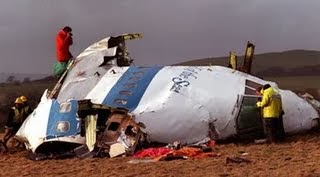
A former Iranian spy who has defected to Germany claims that Ayatollah Khomeni ordered the 1988 bombing attack on Pan Am Flight 103, which blew up over Lockerbie, Scotland, as revenge for the (accidental) downing of an Iranian airliner by the United States.
Let's go to the videotape.
The Lockerbie bombing was ordered by Iran and carried out by a Syrian-based terrorist group, a former Iranian intelligence officer has admitted.
Abolghassem Mesbahi, a defector to Germany, said Pan Am flight 103 was downed in 1988 in retaliation for a US Navy strike on an Iranian commercial jet six months earlier, in which 290 people died.
He claims the Ayatollah Khomeini, who was Iran’s Supreme Leader, ordered the bombing “to copy exactly what happened to the Iranian Airbus”.
Previously unseen evidence gathered for the aborted appeal hearing of Abdelbaset al-Megrahi, the former Libyan intelligence officer convicted of the bombing, supports Mr Mesbahi’s claim and suggests that the bombers belonged to the extremist group the Popular Front for the Liberation of Palestine – General Command (PFLP-GC).
Documents obtained by Al Jazeera television for a documentary called Lockerbie: What Really Happened? name key individuals said to be involved in the bombing, including the alleged bomb-maker, the alleged mastermind and the man who may have put the bomb on the doomed Boeing 747.
Joined at the hip: New Iranian Defense Minister was behind Hezbullah's Beirut Marine baracks bombing
This probably makes President Obama and Secretary of State Kerry feel all warm and fuzzy, but patriotic Americans are and should be outraged.
Thirty years ago last month, Hezbollah blew up the barracks of the U.S
Marines and French paratroopers stationed at the Beirut airport, killing
241 U.S. servicemen and 58 Frenchmen. It wasn’t Hezbollah’s first
terrorist operation, but this attack, the most memorable in Lebanon’s
vicious and chaotic 15-year-long civil war, marked the Party of God’s
entry onto the world stage.
Three decades later, thanks to the efforts of Israeli Hezbollah expert
Shimon Shapira, we now know that one of the men responsible for the
attack was an Iranian Revolutionary Guard Corps (IRGC) commander named
Hossein Dehghan—the man Iranian president Hassan Rouhani recently
tapped to be his defense minister. In other words, Hezbollah and the
Islamic Republic of Iran have been joined at the hip from the very
beginning, even before the 1979 Iranian revolution.
Iran's early involvement in Hezbullah puts the lie to the claim that Hezbullah was founded as a reaction to the Israeli presence in southern Lebanon.
The big bang theory of Hezbollah that puts the Israeli
occupation at the alpha point is based not in fact but in legend—it’s
an Israel-centric myth that makes the Jewish state Hezbollah’s
motivation and prime mover. In reality, the story of Hezbollah’s origins
is a story about Iran, featuring the anti-shah revolutionaries active
in Lebanon in the 1970s, years before Israel’s intervention. Thus, to
uncover Hezbollah’s roots, it is necessary to mine the accounts of
Iranian cadres operating in Lebanon a decade before Israel invaded.
There we find that, contrary to the common wisdom,
Hezbollah didn’t arise as a resistance movement to the Israeli
occupation. Rather, it was born from the struggle between Iranian
revolutionary factions opposed to the shah. Lebanon was a critical front
for this rivalry between Hezbollah’s Iranian progenitors and their
domestic adversaries. Accordingly, an accurate understanding of this
history gives us not only the true story of Hezbollah’s beginnings, but
also an insight into the origins of Iran’s Islamic Revolution. Those
early internal conflicts and impulses, played out in Lebanon as well as
Iran, also provide a roadmap for reading the nature of the current
regime in Tehran, its motivations and concerns, its strategies and
gambits as it moves toward acquiring a nuclear weapon and challenging
the American order in the Middle East.
And Yasser Arafat's PLO was right in the thick of things - yes, in founding Hezbullah. Read the whole thing.
Iran was then trying to obtain missiles from the U.S. (with Israel acting as an intermediary) in exchange for the release of Americans held hostage by Iranian-backed proxies in Lebanon.
The missiles were provided but the hostages were not—a victim, by some accounts, of hard-line opposition within Iran to the more pliable course advocated by Mr. Rouhani. So it goes with Western outreach to Iranian moderates: It always fails, though whether it's on account of the moderates being duplicitous or powerless is a matter of debate. Maybe Mr. Rouhani isn't "a wolf in sheep's clothing," as Israeli Prime Minister Benjamin Netanyahu says. Maybe he's a sheep among wolves.
If so, he's a very canny sheep. "If you don't bare sharp teeth before [Ayatollah] Khomeini," he advised Nir, "you're going to have troubles all over the world. If you threaten him with military force, he'll kiss your hand and run."
Elsewhere in the conversation, Mr. Rouhani suggested a strategy for getting the hostages released. "If for instance, you said to [Khomeini], 'You must release all of the hostages in Lebanon within five days. If not—we'll deal you a military blow and you will be responsible for the results,' do it, show that you are strong, and you will see results."
And there was this: "If we analyze Khomeini's character, we will see that if someone strong stands opposite him, he will retreat 100 steps; and if he is strong and someone weak faces him, he will advance 100 steps. Unfortunately, you have taken a mistaken approach. You have been soft to him. Had you been tougher, your hand would be on top."
Mr. Rouhani's analysis of Khomeini's mind-set would soon find tragic confirmation. On July 3, 1988, the USS Vincennes mistook an Iranian jetliner for a fighter jet and shot it down, killing nearly 300 people. Khomeini, who was sure the incident was no accident, thought Washington intended to enter the Iran-Iraq war on Saddam Hussein's side. Just 17 days later, on July 20, Khomeini accepted a humiliating cease-fire with Iraq: "Unhappy am I that I still survive and have drunk the poisoned chalice," he said in a radio address.
Khomeini is long dead, but the regime's mentality of yielding only to intense pressure and credible threats of force remains the same.
Read the whole thing (yes, I know it's subscription only and someone sent it to me by email). The bottom line is that Obama and Kerry are doing exactly what Rohani told Nir not to do.
Iran’s experiences in Sudan demonstrate how traditional diplomacy is
subordinated to the Islamic Republic’s boarder, asymmetrical goals.
Sudan’s Islamist National Congress Party (NCP)-led government signed a military cooperation agreement with Iran in 2008; according to The Telegraph, the IRGC maintained
a base in Al Fashr, Darfur, as recently as September of 2011. The
Conflict Armaments Research report strongly suggests that Iranian
ammunition was used in at least some of the atrocities committed by
Khartoum-allied militias during the conflict in Darfur, and that Sudan
was a transit point for Iranian ammunition that eventually made its way
to Al Qaeda in the Islamic Maghreb, on the other side of Africa.
This relationship is widely resented within Sudan itself. A
significant faction within Sudan’s notoriously divided regime is set
against a continued relationship with Iran, and in November of last
year, foreign minister Ali Karti spoke out
against the docking of Iranian warships in the Red Sea city of Port
Sudan. According to one East Africa-based analyst who works frequently
in Khartoum, the Sudanese government views its alliance with Iran as
purely opportunistic. “It’s a very self-interested relationship,” he
says. “In its propaganda, the NCP will talk about the infidel west, the
Zionists, the communists, the atheists — and they will put the Shia in
that list as well.”
For many Sudanese, the Yarmouk incident only demonstrated the cost of
Sudan’s conscription into the Israeli-Palestinian conflict by its
Iranian allies—a conflict which has nothing to do with Sudan’s own
already-shaky internal affairs. “A lot of Sudanese are very upset, but
not at the actual Israeli strike,” the analyst said. “They’re upset
about the fact that the government is involving themselves in something
that’s a lot bigger than what Sudan can handle.” Amongst some of Sudan’s
leaders, and a significant part of its populace, Iran is an unwelcome
ally. Even a fellow pariah state — truly an ally of last resort—harbors
little real enthusiasm for the Islamic Republic and its policies.
But Iran has gotten exactly what it needs out of Sudan, regardless of
how facile and opportunistic the ties between the two countries really
are. Sudan is a beachhead for the IRGC — a transit point for weaponry
that allows Hezbollah to aid in the Assad regime’s survival, and Hamas
to rain Fajr 5s on the majority of Israel’s civilian population. It
doesn’t matter that Sudanese resent the bombing of their capital city,
or that Sudan is under international sanctions, or that Iran’s
relationship with such a problematic country is liable to deepen
perceptions of the Islamic Republic’s international isolation. All
across the continent, Iran’s expansionist foreign policy is in direct
conflict with its economic and soft power outreach—and Iran has
succeeded is using Africa to advance its interests anyway.
South Africa, for instance, seems at first glance like a signal
Iranian failure. Africa’s largest economy has totally caved to American
and E.U. pressure on Iranian oil purchases, even despite the
traditionally left-leaning foreign policy of the ruling African National
Congress. In early June, the country’s Department of Energy announced
that it had totally cut off its oil trade with Iran, and Trevor Houser
of the Rhodium Group, which tracks the effects of sanctions on Iran’s
oil sales, confirmed by email that “South African customs has not
recorded any oil imports from Iran for several months now.”
Iran’s oil trade with South Africa has evaporated, but the Islamic
Republic scored a crucial consolation prize: a major investment from
South African cell phone giant MTN, along with a raft of favors from the
South African government. According to a civil complaint filed in
District of Columbia federal court, MTN elbowed Turkcell, a Turkish
competitor, out of a 49% stake in an Iranian joint venture called
Irancell by “promising Iran that MTN could deliver South Africa’s vote
at the International Atomic Energy Agency, promising Iran defense
equipment otherwise prohibited by national and international laws, and
the outright bribery of high-level government officials in both Iran and
South Africa.”
The suit alleges that between 2003 and 2005, MTN won its Iranian
license through a series of lucrative kickbacks. These consisted of straightforward bribes
paid to Iranian officials, although the suit presents strong evidence
that South Africa’s pro-Iran votes at the IAEA between 2005 and 2008
were a quid pro quo for the Islamic Republic’s approval of MTN’s
Irancell investment. The complaint boasted over 60 pages of
documentation, including damning internal emails leaked by an employee
at MTN’s Tehran offices. It goes into specific detail about vehicles and
military equipment the South Africans would provide to Iran if MTN were
awarded the Irancell stake, a list which included “Rooivalk helicopters
(based on the U.S. Apache platform), frequency hopping encrypted
military radios, sniper rifles, G5 howitzers, canons…and other defense
articles.” (The weapons were never delivered, and the Turkcell case was
withdrawn in May of 2013–but only because the U.S. Supreme Court ruled a
month earlier that international corporate civil suits could no longer
be tried in U.S. court).
The scandal has resulted in no criminal prosecutions in South Africa.
MTN still owns nearly half of Irancell, an arrangement that nets the
company over $117 million
a year. Irancell’s Iranian owner is a holding company whose investors
include Iran Electronics Industries, a government-connected electronics
and defense company that has been under U.S. sanctions
since September of 2008. Iran and the IRGC are still leveraging their
relationship with South Africa, even after the collapse of the
companies’ oil trade. And according to Mark Dubowitz of the Foundation
for Defense of Democracies, the country is “a very hospitable place for
Iranian sanctions-busting.” In early June, the U.S. Treasury Department added 37 Iranian front companies to its sanctions list. Three were based in South Africa.
This pattern—in which Iran scrapes for asymmetrical gains within a
challenging diplomatic environment, and in spite of its own internally
divided conventional diplomacy—repeated itself in Nigeria. In October of
2010, Nigerian authorities scored the largest seizure of an Iranian
weapons shipment in African history, when a container ship carrying
crates of rocket launchers and heavy mortars was impounded in the port
of Lagos. This embarrassment hardly ended Iran’s efforts in the country.
In June of 2013, a Hezbollah cell was uncovered in
the northern Nigerian city of Kano. And Iran has an asset in Nigeria
that’s arguably more valuable than a foothold for its Lebanese proxies:
Sheikh Ibrahim Zakzaky, a radical Iranian-trained Shi’ite cleric and a
promoter of Iranian state ideology in Sub-Saharan Africa’s most populous
country.
...
But perhaps the most startling Iranian success in Africa has to do
with its pursuit of the ultimate asymmetrical objective: a nuclear
weapons capability. Robert Mugabe’s regime in Zimbabwe inked a
uranium agreement with Iran in 2011, and Ahmadinejad visited Niger, the
world’s fourth-largest uranium producer, late in his second term as the
Islamic Republic’s president. A 2006 Wikileaks cable asserts that
Iran had smuggled Congolese uranium through ports in Tanzania. As for
Tanzania—its government has proven remarkably tolerant of Iranian
tankers operating under Tanzanian registration
in order to evade the oil sanctions regime. Tanzania is a close enough
U.S. ally to warrant a visit from Barack Obama during his July, 2013
trip to Africa. Iran can get what it needs even from African countries
with established, pro-western bona fides—and despite an almost total
absence of real friends in the continent.
As with its nuclear program, Iran has found its way around the
obstructions that diplomacy and statecraft are constantly throwing in
its path. Despite the pinch of international sanctions, and setbacks
like the Stuxnet computer virus, Iran has increased the number of its
operating uranium centrifuges, along with its stockpile of fissile
material. Thanks to diplomatic stalling tactics, like the ones perfected
by Iranian president-elect and former nuclear negotiator Hassan
Rowhani, and its patient, decades-long accumulation of nuclear
components, Iran has steadily progressed towards a nuclear weapons
capability —even in the face of a nearly-global effort at derailing
them.
Just when you thought that the White House's groveling to the most militant Islamists couldn't possibly get worse, we find out that US Department of Homeland Security advisor Mohamed Elibiary spoke at a tribute to the founder of the 'Islamic revolution' in Iran, Ayatollah Khomeini in 2004 (Hat Tip: MFS - The Other News).
It has come to our attention that in December 2004, Mr. Elibiary spoke
at a tribute to Ayatollah Khomeini titled “A Tribute To The Great
Islamic Visionary” sponsored by the Metroplex Organization of Muslims in
North Texas in Irving, TX. When the event was criticized in an
editorial carried by a local newspaper, Mr. Elibiary offered the
following explanation claiming that he hadn’t realized that “the event honored Imam Khomeini”:
I have been asked whether, if I had realized before I
spoke that the event honored Imam Khomeini, I would have left
immediately. I don’t know. My activism, which is designed to bring
Muslims into the mainstream, calls upon me not to cede any territory to
radical views without presenting a moderating counterpoint. I have
learned that, to his supporters, Imam Khomeini is not the hostage
crisis, or the one who hated America as the “Great Satan,” but a
liberator from the shah’s hated dictatorship. As Natan Sharansky
correctly points out in his book The Case for Democracy, people flock to
promises of freedom, because all human beings desire to be free. I have
been asked what I would say to someone who believes that there is no
good reason to attend a tribute to Imam Khomeini. If their concerns
revolved around the American experience of him, I would say that I echo
their feelings. But if anyone wishes to learn about their opponent, they
must listen, or they’ll remain ignorant and make mistakes that cost
them in their struggle to defend their values and views. Just because I
listen to Osama bin Laden’s tapes and agree that the West routinely
insults Muslim dignity, that doesn’t make me al-Qaeda. By listening I
gain a better understanding of a philosophy I wish to counter. Just
because I agree with Che Guevara that nonregulated capitalism is
exploitive of the poorest in a society, that doesn’t make me a communist
– just one who sees the benefit of Teddy Roosevelt’s crusade against
business monopolies.
It is to at all clear to the GMBDR how Mr. Elibiary could have failed
to recognize that the event was a tribute to Khomeini given the name of
the event and the associated flyer. It is also not clear why Mr.
Elibiary agreed to share a podium with Mohammad Asi given what his own characterization of Mr. Asi:
Imam Mohammad Asi, who also spoke at the MOMIN event, is
more troubling than Khomeini, in my opinion, because his views are a
direct threat, not just a historical one, to our American way of life.
He does believe that America is the “Great Satan” and opposes the
reformers in Iran who are calling for a dialogue between Islam and the
West. He sees “Zionist Jews” as controlling the entire world (outside
Iran, of course) and strongly ridicules full political participation by
Western Muslims. I don’t know what to say about all this other than that
it’s diametrically opposed to the views of the invited speakers – Imam
Kavakci, Iyas Maleh and myself. Mohammad Asi’s beliefs run counter to
the very existence of our organizations, decades of activism, everything
we said and saw from the leadership at the MOMIN Center.
Keep in mind as you watch this that the Prime Minister of the country in which this takes place is President Obama's Best Friend Forever, Recep Tayyip Erdogan.
More eerie similarities between Iran 1979 and Egypt 2011
Michael Totten interviews Abbas Milani, an Iranian expat who has just written a book about the Shah of Iran. Milani was an opponent of the Shah, was not (and is not) an Islamist, but spent six months in jail with cellmates who became leaders of Iran's Islamic revolution. Milani points out some eerie parallels (that go much deeper than the ones I discussed in an earlier post) between Iran 1979 and Egypt 2011 (Hat Tip: Instapundit).
MJT: So why, when you published a piece in The New Republic a few days ago, did you compare the upheaval in Egypt to the Iranian Revolution 31 years ago rather than to Tunisia’s Jasmine Revolution that toppled Ben Ali less than 31 days ago?
Abbas Milani: Iran and Egypt are very similar. They have been, along with Turkey, the key bellwether states in the region. What happens in these three places has shaped what happens in the Middle East for a hundred years.
Tunisia—in terms of size, history, and trajectory—is far less like Iran than Egypt is. Egypt is the most important center of Sunni learning while Iran is the most important center of Shia learning. And the two countries have been very much in competition with each other for hegemony over the Islamic world. The Shah spent his last days in Egypt. There is a fifty year connection between the Pahlavi dynasty and Egypt.
Look also at the events themselves and the way the United States has tried to position itself. What’s going on right now in Egypt is eerily reminiscent of the events in Iran in 1979. The United States supported Pahlavi and Mubarak overtly. In both cases there was behind-the-scenes pressure to democratize and open the system. The Shah resisted, claiming a communist threat. Mubarak resisted, claiming a Muslim Brotherhood threat.
After a while the Shah became impervious to American pressure because he had oil money. He had more money than he knew what to do with. During those very crucial years the Iranian middle class mushroomed. The educated class was increasing. These were the years when pressure for democracy was most urgent, but the Shah was impervious to it.
MJT: How big was the middle class in 1979?
Abbas Milani: It depends on how you define it. If you look at the income, the amount of urbanization, the number of educated people, the number of people who lived in their own domicile, the number of people who could travel outside the country—all these grew rapidly in the 1960s and 1970s thanks to the push for industrialization that began in the early 1960s. It began before the oil money came in.
We had a class of brilliant Iranian technocrats, many of them educated in the United States, including right here at Stanford. They put into effect a remarkable process of industrialization that by 1970 was bearing fruit. These people demanded political rights, and the Shah, instead of opening the country, clamped down with the one-party system.
I am absolutely convinced that in 1975, when he was at the height of his power, if the Shah had made just a third of the concessions he later made in 1978, we would be looking at a very different Iran today.
MJT: It was too late in 1978.
Abbas Milani: What Mubarak and the Shah both failed to understand is that if you make concessions when you’re weak it just increases the appetite for more concessions. If they would have made concessions when they were in a position of power, they could have negotiated a smooth transition to a less authoritarian government.
In Egypt, when the US pressured Mubarak to announce that he would not run again, that he should come out publicly and say he has cancer and that there will be a free election soon, he instead tried to create a monarchy.
Milani also has a lot to say about the Muslim Brotherhood and the parallels between its behavior today and Khomeni's behavior during the last four months before the Shah fell. It is not reassuring.
I am an Orthodox Jew - some would even call me 'ultra-Orthodox.' Born in Boston, I was a corporate and securities attorney in New York City for seven years before making aliya to Israel in 1991 (I don't look it but I really am that old :-). I have been happily married to the same woman for thirty-five years, and we have eight children (bli ayin hara) ranging in age from 13 to 33 years and nine grandchildren. Four of our children are married! Before I started blogging I was a heavy contributor on a number of email lists and ran an email list called the Matzav from 2000-2004. You can contact me at: IsraelMatzav at gmail dot com