Iran once again claims to have shot down an American drone. This time, it's a ScanEagle drone (pictured) and it was allegedly
shot down over the Persian Gulf. The US once again claims that none of its drones are missing, but
we've heard that before, and
we know what the results were. This is from the first link.
Rear
Admiral Ali Fadavi, the commander of Iran's Revolutionary Guard Corps
(IRGC) naval forces said the drone had been intercepted after it
violated Iranian airspace, according to Sepah News, the IRGC's official
news site.
Fadavi's announcement comes exactly a year after Iran reported it's
army's electronic warfare unit had downed a US RQ-170 Sentinel drone
over the Iranian city of Kashmar, around 225km from the border with
Afghanistan.
However, a US Navy spokesman said that no US drone has been lost in the Gulf recently.
"The
US Navy has fully accounted for all unmanned air vehicles (UAV)
operating in the Middle East region. Our operations in the Gulf are
confined to internationally recognized water and air space," a spokesman
for US Naval Forces Central Command in Bahrain said.
"We have no record that we have lost any ScanEagles recently."
ScanEagle drones, which are small in size and have a long endurance, are used for a variety of naval operations.
Fars news agency reported that the drone was captured sometime "in the last few days." It was not clear how it was captured.
"These
kinds of aircraft are normally launched from large ships," said Ali
Fadavi, the IRGC's naval commander, according to Fars.
And a little
detail about the ScanEagle.
ScanEagle is a descendant of another Insitu UAV, SeaScan,
which was conceived of as a remote sensor for collecting weather data
as well as helping commercial fishermen locate and track schools of tuna.
ScanEagle emerged as the result of a strategic alliance between Boeing
and Insitu. The resulting technology has been successful as a portable
Unmanned Aerial System (UAS) for autonomous surveillance in the
battlefield, and has been deployed since August 2004 in the Iraq War.
ScanEagle carries a stabilized electro-optical and/or infrared camera
on a light-weight inertial stabilized turret system integrated with
communications range over 100 km, and flight endurance of 20+ hours.
ScanEagle has a 10-foot (3 m) wingspan and can fly up to 75 knots
(139 km/h), with an average cruising speed of 60 knots (111 km/h). Block
D aircraft featured a higher resolution camera, a custom-designed Mode C
transponder and a new video system. A Block D aircraft, flying at Boeing's test range in Boardman, Oregon set a type endurance record of 22 hours, 8 minutes.[2]
ScanEagle needs no airfield
for deployment. Instead, it is launched using a pneumatic launcher
patented by Insitu as the "SuperWedge" launcher. It is recovered using
the "SkyHook" retrieval system, which uses a hook on the end of the
wingtip to catch a rope hanging from a 30 to 50-foot (15 m) pole. This
is made possible by a high-quality differential GPS
units mounted on the top of the pole and UAV. The rope is attached to a
shock cord to reduce stress on the airframe imposed by the abrupt stop.
What could go wrong?

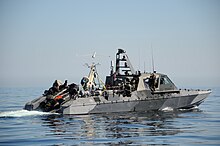 Sea-borne launch from a Mark V Special Operations Craft
Your picture is of a Global Hawk (vaguely the size of a 737) that costs around 20-40 million dollars depending on payload.
ReplyDeleteA Scan Eagle is a MUCH smaller truck launched UAV.
As in, big freaking deal. A Global Hawk would be a big deal.
"Shot down" implies destruction of the scaneagle. I would be hoping that it wasn't just delivered undamaged, ready for reverse engineering, to the Iranians by the Obama Posse. They have a track record.
ReplyDeleteNote that the first photograph is in fact a Global Hawk, not a Scan Eagle.
ReplyDeleteGeoffrey, the "big deal" will be the payload (sensors, etc.), not so much the platform. The tiny ones would seem to be the most valuable if you've got people trying to rip off other people's technology for FREE!
ReplyDelete